Pulling It All Together: Reading Jesus Through the Right Lens


Over the past several posts in this “Not What You Think It Means” series, we have revisited words that sit at the center of Jesus’ message:

Kingdom.
Repent.
Believe.
Gospel.

At first glance, this may have felt like a long detour into vocabulary. But it was never really about vocabulary. It was about lenses.  Because how we understand those words shapes how we read everything Jesus said and did.

If the gospel is primarily about “how I get to go to heaven,” then we will inevitably read the Gospels through that framework. We might admire Jesus, learn from Him, or worship Him, but we may miss much of what He was actually announcing.

Jesus did not begin His ministry by saying, “Here is how to get to heaven.”  As we’ve seen, Mark summarized Jesus’ message this way:

“The time is fulfilled, and the kingdom of God has come near. Repent and believe the gospel.” (Mark 1:15)

That announcement becomes the interpretive key for everything that follows.  Without that lens, we can easily misread the Gospels.  And certainly not capture the full weight of what the writers wanted their readers to hear.


We May Reduce Jesus to a Sin-Forgiveness Mechanism

If the primary point of Christianity becomes personal afterlife assurance (“after-life” insurance?), Jesus can slowly become reduced to the One who helps us “go to heaven.”

Of course, forgiveness matters deeply. Eternity matters deeply.  But the Gospels reveal Jesus announcing something much larger: the reign of God breaking into the present world.  Once we begin to see that, His words and actions make more sense and take on new meaning.

His miracles were not random supernatural proofs designed merely to convince people that He was divine. They were signs of the kingdom.

Jesus was not merely preparing people for life after death. He was revealing what life under the reign of God looks like right now.


We May Misread the Parables

The parables especially begin to change when viewed through a kingdom lens.  Modern readers often approach parables looking primarily for moral lessons or hidden theological codes. But Jesus repeatedly said:

“The kingdom of God is like…”

That matters.  The parables were helping people imagine what happens when God becomes King…

  • The kingdom was like a mustard seed — small, overlooked, yet growing into something far larger than expected.
  • The kingdom was like yeast in dough — quiet, hidden, yet slowly transforming everything.
  • The kingdom was like a treasure hidden in a field — valuable enough to reorder one’s entire life around it.

Without a kingdom lens, we can flatten these stories into generic encouragements about faith or morality.  But Jesus was describing an entirely new reality breaking into the world.

Even parables of judgment begin to read differently. They are not merely threats about the afterlife. They are warnings about resisting the reign of God that was arriving in their midst.


We May Miss Why Jesus Clashed with Religious Leaders

Without understanding the gospel of the kingdom, Jesus’ confrontations with religious leaders can seem unexpectedly harsh.  Why did He provoke them so often?  Why did Sabbath debates become so intense? Why were they scandalized by what he said and did?

Because Jesus wasn’t merely tweaking religious behavior. He was challenging entire ways of seeing God, power, holiness, and identity.  The kingdom of God was disrupting existing systems. He was inaugurating a radical reorientation of thought and life in light of the reality that God’s reign had come near.

“You have heard it said… but I say to you.”

Jesus continually challenged assumptions about enemies, status, greatness, purity, wealth, retaliation, righteousness, etc.

It was all very scandalous!


The Sermon on the Mount Changes Completely

This may be most obvious with the Sermon on the Mount.  Without a kingdom framework, the Sermon can feel impossible, disconnected from reality, or reduced to inspirational ideals.

Love your enemies.
Turn the other cheek.
Bless those who curse you.
Do not worry.
Seek first the kingdom.

Read through an individualistic “how do I get saved?” framework, these teachings can feel strangely disconnected from the “main point” of Christianity.  But Jesus was describing what life looks like under the reign of God, which is the main point.

The Sermon on the Mount is not random ethics. It’s foundational.  It describes life under God’s rule.  It describes the kind of people God is inviting and forming to participate as workers in his kingdom.  

The Beatitudes suddenly become more than poetic sayings. They become announcements of who the kingdom is available to: the overlooked, the humble, the merciful, the peacemakers.

“Seek first the kingdom of God” stops being a decorative Christian phrase and becomes the framework through which we order our lives.

Why This Matters Going Forward

This is why we have spent time visiting these foundational words.  We are not merely nuancing definitions. We are learning to read Jesus through the framework He Himself announced.

The kingdom of God has come near.
Repent.
Believe the good news.

From here forward, we are going to revisit Jesus’ teachings, actions, parables, and confrontations through that lens.

Because when the message of Jesus becomes centered primarily on “going to heaven when we die,” Jesus Himself can gradually become reduced to the means of getting there rather than the One announcing and embodying the reign of God breaking into the present world.

And once that happens, discipleship can quietly become optional.

Following Jesus may be treated as an advanced step only for especially committed Christians rather than the normal response to the King and His kingdom. The focus can shift toward securing forgiveness or eternal destiny while leaving the larger invitation of Jesus — “Follow Me” — sitting at the edges of the Christian life.

Ironically, this can also drift toward moralism.

When the kingdom of God is no longer the central framework, the teachings of Jesus become reduced to ethical expectations detached from the life and power of God’s reign. Remember, He called people to become disciples —

Apprentices who would learn to live under the reign of God here and now.
Gospel: Not what you think it means (Part 3)

(Read Part 1 and Part 2 [here] and [here].)


A conversation I haven’t been able to shake

About 10–15 years ago, I had a conversation that has stayed with me.

They said, “I shared the gospel with a co-worker the other day.”

I responded, “That’s great. What exactly did you share?”

They said, “You know… the Roman Road.”

So, I asked, “Isn’t Jesus’ crucifixion central to the Roman Road?”

“Well, yes.”

Then I asked one more question:

“What was the gospel Jesus proclaimed in Mark 1:14–15?”

Pause.

“Hmmm…”


That moment wasn’t about catching someone off guard. It revealed something deeper.

We use the word gospel all the time.
But when pressed – What is it, exactly? – the answers start to drift.

That’s what we began to see in Part 1.
That’s what we pressed into in Part 2.

Now it’s time to attempt to “bring it home.”


When the gospel became something else

Somewhere along the way, the word gospel got reduced.

Not denied.
Not rejected.
Just…shrunk.

Instead of an announcement, it became a formula.
Instead of news, it became a transaction.
Instead of a King and His kingdom, it became a plan for my afterlife.

This didn’t happen overnight. But in the mid-20th century, tools like the Roman Road and the Four Spiritual Laws began to dominate how the gospel was communicated (See the addendum).  These tools weren’t the problem. They were trying to help. They highlighted something essential: that Jesus’ death and resurrection matter for our salvation.

But over time, something subtle happened.  The gospel itself became equated with these presentations.  As Scot McKnight has argued, the gospel was reshaped around helping people make decisions about personal salvation.

And when that happens, the message inevitably narrows.


From gospel to “plan of salvation”

Think about the common thread in most gospel presentations:

  • You are a sinner
  • Sin separates you from God
  • Jesus died for your sins
  • If you believe, you go to heaven

None of that is false.  But is that the gospel?  The good news Jesus proclaimed?

Here’s the tension we can’t ignore: Jesus proclaimed the gospel before He went to the cross.

In Mark 1:14–15, Jesus announced good news.  Not, “I am about to die so you can go to heaven.”  But “The time has come. The kingdom of God has come near. Repent and believe the good news.”

The gospel Jesus proclaimed was not first about how to get saved.  It was about what God was doing – right then, right there.


What gets lost when we shrink the gospel

When we reduce the gospel to a plan of salvation, the consequences are real – even if unintended.  The focus shifts almost entirely to me – my sin, my decision, my destination.

The story shrinks – from God’s reign breaking into the world to a private spiritual transaction.

And the resurrection? It fades.

I’ve seen this firsthand. I once asked a group of college students what Jesus did at Easter.  They answered, “He died on the cross for our sins.”  I followed up: “And then what?”

“We get to go to heaven.”

They skipped right past the resurrection – the very thing that makes the gospel good news.

This is what Dallas Willard called the gospel of “sin management” – a version of Christianity focused almost entirely on dealing with sin, while leaving transformation and kingdom life largely untouched.


A gospel that fits too easily

There’s another layer to this.

Sociologists Christian Smith and Melinda Lundquist Denton described the default belief system of many as Moralistic Therapeutic Deism[1]:

  • God wants you to be a good person
  • God wants you to be happy
  • God helps when needed
  • Good people go to heaven

When the gospel is reduced to “how to go to heaven,” it fits almost seamlessly into that framework. But that is not the gospel Jesus proclaimed.  

Not even close.


The response I held back

In Part 1, I mentioned a Facebook “survey” asking people to define the gospel.

There was one response I held back.

My friend Crystal Kirgiss[2] wrote: 

1. King Jesus reigns.  2. His death and resurrection provide a way for me to be part of his kingdom. (King – and all its implications.  Kingdom – and all its implications.)

Simple.  Clear.  And loaded with meaning.


What’s there – and what’s not

Notice what’s present:

  • A King
  • A Kingdom
  • A present reign
  • A death and resurrection that accomplish something
  • An invitation to participate

Now notice what’s not central:

  • A formula
  • A scripted prayer
  • A primary focus on going to heaven

Again, those ideas aren’t necessarily wrong.  They’re just not the starting point.


The gospel that the early church proclaimed

The earliest Christian message was not primarily advice about life after death. It was an announcement.  Something had happened.

Jesus is the Messiah.
Jesus was crucified.
Jesus was raised.
Jesus is Lord.

Not someday. Now.

This is why the resurrection is a big deal!

Without it, there is no reigning King.
Without it, there is no kingdom breaking in.
Without it, there is no gospel.

As N. T. Wright has emphasized, the gospel is about what God has done in and through Jesus to become King – and to set the world right.


Why this changes everything

If the gospel is primarily about how I get to heaven, then the Christian life becomes:

  • Make a decision
  • Manage sin
  • Wait for heaven

But if the gospel is the announcement that Jesus is King, then everything shifts. Now:

  • Salvation is how we enter the story
  • Discipleship is not optional
  • The present matters – not just the afterlife
  • Transformation is expected – not just forgiveness

A reduced gospel produces a reduced Christianity. It always has. It always will.


So let’s say it clearly

What is the gospel?

Not a formula.
Not a technique.
Not a sales pitch.

The gospel is an announcement. A declaration:

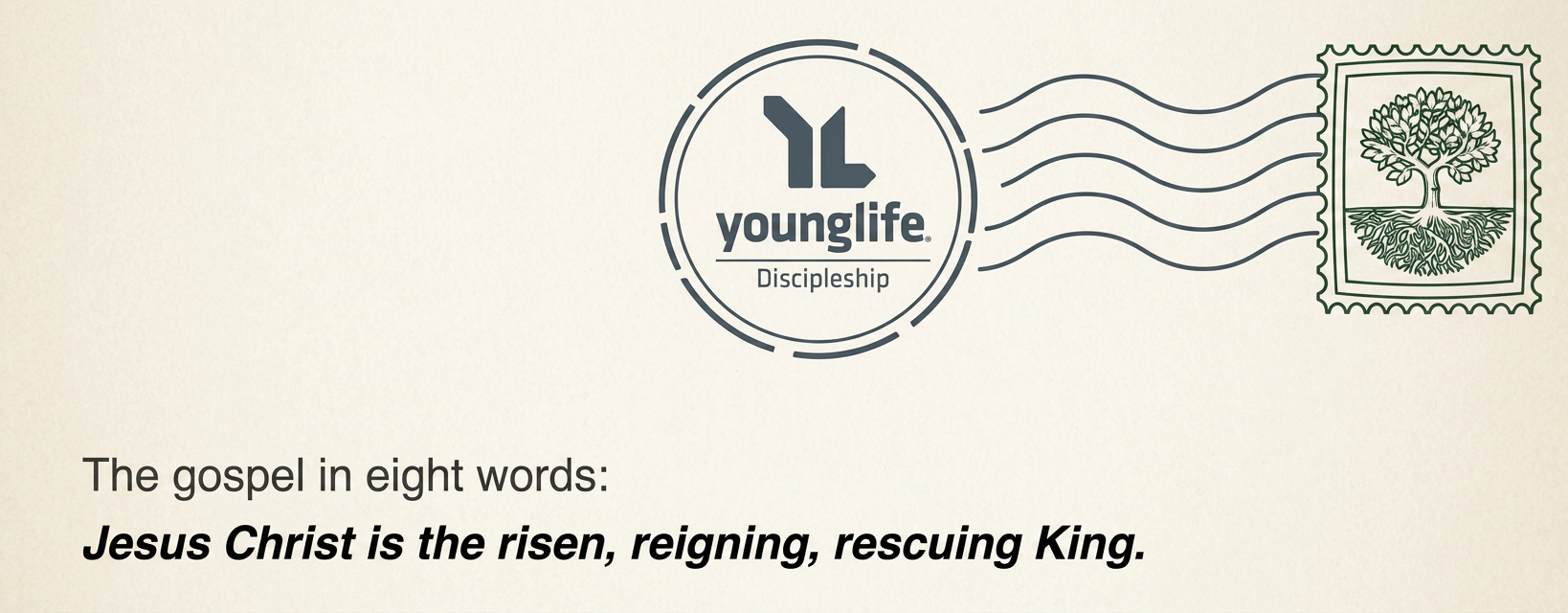
Jesus Christ is the risen, reigning, rescuing King.[3]

Sit with that for a moment.

Not just Savior.
King.

Not just forgiving.
Reigning.

Not just future hope.
Present reality.


[1] Smith, C., & Denton, M. L. (2005). Soul searching: The religious and spiritual lives of american teenagers. Oxford; New York: Oxford University Press.

[2] Director of Discipleship Content and Partnerships, Young Life

[3] Interestingly, this statement was also provided by Crystal Kirgiss.  In arrived in my inbox via her monthly “Discipleship Postcard” to Young Life staff on April 7, 2026, while I was developing this “Not what you think it means” series.  (See “postcard” above.) 


ADDENDUM. If you are not familiar with the “Roman Road” or the Four Spiritual Laws, here they are…

The Roman Road is an oft-used plan of salvation – getting its name from the fact that it follows a journey through the Apostle Paul’s letter to the Roman Church.  The five core verses typically outline this plan of salvation:

  1. Romans 3:23 – Everyone is a sinner: “For all have sinned and fall short of the glory of God”.
  2. Romans 6:23a – The consequence of sin is spiritual death: “For the wages of sin is death”.
  3. Romans 6:23b – God offers a free gift: “But the gift of God is eternal life in Christ Jesus our Lord”.
  4. Romans 5:8 – Jesus died for us while we were still sinners: “But God demonstrates his own love for us in this: While we were still sinners, Christ died for us”.
  5. Romans 10:9-10, 13 – Confess and believe to be saved: “That if you confess with your mouth Jesus as Lord, and believe in your heart that God raised Him from the dead, you will be saved.”

Another well-known plan of salvation is Campus Crusade’s Four Spiritual Laws, developed by founder Bill Bright.  The Laws:

  1. God loves you and offers a wonderful plan for your life (John 3:16; 10:10).
  2. Man is sinful and separated from God.  Therefore, he cannot know and experience God’s love and plan for his life (Rom. 3:23; 6:23).
  3. Jesus Christ is God’s only provision for man’s sin.  Through him, you can know and experience God’s love and plan for your life (Rom. 5:8; 1 Cor. 15:3 – 6; John 14:6).
  4. We must individually receive Jesus Christ as Savior and Lord; then we can know and experience God’s love and plan for our lives (John 1:12; 3:1 – 8; Eph. 2:8 – 9; Rev. 3:20).

Compared to the Roman Road, a major difference in the Four Spiritual Laws is the addition of language about a wonderful plan for our lives.  McKnight spoke to this addition: “regarding God loves you and has a wonderful plan for your life, in 1957 a salesman, Bob Ringer, told Bill Bright that he had to learn to evangelize by beginning on a positive note — sales, he was told, begins with something positive”. (McKnight, S. (2016). The king jesus gospel: the original good news revisited. Grand Rapids, MI: Zondervan.)