
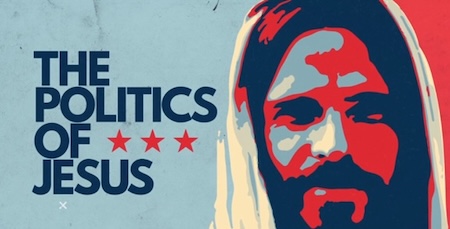
When we hear the word political, our minds often drift toward partisan bickering, campaign ads, and endless fights between the left and the right. Politics, fundamentally, is about how communities govern themselves and pursue human flourishing together – how power is exercised, how justice is pursued, and how public life is ordered. It concerns the values and structures that shape public life.
Partisanship is narrower. It is allegiance to a party, ideology, tribe, or faction, often reducing reality into “us versus them.” In short, being political is about the common good; being partisan is about taking sides.
That distinction matters when we talk about Jesus.
Whether we recognize it or not, Jesus was profoundly political. He proclaimed a kingdom, confronted systems of power, redefined authority, and announced a new social reality under the reign of God. Yet he consistently resisted being co-opted by the partisan movements of his day.
He did not align himself with the Pharisees, Sadducees, Herodians, or Zealots. He transcended them all.
And that frustrated people.
Some wanted Jesus to overthrow Rome. Others wanted him to reinforce the religious establishment. Still others hoped he would baptize their version of nationalism or morality. Jesus refused every attempt to squeeze him into a human political category.
That refusal still frustrates people today.
The Politics of the Kingdom
Jesus’ first public proclamation was deeply political: “The kingdom of God is at hand. Repent and believe the good news.” (Mark 1:15)
In the Roman world, Caesar claimed titles like “Lord” and “Savior.” The empire proclaimed its own “gospel” — good news about the reign of Caesar and the peace of Rome.
So when Jesus announced the kingdom of God, he was declaring an alternative reign, an alternative allegiance, and an alternative vision for human flourishing. The earliest Christians understood this – when they confessed, “Jesus is Lord,” they were simultaneously declaring, “Caesar is not.”
But Jesus’ politics did not mirror Caesar’s politics.
His kingdom would not advance through domination or violence. It would spread through love, truth, healing, forgiveness, and love of the enemy. Jesus subverted the normal assumptions of political power.
As Stanley Hauerwas often argues, Christians are called to resist the political categories, assumptions, and demands of their age. The church proclaims that we belong first to another kingdom.
Challenging Power Without Grasping for It
Jesus consistently confronted distorted uses of power.
He overturned tables in the temple because worship had become entangled with exploitation (Matthew 21:12–13). He rebuked leaders who burdened others while refusing to help carry the load (Matthew 23:4). And he taught that leadership in God’s kingdom is about serving, not “lording it over” others (Mark 10:42–45, Luke 22:25–26), contrasted with the politics of earthly kingdoms.
Jesus rejected domination as the pathway to transformation.
That is why he puzzled both the religious establishment and the political revolutionaries of his day. The Zealots wanted revolt. Rome wanted order through force. Jesus chose servanthood.
He taught that greatness looks like humility, leadership looks like sacrifice, and authority looks like washing feet.
Refusing Partisan Co-Option
One of the clearest examples of Jesus resisting partisan co-option came when he was asked whether Jews should pay taxes to Caesar (Matthew 22:15–22).
The question was a trap.
If Jesus endorsed the tax, many Jews would see him as siding with Rome. If he rejected it, Rome could brand him a revolutionary.
Jesus refused the false binary.
“Give to Caesar what is Caesar’s,” he said, “and to God what is God’s.”
With one statement, Jesus acknowledged the limited role of earthly government while also relativizing its authority. Caesar may have his coins, but Caesar does not own human souls.
If coins bear Caesar’s image, human beings bear God’s image. Our ultimate allegiance belongs to God.
This is why Christians must be careful whenever political parties attempt to claim unquestioned loyalty. The moment the church becomes fully identified with a partisan movement, it risks domesticating the kingdom of God into something far smaller than Jesus intended.
Jesus consistently resisted those kinds of reductions.
After feeding the five thousand, the crowds attempted to “make him king by force.” Jesus withdrew from them (John 6:15). They wanted a Messiah who fit their political expectations.
Jesus would not comply.
The Politics of Radical Human Dignity
Jesus’ politics were also visible in the people he welcomed.
Philip Yancey noted that Jesus refused to let institutions interfere with love for actual human beings…
Jesus spoke with a Samaritan woman whom society marginalized ethnically, morally, and religiously. He called Matthew the tax collector and Simon the Zealot into the same circle of disciples. He ate with Pharisees and sinners. He touched lepers, welcomed children, and praised outsiders.1
Again and again, Jesus placed people above categories. And every one of these actions carried political implications because they redrew the boundaries of belonging.
The kingdom of God was not built around tribal purity or partisan identity. It was built around reconciliation.
Why This Matters Now
Following Jesus cannot be apolitical.
To live under the lordship of Christ means caring about justice, truth, peace, mercy, and the ordering of life together. Christians cannot retreat into a privatized faith that ignores public life.
At the same time, Jesus warns us against becoming captive to partisanship. Paul rebuked believers for dividing themselves into factions:
“One of you says, ‘I follow Paul’; another, ‘I follow Apollos’… Is Christ divided?” (1 Corinthians 1:12–13)
That warning still matters. Whenever Christians equate the kingdom of God with a political party, ideology, nation, or movement, we shrink the gospel into something tribal. We tame the radical vision of Jesus. We begin treating political opponents as enemies to defeat instead of neighbors to love.
N.T. Wright writes that God’s kingdom is the place “where love and justice and truth and mercy and holiness reign unhindered.”2 Those realities never fit neatly into partisan categories. The kingdom critiques every party. Every ideology. Every ruler.
Including the ones we prefer.
Living as Citizens of Another Kingdom
So the question is not whether Jesus was political. He clearly was.
The better question is this: How can we be political like Jesus without becoming partisan like the world? That may mean:
- Speaking truth to power, no matter who holds office.
- Prioritizing the vulnerable even when it costs us socially or politically.
- Refusing to demonize those on “the other side.”
- Caring more about faithfulness than winning.
- Remembering that our ultimate hope is not found in elections, parties, politicians, or nations, but in the risen Christ.
In a polarized age, the church has an opportunity to model a different kind of public witness – a people shaped not by outrage, fear, or tribalism, but by the ethics of the kingdom of God. A people who proclaim that Jesus is Lord.
And because Jesus is Lord, no political party ever will be.
1 Yancey, P. (1995). The Jesus I never knew (International trade paper edition). Zondervan Publishing House.
2 Wright, N. T. (2004). Matthew for everyone : Part two. Westminster John Knox Press.

