John at the Jordan: A Familiar Act, a Radical Message


As we discovered in the previous post, when John appeared along the Jordan River, calling people to be baptized, he wasn’t inventing something new. Ritual washing was already woven into Jewish life. From the Temple mikva’ot in Jerusalem to the purifying baths found in nearly every Galilean village, immersions were familiar acts of cleansing – acts that symbolized a person’s desire to approach God with purity.

But John’s baptism was different. He took a familiar ritual and reoriented it – not around the Temple, not under priestly oversight, but around a message: “Repent, for the kingdom of heaven has come near” (Matthew 3:2). What had long been an act of purification became a call to transformation.

A Baptism Outside the System

In the first century, ritual washings were part of the rhythm of faith. These washings – tevilah in Hebrew – were repeated again and again as needed. They prepared one externally for worship, but didn’t change the heart.

John’s setting was the first sign that something new was happening. He wasn’t at the Temple. He wasn’t officiating under the watchful eye of priests. He was out in the wilderness – at the Jordan, the river that once marked Israel’s entry into the Promised Land. There, at the symbolic border of new beginnings, he called people not to repeat a ritual, but to prepare for a divine encounter.

“Repent, for the kingdom of heaven is at hand!” — Pieter de Grebber, “St. John the Baptist Preaching Before Herod,” 17th century )

Repentance: More Than Regret

John’s call was simple yet seismic: “Repent.” The Greek word metanoia literally means “to change one’s mind,” but it carries far more than intellectual reconsideration. In Hebrew thought, repentance – teshuvah – means turning around.

There is an order to repentance. Before one can turn around and change direction, they must first come to a realization that they might, in fact, be going the wrong way – a change of mind.. What did the people have to change their minds about? About God? About His nature? About their role as God’s kingdom people? About justice and mercy?

Turns out, the first-century Jewish people had a lot to change their minds about. Likely that’s why John (and later, Jesus) called the religious leaders a brood of vipers (Matthew 3:7, Matthew 12:34). The religious leaders (priests, Pharisees, Sadducees, zealots, etc.) were actually leading people away from God by misrepresenting his character, relying on their own national ideologies.

John’s message of repentance wasn’t merely to feel sorry or guilty. It meant rethinking about God, His character, and especially the nature of His kingdom…

…because it was breaking in!

Preparing the Way

John’s ministry echoed the words of Isaiah:

“A voice of one calling in the wilderness, ‘Prepare the way for the Lord, make straight paths for him’” (Isaiah 40:3).

To “prepare the way” meant to ready the heart for God’s arrival. Just as ancient workers leveled roads for a coming king, John’s preaching cleared the inner landscape – removing obstacles of pride, hypocrisy, and indifference.

His baptism was a symbol of readiness. Those stepping into the Jordan weren’t simply washing away ritual impurity; they were acknowledging their need for renewal and pledging themselves to hear a new narrative.

This is why tax collectors and soldiers came, confessing their sins (Luke 3:10–14). It’s why Pharisees, used to controlling religious access, bristled at John’s independent authority (Matthew 3:7–9). John’s message cut through social boundaries and religious assumptions. He was leveling the ground for the coming King.

The Wilderness as God’s Classroom

I suspect the wilderness wasn’t accidental. Throughout Israel’s story, God met His people in desolate places – calling them out of comfort to confront their need. From Moses’ encounter at the burning bush to Israel’s forty years of wandering, the wilderness was where God stripped away illusion and invited trust. 1

By situating his baptism there, John was signaling a return to dependence on God. The wilderness was a place of renewal and recalibration – a spiritual reset for those willing to leave old thinking behind.

And the Jordan itself carried deep memory. This was the river Joshua crossed when Israel finally entered the land of promise (Joshua 3). To stand in those waters again was to reenact a moment of covenant renewal – to step forward in faith toward God’s future.

A Radical Message in Familiar Waters

So when John called Israel to the Jordan, he wasn’t rejecting tradition – he was fulfilling it. He transformed an external practice into an internal awakening, a ceremonial act into an ethical summons, and a repeated ritual into a watershed moment.

John’s baptism didn’t cleanse in order to make one fit for Temple sacrifice; it cleansed to make one ready to meet the Lamb of God who would take away the sin of the world (John 1:29).

And that was radical.

The Heart of the Matter

Repentance, then, was not a demand to do better but an invitation to be changed. It was not a self-improvement program but a surrender to God’s transformative work.

The act of entering the water symbolized death to the old self and emergence into new life. It prefigured the deeper baptism Jesus would later offer – baptism with the Holy Spirit (Mark 1:8), an inner renewal only God could accomplish.

John’s message pressed toward that truth. “I baptize you with water for repentance,” he said, “but after me comes one who is more powerful than I… He will baptize you with the Holy Spirit and fire” (Matthew 3:11).

The familiar act pointed beyond itself – to a greater cleansing, a truer renewal, a living relationship with the King Himself.

A Call That Still Echoes

John’s voice still echoes across the centuries. In a world that often substitutes religious performance for heart change, his message calls us back to the Jordan – to the place of turning, of release, of preparation.

Repentance remains the doorway to encounter. It is the act of aligning our hearts with God’s kingdom and making room for His reign.


  1. I think of a statement credited to Rabbi Abraham Joshua Heschel: “It took one day to take the Israelites out of Egypt, but forty years to take Egypt out of the Israelites.” ↩︎

John the Baptist Didn’t Invent Baptism


Before John the Baptist ever called people to the Jordan, the Jewish world already knew something of water and washing. Immersion wasn’t a novelty. It was woven into daily life, into rhythms of purity, preparation, and belonging. John didn’t invent the idea — he simply took it out of the Temple courts and into the wilderness.

The Mikveh: Ritual Purity and Readiness

The Hebrew word mikveh means “a gathering” — often of water — and it came to describe a pool used for ritual immersion. These baths, carved into stone and fed by “living” water (rain or spring), appear throughout first-century Israel. Archaeologists have uncovered mikva’ot (plural) near the Temple Mount, around Qumran, and in Galilean villages — evidence of how normal immersion had become by the time of Jesus.

In Jewish life, immersion in the mikveh wasn’t about moral guilt but ritual status. It restored purity so one could reenter worship or communal life after contact with impurity — things like childbirth, disease, or death (see Leviticus 15; Numbers 19). Priests immersed before serving; ordinary people did so before festivals or Sabbath meals. It was familiar, repeatable, expected.

In other words, the mikveh wasn’t about forgiveness. It was about fitness — being fit to approach God’s presence.

mikveh near the base of the Southern Steps of the Temple Mount in Jerusalem

Proselyte Immersion: From Outsider to Insider

By the first century, another form of immersion had emerged: that of Gentiles converting to Judaism. A convert underwent three steps — circumcision (for men), immersion, and a temple sacrifice. The immersion symbolized a transition from impurity to purity, from outsider to member of God’s covenant people.

Rabbinic writings later summarized, “By three things did Israel enter into the Covenant — by circumcision, immersion, and sacrifice.” The convert, it was said, became “like a newborn child.” It was a fresh start — but again, a ceremonial one.

Prophets, Purity, and the Promise of Cleansing

Long before mikva’ot were carved in stone, the prophets had used washing language symbolically:

“Wash yourselves; make yourselves clean,” Isaiah pleaded (1:16). “I will sprinkle clean water on you,” promised Ezekiel, “and you shall be clean … I will give you a new heart and put a new spirit within you” (36:25–27).

Water had always hinted at something deeper — not just the washing away of dust, but the cleansing of the heart.

Groups like the Essenes took this seriously. The Dead Sea Scrolls describe daily immersions tied to covenant faithfulness and inner purity. For them, water symbolized moral renewal — a visible act expressing invisible obedience.

A Familiar Form, a Coming Shift

So when John began calling Israel to the Jordan, he wasn’t performing a strange ritual. He was using a symbol everyone already understood. Immersion was a language his hearers spoke fluently.

What was new was the location — outside the Temple system — and the message behind it. But we’re not there yet. For now, it’s enough to see that John’s work grew out of a long Jewish conversation about cleansing, belonging, and readiness before God.

In an earlier post, Baptism, Pickles, and Steel Poles, we compared baptism to both the preserving of cucumbers and the strengthening of steel. Ordinary materials — transformed by immersion. That’s what was happening in Israel’s ritual life long before John: familiar practices pointing toward deeper transformation.

John didn’t invent baptism; he reinterpreted it. He stood in a long tradition of washing and readiness — but instead of pointing people to the Temple, he pointed them toward repentance and the coming King (and His kingdom).

Before the new could begin, the old had to be remembered. And the old, as it turns out, had always been whispering: “Get ready.”


For those who love to learn more, some sources…

On the Mikveh:

On Proselyte Baptism:


Isaiah’s Kingdom Message


We would be remiss in this “kingdom journey” if we didn’t spend time with Isaiah and his 60-year ministry as a prophet. His prophetic voice rang out in one of Israel’s darkest seasons. His book spans decades of judgment, grief, promises, and breathtaking visions of God’s kingdom breaking in.

Isaiah’s ministry began in the eighth century B.C. during the reign of Uzziah (Isaiah 6:1). He served as a prophet in Jerusalem, speaking to kings and common people alike. His call was both daunting and exhilarating as he announced God’s word to a people who largely did not want to hear it. He saw firsthand their idolatry, injustice, and false worship. He warned them that Assyria, and later Babylon, would be instruments of God’s judgment.

Isaiah was not simply a prophet of doom. He was also a prophet of hope. His message unfolds in a rhythm of judgment and restoration, not an uncommon theme in the Hebrew scriptures. Israel would be cut down like a tree, but “the holy seed will be the stump in the land” (Isaiah 6:13). In other words, God’s kingdom story and the role of his people were far from over.

Isaiah in the Shadow of Exile

Isaiah straddled a critical time in Israel’s history. Some of his prophecies addressed the immediate threat of Assyria, but his vision stretched far beyond. He foresaw Babylon’s rise and the devastating exile that would follow (Isaiah 39:5–7). For Judah, this meant the unimaginable: the temple destroyed, the land lost, the people scattered.

What do you say to a people stripped of their identity and hope? Isaiah’s answer was to re-anchor them in the character of God. He reminded them that the Holy One of Israel was not confined to stone walls or earthly thrones. Even in exile, God was King.

Comfort, comfort my people, says your God” (Isaiah 40:1). These words echo like cool water in the desert. Isaiah dared to declare that exile was not the end. God was still writing the story, still keeping covenant, still shaping a people for Himself. The kingdom would come, not by human might but by God’s own faithful hand.

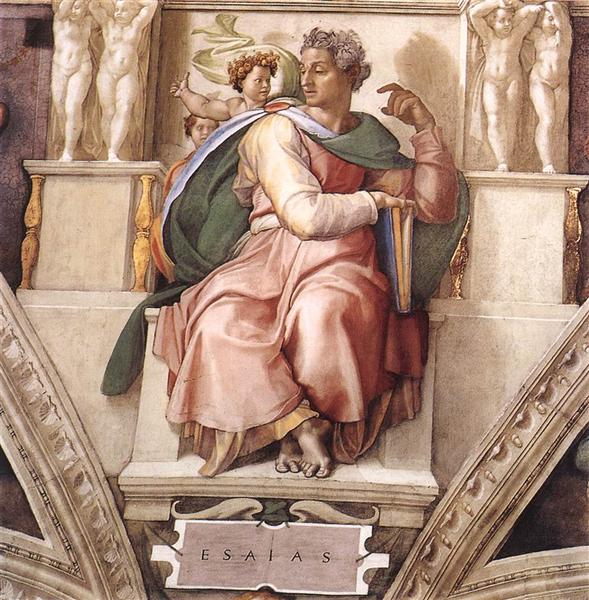
The Prophet Isaiah, Michelangelo (1509, Sistine Chapel)

The Kingdom Vision

Isaiah’s prophecies pulse with kingdom language. He envisioned a day when swords would be beaten into plowshares, and nations would learn war no more (Isaiah 2:4). He pictured a highway in the wilderness, where God Himself would lead His people home (Isaiah 35:8–10). He described a feast of rich food for all peoples, where death is swallowed up forever (Isaiah 25:6–8).

These aren’t just nice images. They are glimpses of God’s reign breaking into human history. Isaiah insisted that God’s kingdom is not limited to Israel’s borders – it is global, cosmic, and eternal.

But who could possibly bring such a kingdom?

Pointing to the King

Isaiah repeatedly pointed forward to a figure who would embody and establish God’s reign. Sometimes he called Him the shoot from Jesse’s stump, a Spirit-filled ruler who delights in righteousness and justice (Isaiah 11:1–5). Other times, He is the Servant of the Lord, who suffers on behalf of His people, bearing their sins to bring them peace (Isaiah 53:4–6).

For Christians, these words unmistakably point to Jesus. He is the child born, the son given, the one called Wonderful Counselor, Mighty God, Everlasting Father, Prince of Peace (Isaiah 9:6). He is the Servant who was pierced for our transgressions and crushed for our iniquities. He is the Spirit-anointed King who announces good news to the poor and freedom for the captives (Isaiah 61:1–2; see Luke 4:18–21).

Isaiah, centuries before Bethlehem, gave Israel a vocabulary of hope that would only make full sense in Jesus.

Kingdom People Then and Now

Isaiah’s voice continues to call out across the centuries. His message to exiles is just as relevant to us. We may not be dragged off to Babylon, but we know what it is to live in a fractured world where kingdoms rise and fall, where injustice festers, and where hope feels fragile.

Isaiah’s kingdom vision re-centers us. It reminds us that our story is not defined by loss or despair but by the faithful God who keeps His promises. It challenges us to live as kingdom people even in exile (both real and perceived) – to pursue justice, to care for the oppressed, to keep our eyes fixed on the coming King.

The same King that Isaiah saw in the temple, high and exalted, with the train of His robe filling the sanctuary (Isaiah 6:1), is the King who took on flesh and walked among us. He is the crucified and risen Lord who promises, “Behold, I am making all things new” (Revelation 21:5).

Living Isaiah’s Hope

To read Isaiah is to be both unsettled and comforted. We are unsettled by his honesty about sin, judgment, and the futility of our false securities. But we are comforted by his relentless insistence that God is faithful, that exile is not the end, and that a King has come – and will come again.

Like the exiles who first heard Isaiah’s words, we are invited to trust, to wait, to hope. To beat our swords into plowshares in anticipation of peace. To walk the highway of holiness with joy. To live as witnesses to a kingdom that is already here and yet still to come.

Isaiah helps us see what’s true: God is King, His kingdom is and has broken in, and Jesus is the fulfillment of the promises. And in that kingdom we find our home.


Choosing Kings: The Anarchy of Rejecting God

Anarchy1 often conjures images of chaos, but at its root, it simply means “without a ruler.” That’s a more familiar story than we might think – one that traces all the way back to Eden and runs straight through our own hearts.

Individualism comes to mind. American individualism for sure. We really don’t want anyone telling us what to do. We don’t like big government, except when we want it to provide for our individual needs.

But Americans don’t have a corner on the market. It seems anarchism has been the Achilles’ heel of humanity through the ages, starting with Adam and Eve, the original individualists who preferred to reign in their own corner of the kingdom instead of submitting to God. And humanity has maintained a pattern of anarchy.

Yahweh, sovereign over all creation, is not unaware of humanity’s innate inclination toward disorder and self-rule. Nevertheless, as we have been discovering in previous blog posts, he chose flawed people through whom to initiate the redemption of a broken world. Upon the Israelites’ settlement in Canaan, God instituted a distinctive system of governance.

He appointed judges – not through human election or self-appointment, but by divine calling. Unlike other nations, Israel had no centralized army, no system of taxation, and no bureaucratic administration – only tribes trying, however imperfectly, to live in covenant with the One who had delivered them from bondage.

But as we read in 1 Samuel 8, everything changed. The people said to Samuel, 2 “Now appoint for us a king to judge us like all the nations” (v. 5). They were willing to trade faith for familiarity – to be like everyone else, even if it meant rejecting the One who had rescued them.

Samuel was crushed. So was God.

“They have not rejected you,” God told Samuel, “but they have rejected me from being king over them.” (1 Samuel 8:7)

Let that sink in: the desire for a human king is framed as a rejection of divine kingship. God even warned them exactly what would be coming – a king would take their sons for war, their daughters for labor, their fields, their income, their freedom. “And you shall be his slaves” (v. 17).

It’s as if God were saying: You’re asking for your own oppression.

And they still said yes.

There’s an echo here of something deeply anarchist – not in the chaotic, lawless sense – but in the conviction that concentrated human power inevitably corrupts. True community doesn’t require coercion, but covenant. God’s intent was not empire, but a people shaped by justice, humility, and mutual care.

In their demand for a king, Israel was opting out of covenant trust and into tyranny. They chose domination over dependence. Control over communion. And God didn’t force them. He gave them what they asked for – and allowed them to live with the consequences.


The question lingers for us:
– Are we still choosing kings over covenant?
– Power over presence?
– Control over trust?

Maybe God’s “no” in 1 Samuel 8 isn’t just about ancient Israel. The kingdom Jesus proclaimed was never meant to mirror our systems – it was meant to subvert them. No golden thrones. No iron swords. Just a cross, a basin, and a table.

A little upside-down.
A little unsettling.
A little… anarchist.


1 Anarchy comes from the Greek anarkhia, meaning “without a ruler” (an- = without, arkhos = ruler). It has several uses depending on context – political, philosophical, social critique, etc. – but at its core, anarchy refers to the absence of formal government or authority.

2 Samuel was a prophet, judge, and faithful leader of the Israelites. He prayed when others panicked, listened when others rebelled, and helped a restless nation find its footing. His story can be found in 1 Samuel.

The Parable of the Servant King

As I read through the Gospels this past month, I was repeatedly struck by the image of Jesus as a servant. After reading John 13, I began to realize that Jesus is not only a Benevolent King, but a Servant King. So I had ChatGPT review The Parable of the Benevolent King and offer a “Servant King” version of the parable. For what it’s worth, this is what ChatGPT created…


The Parable of the Servant King and the Kingdom of Merea

Long ago, nestled between green hills and silver streams, there was a kingdom unlike any other. It bore no grand name, yet its people called it Merea, meaning “beloved dwelling.” It had no towering walls, no boastful banners, and no gleaming thrones—but it had a king.

His name was Elandir, though few addressed him by it. To most, he was simply the Servant King.

He wore no crown, save the sun-weathered hood of his traveling cloak. He carried no scepter, only a staff worn smooth from walking with the people. He lived not in a distant palace, but in a modest home at the heart of the village square, where he could be seen each day mending fences, helping mothers lift heavy buckets, or kneeling beside the sick.

Though he could command legions, he chose instead to lead by invitation, not by force. His strength was in his nearness.

The People of the Kingdom

In Merea, everyone had a place, and everyone had a part to play—not out of obligation, but out of gratitude. The king’s way inspired imitation.

The Stone-Menders fixed broken pathways, not for praise, but to ensure the elderly didn’t stumble. The Bread-Makers baked before dawn, leaving warm loaves on the doorsteps of those in need. The Fire-Keepers walked the streets on cold nights, carrying embers to reignite the hearths of the poor.

There were Listeners whose task was to visit the lonely, to sit, nod, and remind the forgotten they were seen. There were Messengers, not to carry royal edicts, but to deliver encouragement, celebrate births, and mourn losses with the grieving. Even the Children had their ministry—they brought laughter, drew chalk flowers on the town square, and reminded the old how to dance.

The Servant King gave no titles. He said that the most honored were those least noticed.

Each day he would rise before the sun and walk the length of the town, checking on the sick, delivering water, patching roofs, and praying quietly for his people. And when asked why he did such menial tasks, he would smile and say, “Because love kneels.”

Why So Many Came

The stories of Merea spread like spring wind. In lands where kings rode stallions and ruled with iron fists, the idea of a ruler who served seemed like a tale for children. Yet as the tales persisted, people began to wonder: Could such a place exist?

Travelers came—some limping, others tired of being used, many carrying wounds too deep to name. They expected gates, guards, and bureaucracy. Instead, they found the king himself waiting at the edge of the road with a cup of water and a question: “Would you like to come home?”

They stayed, not because of riches or promises, but because they were seen, known, and loved. Here, they weren’t asked what they could produce—but who they were becoming. In a world driven by status and achievement, Merea whispered a different word: belonging.

Those Who Chose to Leave

Yet not all who arrived stayed. Some grew frustrated at the Servant King’s ways. They wanted to climb ladders, not wash feet. They asked, “Why does no one rise above the rest here?” And the king, with gentleness, would reply, “Because we rise together.”

But for those who equated worth with control, it was not enough.

A few grew discontented with the slow pace of mercy. They wanted results, not relationship—efficiency, not empathy. They said, “This kingdom is too soft, too slow, too kind.” And the king, though grieved, did not chain them. He only walked with them to the edge of the kingdom and said, “Should you wish to return, the door will always remain open.”

Others left quietly—not out of anger, but from fear. The love they found in Merea felt too complete, too undeserved. They whispered, “I’m not worthy.” And though the king assured them, “None are, that’s why love bends low,” some still turned away, unable to receive what could not be earned.

A Kingdom That Keeps Giving

Yet the Servant King did not despair. He kept sowing seeds, bandaging wounds, listening to stories, and setting tables. The kingdom did not grow by conquest, but by kindness. It expanded not in borders, but in beauty.

Children raised in Merea grew up with strong hands and soft hearts. The old passed their wisdom to the young, and no one was left behind. Festivals were thrown, not for profit, but to celebrate life together. And in every corner of the land, the fragrance of compassion lingered.

And still, the Servant King walks the roads. Some say he’s grown older. Others say he’s only grown deeper—his eyes full of both sorrow and joy. He still waits by the gates each morning, lantern in hand, ready to welcome the next weary traveler who dares to believe that greatness might be found in kneeling love.


I Almost Bought the Farm

Quite literally! Growing up, I loved farming – despite the inherent challenges of dairy farming in the ’50s and ’60s. We didn’t have much. I remember some bleak Christmases. We only made the 3-mile trip into town if it was absolutely necessary. Dairy farming is a 365-day-a-year commitment, so youth sports and weekend getaways were out of the question. Still, I wouldn’t have traded that upbringing for anything.

But I did – I went to college to be an engineer.

After a couple of years of college, I found myself unsure of what I really wanted to do with my life. I struggled in college. My grades were probably an indicator of my uncertainty. So I dropped out for a time, choosing to work for the local company that had hired me to work in their drafting department as a junior in high school. I had employment as long as I was in school, so I continued taking one or two evening engineering courses per semester at the University of Minnesota. Evening classes in the ’70s required an in-person commute, unlike online school today.

While working and commuting to the U, a dairy farm near my home became available for purchase. Because of my uncertainty about life, I decided to consider the possibility of buying the farm and becoming a dairy farmer. A high school classmate of mine was the realtor. We had many discussions as to how I might be able to purchase the farm. I was excited about the possibilities of becoming a landowner.

I almost bought that farm. I suppose I forgot how relentless dairy farming is. But when our future feels uncertain, we often retreat to what we know best. I wonder if that’s what happened with the Israelites in the wilderness when they formed the golden calf. Moses, their leader and the voice of Yahweh, had vanished up the mountain. Their future looked uncertain. So they defaulted to what was familiar: a tangible god, something they could control.

In time – forty years’ time – they learned to trust God. They followed Him through the desert, being shaped into a people ready to live in the land He had promised. That land wasn’t just a gift, but a launch point – a base from which they would fulfill their calling to be God’s covenant people, a blessing to the world. As kingdom people, they would participate in His redemption project – new creation and an “on earth as in heaven” type restoration.

But their desert journey came with hard lessons. The biggest one? God is sovereign. They were not. Yielding to His rule brought life. Resisting brought the opposite.

Eventually, they were ready. Joshua led them across the Jordan into Canaan. The land was apportioned according to their tribal lines – though the tribes of Reuben, Gad, and half of Manasseh chose to settle east of the river.

Before they entered, Yahweh made it abundantly clear how they were to live together in the land under his Kingship. This was the point of the Torah: for God to be their God, and they His people (cf. Exodus 6:6-7, Leviticus 25:38, Deuteronomy 29:13, Jeremiah 7:23, etc).

Theologically, we know this as the Covenant Formula*

As Creator, the land belonged to Him. “The land must not be sold permanently, because the land is mine and you reside in my land as foreigners and strangers (…)” (Leviticus 25:23-25). They were guests – stewards, not owners.

They were there at His pleasure, so to speak.

As landlord, God gave them instructions on how to treat the land and each other. Every seven years, the land was to rest. This not only rejuvenated the soil but also gave farmers, servants, and animals a Sabbath. This same principle was instituted by the United States Soil Conservation Service to combat the propensity for things like the Dust Bowl. We did something similar when I farmed, fallowing about one-seventh of our land each year. Good husbandry.

God also instituted the Year of the Jubilee. Every 50 years, property returned to its original family, debts were forgiven, and slaves were released. A full reset. A radical vision of liberty and justice.

But as far as we know, the Jubilee was never observed.

For a long time, I struggled with the fairness of Jubilee. But once I grasped that the land never truly belonged to them – it was God’s – the whole concept made sense. He was King. He owned everything. The people were simply stewards.

Somewhere along the way, they lost sight of that. Sometimes I wonder if we have too. God is still King. He still owns everything. We are still stewards – of our resources, our relationships, our work, even our time.

What would it look like if we lived more like that were true?


* A key element of the Covenant Formula is the people’s relationship with God and with each other. Jesus recapped the Formula with his infamous “Love God, love others” command (see Deuteronomy 6:4-5 and Leviticus 19:18).

Long Live the King!

“Long live the King!” is a phrase rich with historical significance, symbolizing loyalty, continuity, and the enduring nature of monarchy. Its roots appear to trace back to 15th-century France in the declaration “Le roi est mort, vive le roi!”. “The King is dead, long live the King!” is a proclamation that marked both the death of a reigning monarch and the immediate succession of the next. Over time, the phrase found its place in English tradition and thus, “Long live the Queen!” The king (or queen) was kinda a big deal, I guess.

Recent blog posts have responded to the elusive and lingering question, “What is the Kingdom of God that was central to Jesus’ gospel message?” Why is it so hard for us to wrap our heads around and understand? We have slowly been working through scripture in an attempt to get a 30,000-foot view of God’s activity related to his kingdom and his subjects, starting with Almost Getting It back in November 2024.

Over the past months, I have had many conversations with people who, like me, have come to the realization that Jesus’ primary message was indeed about the Kingdom of God, but with the lingering question of what the kingdom actually is. As mentioned previously, I’ve been wrestling with the question for several decades. Part of this blog journey is my own attempts to articulate what the kingdom is (and what it is not, by the way).

For the last couple of months, I’ve begun to wonder if we have been asking the wrong question. We want to know what the kingdom itself is. I don’t know if it’s a Western thing or a human thing, but I suspect tunnel vision results in asking wrong questions. As I ponder Jesus’ interactions with his disciples, it seems like that was an issue for them, too – asking the wrong questions. So ponder this…

Are we more captivated by the characteristics of the kingdom than by the character of the One who reigns?

We want to know stuff about the kingdom – what it is, where it is, its relation to heaven (or vice versa), etc. We are interested in the characteristics of the kingdom. A place. What if we were to focus our attention on the character of the King himself? It’s this very wonderment that led me to create The Parable of the Benevolent King. I was attempting to describe a kingdom that reflected the character of the king. In the process, the characteristics of the kingdom became evident.

I suspect that when the Israelites met Yahweh at Mount Sinai, they were discovering the character of the God who rescued them from oppression and slavery. In the theophany, they discovered his holy presence on the mountain. The gods they knew about in Egypt were tied to time and place and a bit inept.

Try to imagine what they experienced…

16 On the morning of the third day there was thunder and lightning, with a thick cloud over the mountain, and a very loud trumpet blast. Everyone in the camp trembled. 17 Then Moses led the people out of the camp to meet with God, and they stood at the foot of the mountain. 18 Mount Sinai was covered with smoke, because the Lord descended on it in fire. The smoke billowed up from it like smoke from a furnace, and the whole mountain[a] trembled violently. 19 As the sound of the trumpet grew louder and louder, Moses spoke and the voice of God answered him. (Exodus 19:16-19)

This awesome experience was followed by Him delivering a set of commandments given for the people, His subjects. Starting with the Ten, we usually view these commands as precepts on how the people were to live in the presence of a holy God. There is certainly something to that. But what if we also looked at the commands as a revelation of God’s character to a people who knew nothing of his character? Think about it. As we watch world leaders issue “commands,” don’t their directives tend to reveal their character?

Through the Ten Commandments, the people discovered that Yahweh is the only true God, not tied to time and space (Exodus 20). This God did not require images because He created them as his image bearers, as we discussed in an earlier post.

But God didn’t stop with the Ten Commandments. He instituted an additional set of commands (see Exodus 20-23). Like the bottom of the order of the first Ten, these additional couple of dozen commands are mostly related to how his image-bearers were to relate to each other. We might call them social justice laws. They talk about how servants were to be treated, about fair trade, about the treatment of widows and orphans, about how foreigners were to be treated, about justice and mercy, etc. In fact, the NIV translation’s heading for a section of these additional commands is “Laws of Justice and Mercy.”

Can you see how the commands reveal the character of the King?

So again I wonder, is our attention drawn to the discovery of the characteristics of the kingdom rather than the character of the King? Maybe Dallas Willard had that figured out when he said…

Jesus put a face on the Kingdom of God*


* Willard, D. (2024). The scandal of the kingdom : how the parables of Jesus revolutionize life with God. Zondervan Books.

Exodus…

At the end of the previous post, The Great Egress, the million or so Hebrew slaves were headed toward safety on the East side of the Red Sea (Sea of Reeds?). Pharaoh’s stubbornness had required “acts of God,” natural catastrophes to which he finally succumbed. He succumbed to the reality that Yahweh was sovereign and he, in fact, was not. His arrogance and stubbornness had a direct effect on his people, his subjects, to the point that they urged the Hebrews to leave as quickly as possible, taking booty with them (Exodus 12:33). As we read world history, we see time and again “sovereign” kings confused as to who exactly is sovereign. And their subjects bear the brunt of their misguided autocracy.

This rescue from Egypt is known as The Exodus, the primary event of the Hebrew Scriptures’ redemptive history. It was how God fulfilled his promise to the patriarchs (Abraham et al.) of their role in the world and his restoration project. They would become a great nation and a blessing to the rest of the world. It’s also the root of the annual Passover festival, a celebration of God’s justice and mercy (hesed).

As the Hebrews reached safety, they broke into song, praising Yahweh for the rescue. Typical of many Psalms, the song recapped the events of the rescue, praised God for his salvation and redemption from the Egyptians, and acknowledged God’s sovereignty as a faithful God and king (see Exodus 15). A particularly powerful acknowledgment can be found in the middle of the song…

Who among the gods
    is like you, Lord?
Who is like you—
    majestic in holiness,
awesome in glory,
    working wonders?

These are words of a kingdom people acknowledging the majesty of their (newfound?) king. These are words from a people who are grasping the significance that they are subjects of a King of kings. These are words of a people that God will involve in his restoration project. These are the words of a people who were beginning to understand the God who sent this message to them while they were still in captivity…

“I am the Lord [Yahweh], and I will bring you out from under the yoke of the Egyptians. I will free you from being slaves to them, and I will redeem you with an outstretched arm and with mighty acts of judgment. I will take you as my own people, and I will be your God.” (Exodus 6:6-7)

Their God, Yahweh, was with them.

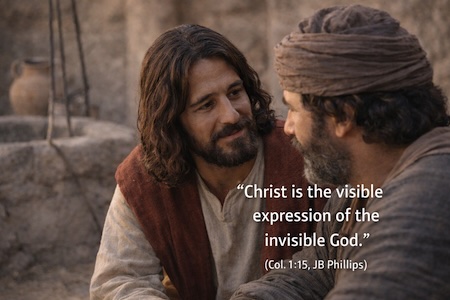
How was he with them? God manifested himself as a cloud pillar during the day and a pillar of fire at night. It’s how God led them and comforted them with his presence. The pillars were visible expressions of an invisible God. We must not miss the significance that the great Jewish theologian turned Christian Apostle, Paul, used a similar reference in his letter to the Church of Colossae…

 Now Christ is the visible expression of the invisible God. (Colossians 1:15, JB Phillips)

God’s presence with the people was a big deal. In the beginning, when things were “on earth as in heaven,” God walked with his created humanity. When the humans disobeyed God and desired to be like Him, the relationship with God was broken. This is why we say we live in a broken world.

Through Moses and the pillars, Yahweh was leading his people home – home being Canaan, the land where they lived before the Joseph debacle. Canaan was the land promised to the original people called to be kingdom ambassadors – Abraham and his descendants…

“I will establish my covenant as an everlasting covenant between me and you and your descendants after you for the generations to come, to be your God and the God of your descendants after you. The whole land of Canaan, where you now reside as a foreigner, I will give as an everlasting possession to you and your descendants after you; and I will be their God.”  (Genesis 17:7-8)

These million or so freed slaves were descendants of Abraham. The covenant applied to them, though likely most didn’t know of Yahweh or the covenant. Keep in mind that when Moses conversed with God through the burning bush, he didn’t know Him or his name, either. It would be fair to assume he was unfamiliar with the Abrahamic covenant as well.

See where this is going? These former slaves, dependents of the people God chose to be “blessed to be a blessing,” were likely unaware of their calling. A million or so people. As mentioned above, regarding the song they sang, they were probably just starting to get a glimpse of this God that rescued them. They had trusted Him thus far, it seems, but that doesn’t mean they knew him. Likely, they were simply trusting the God of Moses (which is pretty significant trust, by the way). They were just beginning to know and trust the creator God.

Yahweh was their God, and they were his people. But they had yet to learn what that actually looked like!

The Great Egress…

In the late 1800s, Phineas Taylor (P.T.) Barnum, known for his flamboyant and often deceptive marketing, decided to create a “memorable” experience for his audience. He placed a sign at one of his shows that read “This Way to the Great Egress.” The sign was placed at an exit, but it was cleverly designed to confuse and disorient the audience. People, thinking they were being directed to something important or special, followed the sign, only to find themselves outside the venue.

It could be folklore, but it’s a great story anyway. Here’s a little-known fact. I’m related to P.T. Barnum. Yes, the greatest showman! I don’t know how I’m related, but I remember meeting an “Aunt Barnum” years ago.

We have been working our way through a “working document” I created for myself – created to help me understand, capsulate, and articulate the kingdom of God that was central to Jesus’ message. Two-thirds of Jesus’ parables were about the kingdom of God – what it’s like and how things work in the kingdom. Understanding the nature of the kingdom is critical to understanding who God is as the King.

Given interruptions related to the holidays, etc., I suppose a brief recap of the ground we’ve covered thus far is necessary. We started with the creation of the universe, God’s’ kingdom – the heavens and earth. Humans were given “say” over God’s earth as stewards and caretakers. At the time of creation, it wouldn’t be a leap to assume God’s will (reign) was on earth as in heaven. Then distraction! The humans, God’s image-bearers, became distracted by the satan’s lure for them to be like God. Adam and Eve lost sight of their calling and their action created fissures in the kingdom on Earth.

God embarked on a project of new creation. He desired to continue to use his created image-bearers to be stewards and workers in the restoration or new creation project. He selected Abram (who became Abraham) to father a people who would serve His purposes in the larger plan of restoration. They were chosen to be his kingdom people, to be a blessing to the rest of the world – ambassadors of sorts.

Abraham’s descendants got distracted, though (see Joseph, Thermuthis, and Moses as well as Moses), ending up in Egyptian captivity for 400 years as slaves. Abraham’s descendants, the kingdom people, found themselves working seven days a week under brutality and brutal conditions. Tyrannical kings don’t get to abuse image-bearers and get away with it. Yahweh, the Lord of lords and King of kings had enough and stepped in to rescue his people. He chose Moses to be the leader who would confront Pharaoh, his adoptive father, and lead the people to freedom.

We know the story. God sent Moses, accompanied by his brother Aaron, with a message for Pharaoh, the king of Egypt…

Yahweh, the God of the Hebrews, has sent me to say to you: Let my people go so that they may worship me in the wilderness.

Pharaoh was not about to lose his workforce, so he refused. The refusal led to a plague on the nation and its people. Pharaoh’s response to the plague? He dug in his heels (his heart was hardened) with more refusal, leading to more plagues – ten to be exact. In the final plague, God sent an angel of death to all firstborns (humans and animals alike), a judgment on Pharaoh, his people, and their gods.

On the night of the plague of the firstborn, God gave the Hebrews traveling instructions: Kill and roast a young lamb, smear some of its blood on the sides and tops of the doorframes of the houses where they gathered to eat the lamb; no time for the bread to rise, so no yeast. Eat the meal with sandals on and staff in hand, ready to move. Seeing the blood on the doors, the angel of death would “pass over” the house, sparing firstborns.

It was the Lord’s Passover (Exodus 12:11). Passover has been celebrated annually by people of Hebrew descent, Abraham’s descendants, ever since – approximately 3500 years.

Pharaoh ultimately let the kingdom people go, though he changed his mind, leading to the Red Sea fiasco that was the demise of his troops. The whole thing is known as the Exodus.

Exodus | ˈeksədəs |: a mass departure of people, especially emigrants

It was a great exodus, most central in the story of God.* I suppose it could also be called the great egress (the action of going out of or leaving a place), but I doubt it will catch on. Through the Exodus, God revealed that His project of renewal would continue its advancement toward “on earth as in heaven.” God’s kingdom people would remain commissioned to bring blessings and shine as a light to the world. The Exodus people were to be his…

Ambassadors!

* An example of the centrality of the Exodus story is the Psalms of Hallel (Psalms 113-118), also called the Egyptian Hallel, sung during the annual Passover meal (seder).

Moses

In a previous post, we were introduced to Moses, raised by the daughter of the king of Egypt, Pharaoh. She had rescued him as a three-month-old floating down the Nile River in an ark. His parents had placed him in the little ark instead of the alternative of being thrown into the Nile to die per an edict of Pharaoh. Moses’ biological mother was his wet nurse, unbeknownst to Pharaoh and his daughter. The beginning of his life was really quite ironic.

It was Pharaoh’s daughter who named him Moses, giving him a name with Egyptian roots. According to the Jewish historian Flavius Josephus, he was given the Egyptian name Mouses “for the Egyptians call water by the name of Mo, and such as are saved out of it, by the name of Uses: so by putting these two words together, they imposed this name upon him.”1

Although he grew up as Egyptian royalty, Moses was apparently aware of his Hebrew heritage. As he grew older, he became increasingly troubled by the harsh treatment of the Israelite slaves. Given his adoption into the Egyptian royal family and his identification with the oppressed Hebrews, Moses grew up with a dual identity. Who else do we know with a dual identity?

When Moses was about 40 years old, he witnessed an Egyptian slave master beating an enslaved Hebrew. In a moment of righteous indignation, Moses killed the Egyptian and hid the body in the sand. The next day, he saw two Hebrews fighting and tried to intervene, but they rejected his help, asking if he intended to kill them as he did the Egyptian. Realizing that his act of violence was known, Moses feared for his life, and for good reason…

Pharaoh, hearing of the incident, sought to kill Moses.

Moses fled Egypt and escaped to the land of Midian, located in the desert region east of Egypt. In Midian, Moses met the seven daughters of Reuel (also called Jethro), who he defended from some harassing shepherds. In gratitude, Jethro invited Moses to stay with his family. Moses eventually married Zipporah, one of Jethro’s daughters, and they had a son named Gershom because he was a foreigner in a foreign land.

Moses spent the next 40 years in Midian, living as a shepherd.

While tending Jethro’s sheep in the wilderness near Mount Horeb, “the mountain of God,” an unusual burning bush caught Moses’ eye. It’s my understanding that burning bushes are common in arid climates. What made this one unusual was the appearance of an angel in the bush. Oh, and the bush wasn’t consumed. I guess that might qualify as unusual. So Moses thought what any of us might have thought…

I will go over and see this strange sight—why the bush does not burn up. (Exodus 3:3)

As he approached, God garnered Moses’ attention by calling his name from within the burning bush – another uncommon occurrence. God provided further identification (as if a non-consumed burning bush with an angel and God’s voice wasn’t enough!). God revealed Himself as the God of his ancestry – the God of Abraham, the God of Isaac, and the God of Jacob. God had Moses’ attention.

God proceeded to share with Moses His plan to deliver the Israelites from Egyptian slavery and oppression. He chose Moses to be the leader who would confront Pharaoh, his adoptive father, and lead the people to freedom. Moses did not feel up to the task, questioning his ability to fulfill this mission. He had concerns. And questions. For example, Moses said to God…

Suppose I go to the Israelites and say to them, “The God of your fathers has sent me to you,” and they ask me, “What is his name?” then what shall I tell them? (Exodus 3:13)

God responded with the well-known statement: I AM WHO I AM.  This is what you are to say to the Israelites: “I AM has sent me to you.” (Exodus 3:14)

In this blog series, an exhaustive discussion of this powerful exchange is beyond the scope of our journey to understand the kingdom of God that Jesus proclaimed. A couple of things are worthy of consideration, however. First, God did not respond to Moses’ question with a scolding theological reply. “Which god are you” was a fair question, given that the Hebrew slaves had lived 400 years in a polytheistic culture of gods and temples associated with different aspects of life, nature, or the cosmos (i.e., sun gods, rain gods, etc.). I always find it fascinating that God met Moses and the Hebrews at their point of theological understanding.

Capturing the essence of the statement I AM WHO I AM could consume an entire book. Essentially, it declares God’s eternal, self-sufficient, and unchanging nature, showing that He is independent of all creation, beyond human comprehension, and the ultimate foundation of all existence. Yahweh is derivative of the I AM statement. See why a book might be required?

Theologically, Moses is referred to as an archetype of Jesus. In short, in the kingdom of God narrative, an archetype is a person who serves as a model pointing to a greater fulfillment in God’s redemptive plan. Both Moses and King David are seen as archetypes of Jesus the Messiah, foreshadowing His role as the ultimate deliverer, king, and mediator.

While pondering Moses’ story, it occurred to me that his dual identity as Egyptian royalty with the roots of the common people is an archetype of Jesus. Thus, the question, “Who else do we know with a dual identity?” This is Advent season when we consider the significance of Royalty taking on the form of commonness.

The King came near!!

1Josephus, Flavius. The Works of Josephus: Complete and Unabridged (p. 491-2). http://www.DelmarvaPublications.com. Kindle Edition.