Before We Climb the Mountain

In the coming weeks, we’ll be digging into Jesus’ Manifesto, the Sermon on the Mount.  The Sermon is arguably Jesus’ most famous body of teaching.  Even people who know very little about Christianity have heard pieces of it.

  • “Blessed are the peacemakers.”
  • “Love your enemies.”
  • “Turn the other cheek.”
  • “Do not worry about tomorrow.”

These words have shaped cultures, inspired movements, challenged assumptions, and comforted countless people through the centuries.

Yet familiarity can sometimes keep us from hearing what Jesus was actually saying.  Before we begin walking through the Sermon itself, I think it will be helpful to spend a little time considering the context.


Some Context…

So, let’s spend a little time considering the four narratives that house the story of Jesus – the four Gospels (remembering that gospel = euangelion = good news).  Where did these four accounts come from, and who were the evangelists who authored them?

The four Gospels were written within the lifetime of people who had seen and heard Jesus.

An important thing to consider.

Matthew was not merely an observer of Jesus’ ministry; he was one of the disciples personally called by Jesus. His Gospel reflects the testimony of someone – a hated tax collector – whose life had been profoundly altered by the One he followed.

Mark likely recorded the recollections of the apostle Peter, another disciple personally called by Jesus.  His life, too, was profoundly transformed by Jesus.  Luke carefully investigated the events he recorded, drawing upon eyewitness testimony and earlier written accounts. John, writing later than the others, offered the reflections of yet another eyewitness who had spent years walking with Jesus.


Why does this matter?

Take a moment and ponder the richness of these four narratives.  Imagine the time spent recalling experiences, stories, and feelings – looking for the right words to express them.  Imagine remembering and capturing three years of your life in a way that would inspire your readers?  That’s what we have here – way more than information.  So it matters!

For years, whenever I worked with students, I wanted them to wrestle with a foundational question: Who is Jesus Christ, and why might I want to follow him?

I wanted them to understand why the Gospels mattered. Simply telling them they were important wasn’t going to cut it.  I wanted them to crawl into the stories and experience Jesus!

So, I would bring a box of my journals into the room and invite students to read entries from various years of my life. Afterward, I would ask, “What do you know about me now that you didn’t know ten minutes ago?”

(Their responses were always quite interesting.)

Then I would show them a photo of my grandchildren and pose a hypothetical question: What if something tragic happened to me and those grandchildren never had the opportunity to know me personally?  How might they learn who their grandfather was?

Eventually, someone would say it.  “They could read your journals.”

Mic drop!

The Gospels are not private journals, but they serve a similar purpose. They preserve the testimony of people who knew Jesus, walked with him, listened to him, and devoted the rest of their lives to telling others about him.

The Gospel writers were not detached observers. They were participants. They had encountered Jesus personally, and their lives had never been the same.  And because of their testimony, we can still hear His voice today.
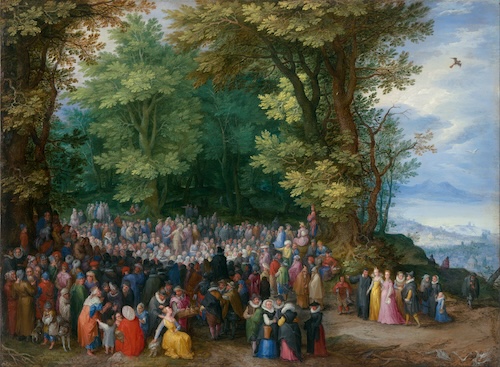

Jan Brueghel the Elder’s Sermon on the Mount (circa 1598)

More Than a One-Time Sermon

The Sermon on the Mount is found primarily in the gospel of Matthew, chapters 5–7, with a shorter but related version appearing in Luke 6. Only Matthew and Luke record such a sermon in this form. 

Many of us have been influenced by Hollywood portrayals of the Sermon on the Mount. The popular television series The Chosen depicts it as a singular, dramatic event, and it may well have been exactly that.

But there is something important to consider.

The themes and teachings found in the Sermon on the Mount appear throughout the Gospels. We encounter them in various settings, conversations, and moments in Jesus’ ministry.

That should not surprise us.

Most effective communicators return repeatedly to their central message. Good teachers often have a handful of foundational themes that they express in different ways over the years. Jesus appears to have done the same thing.

The Sermon on the Mount may be the most concentrated collection of Jesus’ teaching, but it is not an isolated collection of ideas. Rather, it provides a window into the message he proclaimed throughout his public ministry.

As we move through this series, we’ll focus on Matthew’s version of the Sermon. 


Reading the Sermon Through Kingdom Eyes

One more thing is worth mentioning as we begin: Our recent conversations about the kingdom of God must travel with us into this series.

One of the challenges of reading the Sermon on the Mount is that we can mistake it for a collection of moral instructions. We hear “love your enemies,” “do not judge,” or “turn the other cheek,” and immediately begin asking, How do I do that?  

But before asking how, we should ask why.

Jesus did not begin his ministry by announcing a new ethical system. He announced that the kingdom of God had drawn near.

The Sermon on the Mount is rooted in that announcement. It describes what life looks like when God’s reign is welcomed and reveals the character of people learning to live under the loving rule of the King.  The Sermon on the Mount is not primarily about what people should do. It is about the kind of people God’s kingdom is forming.

If the kingdom is the message, the Sermon is one of the clearest pictures of kingdom life. 


An Invitation

As we begin this journey together, my hope is not simply that we will study a famous sermon.

My hope is that we will encounter Jesus.

We’ll wrestle with his words. We’ll allow them to challenge us. We’ll let them expose assumptions we didn’t know we had. And perhaps, along the way, we’ll discover that the Sermon on the Mount is not merely something to be admired.

It is an invitation into the life of the kingdom.

So, before we climb the mountain, let’s remember whose voice we are about to hear.
Jesus’ Manifesto


The Word Makes Us Nervous

The word manifesto makes some Christians nervous.  It sounds political. Ideological. Revolutionary. Maybe even dangerous.

For many, the word conjures images of angry movements, cultural upheaval, or ideological extremism. In our modern moment, “manifesto” often feels politically charged before we even define it. Some immediately associate the term with revolutionary movements on the far left or far right, with propaganda, coercion, or attempts to seize cultural power.

And to be fair, history has certainly produced destructive manifestos. Some have fueled oppression, violence, nationalism, or utopian visions untethered from humility and love. So, the hesitation is understandable.

When we view a manifesto in a category that belongs exclusively to political radicals and cultural revolutionaries, rather than recognizing it more broadly as a public declaration of vision, convictions, and way of life, we have flattened the value of the term.  It then becomes difficult to recognize that Jesus Himself spoke in ways that were deeply public, deeply disruptive, and deeply challenging to the social and religious assumptions of His day – manifesto-like.

I recently read about a pastor preaching a message focused on The Sermon on the Mount. Afterward, one of the church leaders confronted him about his “woke ideologies.” The pastor responded that he had simply been repeating the words of Jesus. The man replied, “Not my Jesus.”

Whether the story is apocryphal or not, it captures something revealing about our moment. We have become so discipled by modern political categories that the teachings of Jesus can sound foreign – even threatening – when heard without the filters we normally place on them.


A Domesticated Jesus?

Perhaps part of our discomfort is that we have grown accustomed to thinking of Jesus primarily in private and personal terms – as though His teachings were mainly about individual spirituality or moral inspiration rather than the announcement of an entirely different kind of kingdom and humanity.  In a sense, we have domesticated Jesus.

When Jesus ascended a hillside in Galilee, sat down with His disciples, and began speaking about blessing, enemies, lust, anger, money, anxiety, prayer, power, integrity, retaliation, and the kingdom of God, He was not offering detached religious reflections for private inspiration. He was announcing an entirely different way of being human under the reign of God.

In many ways, the Sermon on the Mount reads like a manifesto.


What Manifestos Actually Do

A manifesto is a public declaration of vision, values, convictions, and way of life. It names what is wrong with the present order and calls people into an alternative reality. Manifestos challenge assumptions. They form identity. They summon allegiance. They announce that another way is possible.

The Declaration of Independence functioned as a manifesto. It publicly declared that the existing relationship with the British crown was no longer acceptable, articulated foundational convictions about human dignity and governance, and called for an entirely new national identity to emerge.

Martin Luther’s Ninety-five Theses served as a manifesto for reform within the Church. What began as an academic dispute became a public challenge to corruption, spiritual abuse, and distorted theology. Luther was not merely complaining; he was calling people back to a different understanding of the gospel and authority.

Likewise, The Rule of Saint Benedict functioned as a manifesto for an alternative kind of community. Benedict laid out rhythms, values, practices, and shared commitments that shaped how people would live together under the lordship of Christ. It was not simply theoretical theology. It was an embodied vision.


The Manifesto of the Kingdom

Manifestos do not merely describe ideas. They seek to form people.  And that is precisely what Jesus seemed to be doing in the Sermon on the Mount.

We can easily reduce the Sermon on the Mount to one of three things:

  • impossible moral standards meant to make us feel our need for grace,
  • inspirational sayings suitable for coffee mugs and wall art,
  • or ethical suggestions for especially serious Christians.

But Jesus presented the Sermon as none of those things.  This was the manifesto of the kingdom of God.  Jesus announced a new reality breaking into the world: “Repent, for the kingdom of heaven has come near.”  

God was indeed king.

And the Sermon on the Mount described what life looks like when people actually live under His reign.  This manifesto was radically counter-cultural then, and it remains radically counter-cultural now…

  • Blessed are the poor in spirit. 
  • Love your enemies. 
  • Pray for those who persecute you. 
  • Reject performative religion. 
  • Tell the truth without manipulation. 
  • Refuse vengeance. 
  • Seek first the kingdom. 
  • Do not store up treasures on earth. 
  • Do unto others as you would have them do unto you.

None of these fits neatly into modern ideological categories.

Jesus confronted both religious nationalism and moral compromise. He challenged hypocrisy and self-righteousness. He critiqued greed, status-seeking, lust for power, anxiety-driven accumulation, and hatred toward enemies. He called people into a life marked by humility, mercy, purity, courage, integrity, generosity, reconciliation, and radical trust in the Father.

That is not Republican.
That is not Democrat.
That is kingdom.

And perhaps that is why the Sermon still unsettles us.


More Than Private Spirituality

We have become remarkably skilled at admiring Jesus while explaining away the direct implications of His teachings. We sentimentalize the Sermon on the Mount because actually obeying it would require a profound reordering of our lives, priorities, politics, relationships, economics, ambitions, and identities.

Jesus was not merely offering spiritual guidance for getting into heaven someday.  He was forming a people who would embody the life of heaven here and now – “On earth as in heaven.”

A manifesto.

Not enforced through coercion or violence.
Not advanced through domination.
But through surrendered hearts shaped by the reign of God.

In the coming posts, we will spend some time walking through the Sermon on the Mount as Jesus’ kingdom manifesto – not as abstract ideals, but as the invitation into an entirely different way of living in the world.