
“You have heard it said, an eye in recompense for an eye and a tooth in recompense for a tooth. And I say to you, do not resist in kind an evil person, but whoever slaps you on your right cheek, turn the other to him also. If anyone wants to sue you and take your shirt, let him have your coat also. Whoever forces you to go one mile, go with him too. To the one who asks of you, give. And the one who wants to borrow from you, don’t turn away.” (Matthew 5:38–42, BibleProject translation)
“An eye for an eye.”
“Turn the other cheek.”
One sounds like permission to retaliate. The other sounds like an invitation to become a doormat. But what did they mean to those who first heard them?
What if we’ve misunderstood both?
In his fifth “You have heard it said … but I say to you” teaching, Jesus returned to the Torah’s instructions about justice and retaliation. What followed was another glimpse of the surprise of the kingdom.
An Eye for an Eye Was Actually a Restraint
The phrase appears in Exodus 21, Leviticus 24, and Deuteronomy 19. It can sound like permission for vengeance: You hurt me; I hurt you back.
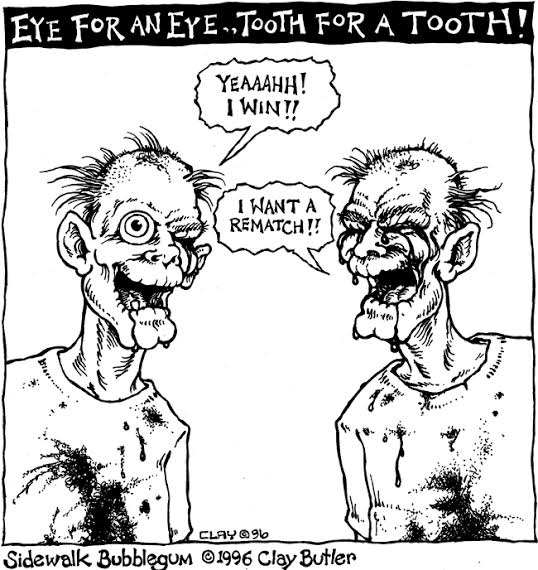
But that wasn’t its original purpose. In Israel’s legal life, “an eye for an eye” placed a limit on punishment. Justice was to be proportionate to the offense. A tooth for a tooth – not an entire family feud over one tooth.
The law restrained retaliation. It didn’t authorize an unlimited cycle of getting even.
But even when punishment is fair, we may still want the last word. We want the other person to feel what we felt.
Jesus offered another way.
Don’t Respond in Kind
Jesus’ words are often translated as, “Do not resist an evil person.” That can sound like a command to do nothing.
The Greek verb antistēnai means to oppose or stand against. The BibleProject renders the instruction, “Do not resist in kind an evil person.” “In kind” is an interpretive clarification, but it helps us hear his examples.
Jesus wasn’t asking his followers to ignore injustice or remain in abusive situations. They could set boundaries, seek protection, and hold people accountable. What he challenged was the impulse to answer harm with more harm.
We don’t have to choose between getting even and doing nothing.
Then came three illustrations. Each was surprising in its own way.
Three Unexpected Responses
The cheek: dignity in the face of humiliation.
Jesus spoke of being slapped on the right cheek. A right-handed blow to that cheek may have been a backhanded slap – a particularly humiliating insult.
Turning the other cheek was neither retaliation nor surrender. It was an unexpected response that challenged the humiliation – and invited the aggressor to recognize the person standing before him as an equal.
The garment: generosity that exposes greed.
Next, Jesus pictured someone suing another person for a shirt, or inner garment. Jesus suggested offering the outer garment too.
That outer cloak was no small thing. For someone poor, it could double as a blanket. The Torah even required a lender who took such a garment as security to return it by nightfall (Exodus 22:26–27).
Imagine grasping for someone’s possessions and being offered even more. Such a response could expose the demand’s harshness without answering greed with greed.
The second mile: choosing how to respond.
Under Roman occupation, soldiers could compel local people to carry their loads. Matthew later used the same Greek verb when Simon of Cyrene was forced to carry Jesus’ cross (Matt. 27:32).
The first mile was demanded. The second was offered.
And it wasn’t a trivial offer. If you had to return to your starting point to get your own stuff, two miles out meant two miles back. A one-mile demand could become a four-mile interruption.
In each scene, the wronged person did something unexpected. They didn’t retaliate or surrender their freedom to respond.
That is part of the surprise of the kingdom.
More Than a Clever Strategy
Jesus added a fourth instruction: Give to the one who asks, and don’t turn away the one who wants to borrow.
Here there’s no aggressor, simply someone in need.
Jesus wasn’t offering clever ways to unsettle bullies. He was describing a generous way of life – a life no longer governed by the need to protect every advantage or insist on getting everything we’re owed.
Breaking the Cycle
Retaliation has a way of making the other person’s behavior our script. They insult us, so we insult them. They mock us, so we mock them. They treat us with contempt, so we return the favor.
Martin Luther King Jr. understood this danger. In Where Do We Go from Here?, he described violence as a “descending spiral” that multiplies the very evil it seeks to defeat.
Doesn’t that describe much of our partisan political culture?
We increasingly justify our contempt by pointing to the other side’s contempt. We excuse cruelty because our opponents are worse. We become so preoccupied with defeating them that we stop asking what our own words and actions are doing to us.
And Christians are hardly immune. We can be careful to defend orthodox beliefs about Jesus while excusing the contempt, deception, or cruelty of a political ally. When loyalty to a political camp determines which behaviors we excuse, politics has begun shaping our discipleship rather than Jesus shaping our politics.
This doesn’t mean convictions don’t matter or that we should avoid hard disagreements. The question is whether we can confront what is wrong without adopting the methods we condemn.
Paul put it succinctly in Romans 12:21: “Do not be overcome by evil, but overcome evil with good.”
The goal isn’t merely to defeat the person who wronged us. It’s to confront the wrong without destroying the possibility of something better.
Who Gets to Decide How I Respond?
So was Jesus teaching his followers to become doormats? Hardly. He was challenging them to live as people whose responses were shaped by God’s kingdom rather than by the behavior of those who opposed them.
That doesn’t guarantee the other person will change. The slapper may slap again. The soldier may never give it another thought.
But the follower of Jesus can still choose not to keep the cycle going.
Someone else’s behavior doesn’t have to determine who we become.
And Jesus wasn’t finished. His next words would carry the surprise of the kingdom even further: “Love your enemies.”

