Long Live the King!

“Long live the King!” is a phrase rich with historical significance, symbolizing loyalty, continuity, and the enduring nature of monarchy. Its roots appear to trace back to 15th-century France in the declaration “Le roi est mort, vive le roi!”. “The King is dead, long live the King!” is a proclamation that marked both the death of a reigning monarch and the immediate succession of the next. Over time, the phrase found its place in English tradition and thus, “Long live the Queen!” The king (or queen) was kinda a big deal, I guess.

Recent blog posts have responded to the elusive and lingering question, “What is the Kingdom of God that was central to Jesus’ gospel message?” Why is it so hard for us to wrap our heads around and understand? We have slowly been working through scripture in an attempt to get a 30,000-foot view of God’s activity related to his kingdom and his subjects, starting with Almost Getting It back in November 2024.

Over the past months, I have had many conversations with people who, like me, have come to the realization that Jesus’ primary message was indeed about the Kingdom of God, but with the lingering question of what the kingdom actually is. As mentioned previously, I’ve been wrestling with the question for several decades. Part of this blog journey is my own attempts to articulate what the kingdom is (and what it is not, by the way).

For the last couple of months, I’ve begun to wonder if we have been asking the wrong question. We want to know what the kingdom itself is. I don’t know if it’s a Western thing or a human thing, but I suspect tunnel vision results in asking wrong questions. As I ponder Jesus’ interactions with his disciples, it seems like that was an issue for them, too – asking the wrong questions. So ponder this…

Are we more captivated by the characteristics of the kingdom than by the character of the One who reigns?

We want to know stuff about the kingdom – what it is, where it is, its relation to heaven (or vice versa), etc. We are interested in the characteristics of the kingdom. A place. What if we were to focus our attention on the character of the King himself? It’s this very wonderment that led me to create The Parable of the Benevolent King. I was attempting to describe a kingdom that reflected the character of the king. In the process, the characteristics of the kingdom became evident.

I suspect that when the Israelites met Yahweh at Mount Sinai, they were discovering the character of the God who rescued them from oppression and slavery. In the theophany, they discovered his holy presence on the mountain. The gods they knew about in Egypt were tied to time and place and a bit inept.

Try to imagine what they experienced…

16 On the morning of the third day there was thunder and lightning, with a thick cloud over the mountain, and a very loud trumpet blast. Everyone in the camp trembled. 17 Then Moses led the people out of the camp to meet with God, and they stood at the foot of the mountain. 18 Mount Sinai was covered with smoke, because the Lord descended on it in fire. The smoke billowed up from it like smoke from a furnace, and the whole mountain[a] trembled violently. 19 As the sound of the trumpet grew louder and louder, Moses spoke and the voice of God answered him. (Exodus 19:16-19)

This awesome experience was followed by Him delivering a set of commandments given for the people, His subjects. Starting with the Ten, we usually view these commands as precepts on how the people were to live in the presence of a holy God. There is certainly something to that. But what if we also looked at the commands as a revelation of God’s character to a people who knew nothing of his character? Think about it. As we watch world leaders issue “commands,” don’t their directives tend to reveal their character?

Through the Ten Commandments, the people discovered that Yahweh is the only true God, not tied to time and space (Exodus 20). This God did not require images because He created them as his image bearers, as we discussed in an earlier post.

But God didn’t stop with the Ten Commandments. He instituted an additional set of commands (see Exodus 20-23). Like the bottom of the order of the first Ten, these additional couple of dozen commands are mostly related to how his image-bearers were to relate to each other. We might call them social justice laws. They talk about how servants were to be treated, about fair trade, about the treatment of widows and orphans, about how foreigners were to be treated, about justice and mercy, etc. In fact, the NIV translation’s heading for a section of these additional commands is “Laws of Justice and Mercy.”

Can you see how the commands reveal the character of the King?

So again I wonder, is our attention drawn to the discovery of the characteristics of the kingdom rather than the character of the King? Maybe Dallas Willard had that figured out when he said…

Jesus put a face on the Kingdom of God*


* Willard, D. (2024). The scandal of the kingdom : how the parables of Jesus revolutionize life with God. Zondervan Books.

Almost Getting It…

Our small group had a “kingdom of God” discussion a while back. We were talking about the common confusion between kingdom and heaven. Someone in the group said, “I understand that heaven and the kingdom of God are not the same, but I’m not sure I could explain why.” We all agreed that the kingdom of God and its “at-handedness” was Jesus’ core message. We understood that Jesus ushered in the kingdom, but describing what that meant was another issue.

With three to four decades spent seeking to understand God’s kingdom as it relates to present-day life—especially given the longstanding emphasis on heaven—I felt somewhat equipped to add depth to our conversation. I felt like I was starting to get it. Then, the question that sent me back to the drawing board: “If Jesus was ushering in the kingdom, where was it before?”

Drats! Just when I was almost getting it!

The question drove me back from whence I had spent years noodling. It required me to step back and wonder what I was missing or not seeing. So I noodled some more—for several weeks. Then something clicked, and I started to “get it” (which is a bit scary to say, knowing that the next good question might send me back to the drawing board again).

While listening to the New Testament scholar and Israel historian Gary Burge on a Holy Post podcast, something resonated. Something clicked. I jumped on my computer and pounded out a bulleted outline I dubbed Kingdom of God: A Synopsis, a working document. Yes, a “working document.” I keep numerous working documents on my computer as I explore, revisit, and refine my theological perspectives. Keep in mind the definition of theology that informs this blog…

Theology is the attempt to understand God and what he is up to.

By this definition, capturing one’s theological perspectives on paper must be a working document because we are in constant discovery and learning mode. Our theology is a work in progress. God is consistently honing our perspectives.

I’ve often shared that this blog is my space to process and document the journey of discovery that God is leading me on. Writing out concepts that are starting to make sense for me sharpens my critical and creative thinking skills. This experience is transformative for me, and I hope it can be beneficial for readers, too.

For several years, I have thought about embarking on an explanation of what I’ve been discovering about this kingdom of God that Jesus said was at hand, that was good news–the gospel. I have made several attempts, each time coming up empty. I find it challenging to put into words my journey of exploring what Jesus truly meant when he spoke of the Kingdom and its essence. Have you ever noticed that when Jesus talked about the nearness of the Kingdom, his followers never asked, “What kingdom?” That has tripped me up for a long time.

I am going to give it another try. I’m going to begin a series of posts exploring my present understanding of the kingdom of God, utilizing thoughts from my working document. Please understand that I will be fleshing out what presently makes sense to me, but it’s the tip of the iceberg. As time passes, I’m sure I will need to tweak and refine some of my thoughts. First, a bit about the journey that got me to this point (which I have talked about in chunks throughout the blog, but let me pull it all together).

About 40 years ago, after a decade of gospel immersion, it became blatantly obvious that Jesus’ core message was the kingdom of God – its arrival, nearness, and nature. However, most teachings and sermons I heard did nothing to help me/us understand why that was Jesus’ focus. I/we were led to believe that Jesus’ main message was about getting people saved and to heaven, which he rarely addressed.

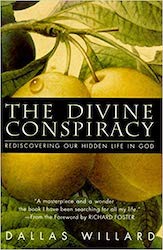
Enter Dallas Willard’s 1998 book The Divine Conspiracy: Rediscovering Our Hidden Life In God. He started with the story of a young fighter pilot who, in the early 1990s, was taking her jet through maneuvers, got disoriented, attempted a steep climb, and drove it into the ground. She had been flying upside down, unbeknownst. Willard posited that in our misunderstanding of God, his kingdom, and Jesus’ message, we have been flying upside down for so long that we don’t know what right-side up is. I know I didn’t.

As I continued working through The Divine Conspiracy and the gospels, I listened to hours of NT Wright lectures as he developed his own kingdom theology, which culminated in his 2008 book, Surprised by Hope: Rethinking Heaven, the Resurrection, and the Mission of the Church. Wright caused me to rethink almost everything! In tackling the question of life after death, Wright demonstrated that most Christians have it wrong. Rather than leaving for heaven, we are resurrected here, with heaven descending to earth—a distinction that makes all of the difference to how we live here today. A game-changer!

With this brief background, I will next start to plow through my “working document.” It will be interesting to see where this takes us. As we embark on this adventure, let’s keep asking God the hard questions like “Where was the kingdom before?” God loves good questions. And who knows, maybe more of us will be able to say…

“I’m almost getting it!”

Best Prof Ever…

As you may know, I took the looong route to obtaining my bachelor’s degree in Structural Engineering. I call it “The Nine-Year” plan. I started my higher ed journey quite traditionally, attending a reputable engineering school. But after the first quarter of my junior year, I dropped out, precipitated by various circumstances related to finances, lack of a sense of purpose, the Vietnam War, etc. I took a position with a local company with whom I had been employed in the engineering department (drafting) since my junior year of high school.

Within a few months of leaving school, I continued my pursuit of a degree in engineering. I commuted an hour after work to the University of Minnesota, taking many degree-fulfilling courses available through the extension program. Unfortunately, some of the required courses were unavailable through the extension program.

So, to complete the final 30 credits toward a degree, I took a two-quarter leave of absence. One of the required courses unavailable via the extension program was engineering physics. Physics proved to be a larger challenge than I had anticipated. I was several years removed from using calculus and the metric system. The pace was break-neck with a rhythm of 1-2 chapters/topics per week and an exam every two weeks. I knew the key to surviving and thriving in college-level math and engineering classes was to work problems – as many as possible, especially via a study group. Amazingly, I knew a couple guys in the class of 150 and we formed such a group.

My physics professor proved to be one of the best professors I ever had. I don’t remember his name, but I surely remember him. He knew his physics, but more importantly, he knew his audience. I remember him dedicating class the day before an exam to address questions we had. We were free to ask about the practice problems from the book that stumped us (“we,” of course, meaning all 150 of us).

He was brilliant in his approach. He would merely set up a problem, then casually remark, “You will be able to take it from here.” His approach allowed him to address 15-20 different problems – exactly what we needed. We didn’t need him to work a problem out to completion. We only needed him to get us started, sketch out the problem, and point us in the right direction. He set us up to “get it.” He didn’t do the work for us – he merely pointed us in the right direction.

How good of a professor was he? He made dreaded physics enjoyable. I learned! I started to “get it.” My presuppositions of engineering physics faded. He set me up to get an “A” in the class, a grade that didn’t come easy for me in college.

Two of my favorite authors, Dallas Willard and Howard Hendricks, both reminded readers that Jesus is the smartest person in the universe and that we would do well to learn from him. He was the best prof (rabbi) ever. He knew his material (the Hebrew Scriptures) and his audience (his apprentices, the religious leaders, and the general populous). He also stayed true to his purpose as a teacher—the proclamation and explanation of the nature of the kingdom of God which had arrived with his appearance.

The kingdom of God is an elusive concept lost on most of us for various reasons. Two-thirds of Jesus’ parables and most of his main discourses (i.e., the Sermon on the Mount) focused on the good news (gospel) of the kingdom’s arrival. Unfortunately, the kingdom of God has become equated to simply “heaven,” a place we go after we die. Such reduction of the gospel does injustice to the kingdom Jesus ushered in. Reading scripture through this narrow lens hinders our ability to fully grasp the true nature of God’s kingdom.

The same was true for the first-century adherents of Judaism. The people were familiar with a coming kingdom but didn’t fully grasp its true nature. They were aware, through less than stellar professors (the religious leaders), that God’s kingdom would arrive someday, but it would arrive in power and glory, overthrowing the pagan kingdoms. The kingdom of God had been reduced to a form of nationalism. Jesus’ teaching aimed to dismantle and challenge their false presuppositions.

For 30-40 years, I found it challenging to reconcile Jesus’ central message about the arrival of God’s kingdom with the teaching I often heard, which emphasized getting to heaven. Closely following the means to heaven attainment were sets of ethics to follow until we finally get to depart this earth. There was no kingdom. There was no explanation of the kingdom’s nature. Most of Jesus’ kingdom teaching was reduced to moralism—behavior modification. There was no transformation. There was no life.

In his recent posthumously written book, The Scandal of the Kingdom, Dallas Willard offers a conceptual understanding of a kingdom…

A kingdom is a society of people with a structure in which there is one person, a king or queen, to whom all the citizens offer loyalty, service and respect.  The sovereign’s part of this relationship is to provide care, protection, and service for the good of the people.

The Hebrew Scriptures contain the story of God and his people, warts and all. Threaded through the narrative are stories that point people to an understanding of a King who provided care, protection, and service for the good of the people (think righteousness, justice, love, and faithfulness—see It’s Foundational). We know this story—the people struggled to embrace God as their king.

The foundational story was highjacked in favor of sets of ethical rules to ensure correct behavior. The professors became moral guardians. No transformation and certainly not life-giving. Jesus’ task was to wrestle the false concept of God’s kingdom away from the highjackers and help the people understand the nature of what was really at hand. Wrestle away? It appears Jesus suggested that’s exactly what he needed to do…

From the days of John the Baptist until now, the kingdom of [God] has been subjected to violence, and violent people have been raiding it. (Matthew 11:12, NIV)

How was Jesus a stellar professor? He brought people back to the story of God and his people. He pointed people to the intent and nature of the Torah, not just the letter of the law, as the highjackers had done. He pointed people to an understanding of a kingdom where the King offered a covenant loyalty and asked the people to respond accordingly.

His stories and discourses wrestled a moralistic and ethical kingdom concept from the moral guardians and gave the people a different kingdom concept. He didn’t provide people with exacting instructions on how to live. Instead, he told stories of what life in the kingdom could look like and invited hearers to become subjects. He told stories that reversed the moralistic view of the kingdom and pointed to a different “ethic.” Oh, and his stories indicated that the kingdom was for anyone and everyone. All were invited.

Like my physics professor, Jesus didn’t work out all the details. He told stories that described the nature of God’s kingdom. He sketched out the concept of the presence of God’s kingdom and let them “take it from there.” And many “got it”—those who had ears to hear. He simply pointed people in the right direction and then said…

“Follow me.”

Five Years!

As I write this it is February 21, 2024. Five years ago today I published the first blog post on this site. Five years! Sometimes five years seems like a long time. Other times it flies by almost unnoticed. For me, this has been one of those “I can’t believe it’s been five years already” type of thing. It’s been a good five years!

Twenty years ago I had created a blog to stay connected with young people I knew through church youth ministry or Young Life. Over time the audience grew to a diverse mix of people – younger and older. The original blog came to a grinding halt as coursework ramped up for the doctorate in education program in which I participated. After a hiatus of several years, I re-entered the world of blogging five years ago.*

I found that I deeply missed the opportunity to write and ponder. Originally I was writing and publishing blog posts to benefit others. However, I soon discovered that I was the main beneficiary, allowing others to “look over my shoulder” as I tried to make sense of and describe my theological thoughts and wonderments. Blogging has become a healthy way for me to process what I was discovering as a Christ-follower.  So I continue.

Practical theology? What do I mean by that? Actually, I was figuring this out as I wandered into this process five years ago. And I’m still figuring it out, which I think is a good thing, actually. I have always described myself as a practical theologian, using the term theologian loosely. In my thinking, a theology that doesn’t play out in one’s everyday life is impractical, or of no real use. A “practical” definition of theology is the attempt to understand God, what he is up to, and then join him in his work.

This blog has focused on just that – how we join God in his work, both globally and in that part of the world where he has landed us. We do that by focusing on Jesus Christ, the incarnate God that became flesh and blood, and moved into the neighborhood (John 1:14, MSG). While focusing on Jesus, we attempt to discover the “Jesus of scripture” over and against the “Jesus” of American/Western Christian culture.

We also focus on Jesus so that we can learn “the Jesus way,” a term coined by Eugene Peterson. Focussing on Jesus to learn his way is what a Christ-follower does. It’s integral to being a disciple, an apprentice – we spend copious amounts of time with him. Why? So we can learn from him, become like him, and join him in his work. John Mark Comer simplifies “join him in his work” as “Do as he did.”** I’ve always appreciated Dallas Willard’s description: “Do as he did/would do if he were you.” Quite practical!

I wonder what the next five years will bring?

* I am grateful to my friend Björk Ostrom for his encouragement five years ago to start blogging again and for his tutorials in WordPress. Björk is a master in WordPress. This is an example of his work: https://pinchofyum.com/

** Comer, J. M. (2024). Practicing the way : be with jesus, become like him, do as he did (First). WaterBrook. 

What Might it Take?

If you have never read the book of Nehemiah in the Old Testament, you should. If you have read it, you might want to read it again, because it is a most amazing story. The books of Ezra and Nehemiah are paired together, following the historical books of Kings and Chronicles.  In the Hebrew Bible, Ezra and Nehemiah are one book entitled Ezra-Nehemiah, but the Christian canon separates them into two different books.

In the fifth century B.C., the Israelites continued to emerge from their exile in the Persian Empire. They were invaded and conquered by the Babylonians in 586 B.C., with Jerusalem and its temple destroyed in the process. God’s chosen people found themselves scattered throughout the Babylonian Empire and eventually witnessed Babylonian’s own fall to Persia.

With the Persian overthrow of Babylon, the Israelites found themselves living under a regime that was more accepting of God’s people and willing to let them return home to rebuild their nation. God raised up a series of leaders to take charge of that homegoing. Two of these were Ezra, the priest, and Nehemiah who became the governor of Judah. 

The Book of Nehemiah is basically a memoir, written by Nehemiah himself and preserved and edited by later Jewish scribes. His story picks up around 445 B.C. when he was the cup-bearer and presumably trusted advisor to the Persian king, Artaxerxes I. Though the entire memoir of Nehemiah is a worthy read, I want to focus our attention on the beginning of the story…

In the month of Kislev (Autumn), Nehemiah learned that his countrymen were in trouble and that Jerusalem’s walls and gates were still in ruins. Nehemiah’s response? In his words:

As soon as I heard these words I sat down and wept and mourned for days, and I continued fasting and praying before the God of heaven. (Nehemiah 1:4, ESV)

His prayer, captured in verses 5-11, reads like any number of Psalms. Starting by appealing to God’s covenant loyalty (see Hesed and Emet), Nehemiah called on him to “let your ear be attentive and your eyes open, to hear the prayer of your servant that I now pray before you day and night for the people of Israel your servants” (verse 6). Continuing in a typical psalmist motif, he confesses the sins of the Israelites, employing the inclusive “we.” He closed his prayer with a specific request that, as the cup-bearer, God would grant him favor with the king.

In Chapter 2, the story picks up in the month of Nisan (March-Aprilish), 4-5 months after Nehemiah received and prayed about Jerusalem’s condition. God granted Nehemiah favor with the king, possibly surpassing his own hopes. (I think of the Apostle Paul’s prayer “to him who is able to do immeasurably more than all we ask or imagine…” [Ephesians 3:20]). The story in a nutshell…

The king noticed Nehemiah’s melancholy countenance and asked what was troubling him. In fear, he shared with the king his lamentation over the fact that Jerusalem lay in rubble. The king asked, “What are you requesting?” Nehemiah’s response to this most favorable question:

So I prayed to the God of heaven.  And I said to the king, “If it pleases the king, and if your servant has found favor in your sight, that you send me to Judah, to the city of my fathers’ graves, that I may rebuild it. (Nehemiah 2:4-5, ESV)

Nehemiah then proceeded to lay out a time frame as well as a plan to rebuild the city, starting with the walls and gates. He audaciously asked Artaxerxes that the provincial governors ensure his safe travel. He also asked for kingdom resources, like timbers for beams to rebuild the gates. The king granted Nehemiah’s requests and topped it off with an army escort back to Jerusalem.

So I prayed…and I said

This is where I want to park for a bit. I have heard many a sermon suggest that Nehemiah prayed and God, in that moment, gave him the exact words to say along with the plans. There is certainly something to that, but I fear it’s too simplistic and doesn’t do justice to the God/human relationship we see throughout the biblical narrative.

Consider this: Nehemiah had 4+ months to ponder the situation back in Jerusalem. I can imagine him repeatedly asking the question, “What might it take?” as he pondered his God-inspired vision to repair the walls and reinvigorate the city. I think Dallas Willard’s description of prayer (“Talking with God about what we are doing together”) is apropos. Though rhetorical in nature, “What might it take?” could have been the ongoing prayer as Nehemiah talked with God about his vision.

I suspect Nehemiah’s response to the king’s question “What are you requesting?” was a natural outcome of months of pondering, talking with God, and asking “What might it take?”

I actually experience something similar 25 years ago. We had moved to a community with the task of reviving its 30-year-old Young Life ministry that was in disarray (rubble?) – to the point that major stakeholders questioned its continued viability. Six weeks into my tenure, I visited the monthly meeting of the community’s youth ministers. After introductions, I was asked to tell a bit of my story – my youth ministry background, what led to my taking the Young Life position, etc.

One of the youth ministers asked a question I did not anticipate: “How might we, as youth ministers, help Young Life get back on track in our community?” I suddenly realized how Nehemiah might have felt! So I prayed and I said, “Send your best kids to Young Life – those who need to be in mission; those who need a neutral place to invite their friends. Young Life can be that place for them.”

I had pondered for years (talking with God!) about how I might work alongside a ministry like Young Life, should I ever join a church staff as the youth minister. I didn’t know exactly what it might look like, but I did know that I would want to make sure my best kids were aware that such a great neutral option was available to them, so they could minister to friends.

And the result? The initial responses were looks of surprise, maybe even shock. But two of the ten youth ministers took me up on the offer. We saw weekly attendance immediately increase from a few to about 100, continuing for the duration of my tenure. I suspect the impact of the question has had a far-reaching impact – far more than the asker dreamed or imagined.

Dovetails

Early into my woodworking experience of using hand tools, I was intrigued by the thought of cutting dovetail joints by hand. I had always loved the look of the dovetail joint but had never made any. There are jigs and templates to cut them with a router, but that seemed cumbersome and didn’t interest me. The first time I watched someone cut dovetails by hand, I was hooked. I wanted to learn.

So, to YouTube I went, looking for instructions on how to cut and fit perfect dovetails. I discovered that everyone had a different approach to cutting them, some with slight variations, some with significant variations (i.e. cutting the tails first versus the pins first). Interestingly, some see the tail/pin preference worthy of controversy, while the practical woodworker admits it’s a personal preference.

The Dovetail Joint

One of my go-to woodworking teachers for laying out and cutting dovetails is Chris Schwarz. He suggested learning by doing – cutting a dovetail a day for about 30 days. So that’s what I embarked on doing. I had the basic tools – a dovetail saw, a coping saw, and a set of chisels. Using pine 1x6s, I started in. Day 1 was indeed practice – cutting the dovetails felt awkward. I cut on the wrong side of the lines so it didn’t fit. On day 2 I concentrated on cutting on the correct side of the line, but overcompensated, so the fit was sloppy. The iterative process continued day after day with minimal improvement, so I discontinued the practice after a couple of weeks.

I then got the idea of making 19th-century replica school boxes for each of my four kids for Christmas. The design of the boxes required dovetail joints – lots of them! What better way to learn than to jump in…

As you can see, the boxes had a lot of dovetails – 24 each, so 96 total. I was wise enough to cut the dovetails on the backside first, knowing they would be far from perfect, hoping that by the time I got to the front they would look better (which turned out to be a good plan). Marking the dovetails was pretty straightforward. Sawing them, not so much.

As I took my dovetail saw in hand, sawing still felt awkward, and continued to feel awkward for a time. Then about halfway through the cutting of the 96 dovetails, something happened. I realized that I had become comfortable with the saw in my hand. It didn’t seem to be something that extended out from my hand anymore. Rather, it seemed to feel more like an extension of my hand! It’s hard to explain what happened, but sawing became more effortless, almost second nature.

Over the years, it’s been fun watching our children and now grandchildren develop various skills as baseball players, BMX racers, swimmers, gymnasts, and musicians. In those early days of learning and development, they looked and sounded awkward. Things were much different after a few years of practice. The baseball glove appeared to be an extension of the hand, “touch-typing” the keyboard or guitar fret became the norm, awkward cartwheels became natural-looking round-offs, BMX track berms negotiated at top speed, etc. With practice, what was once awkward for them to do (and watch 🙂) became second nature.

N.T. Wright, in his book After You Believe: Why Christian Character Matters, talks about “second nature” as it applies to Christian virtue (character). With time and practice, disciplines like reading scripture (especially the Gospels 🙂), praying (Dallas Willard: Talking with God about what we are doing together), loving our neighbor, etc. become second nature. We don’t have to think about them. They become part of the rhythms of our life.

Time and practice and rhythms

N.T. Wright: “Character is transformed by three things. First, you have to aim at the right goal. Second, you have to figure out the steps you need to take to get to that goal. Third, those steps have to become habitual, a matter of second nature.”1 Time and practice for which there is NO shortcut.

Here’s the very good news. With time and practice, some of the character-forming disciplines not only become second nature, but they also become rhythmic in nature. We can’t not practice them. I think of my grandsons walking through the house swinging “air bats.” They can’t help themselves, they can’t not do it!

N.T. Wright was once asked in an interview how important daily prayers and scripture reading were to him. He responded, “I don’t know how to answer that. It’s like asking how important breathing is to me.” Rhythm. It’s the stuff of life!

I think of Eugene Peterson’s rendition of Matthew 11: Get away with me and you’ll recover your life. I’ll show you how to take a real rest. Walk with me and work with me—watch how I do it. Learn the unforced rhythms of grace (Matthew 11:28-30, The Message).

Focused on the Master and with time and practice, we learn unforced rhythms. Who doesn’t want that?

1 Wright, N. T., After You Believe (p. 29). HarperCollins. Kindle Edition.

Talking to God about what we are doing together

I thrive when I have someone with whom I can process ideas. This has been true all my life – be it my wife, Barb, my kids, fellow co-ministers or co-workers. I have always been at my best when I have been able to process my thoughts and ideas with others. It’s when creativity comes to life for me.

I remember many times meeting various people for coffee to brainstorm solutions to an opportunity, talking over my ideas, and suddenly the solution presents itself in an obvious manner. After our time together, I would thank the person for their assistance in the matter, to which they often responded, “I’m not sure what I did to help. You seemed to figure it out by yourself.” I don’t think I’m the only one to have such experiences. It points to the brilliance and simplicity of Dallas Willard’s description of prayer from his book, The Divine Conspiracy

I have mentioned Willard’s description of prayer a couple times previous (Pondertude and Practical “Right Things”). I think it is so powerful and revolutionary that it deserves additional consideration. I started reading The Divine Conspiracy about 20 years ago, shortly after publication. It is a dense read, thus I would read a section, pondering for a time before continuing. After reading his treatment of prayer, however, I stopped reading the book altogether, not wanting to miss the significance. As a reminder, Willard described prayer as simply, “Talking to God about what we are doing together” (p. 243). In the book, he went on to say:

That immediately focuses the activity where we are [in our walk with God] but at the same time drives the egotism out of it. Requests will naturally be made in the course of this conversational walk. Prayer is a matter of explicitly sharing with God my concerns about what he too is concerned about in my life. And of course he is concerned about my concerns and, in particular, that my concerns should coincide with his. This is our walk together. Out of it I pray.

I think this is exactly what the Apostle Paul meant when he encouraged the Christians in Thessalonica to “pray without ceasing” (1 Thessalonians 5:17). I don’t think Paul made this up – it was certainly modeled by Moses, the writers of the Psalms, the prophets, AND Jesus (see Pondertude).

I suspect prayer is another area in our journey with Jesus that we have made far too difficult and awkward. Talking to God about what we are doing together seems so natural, so simple, and so straight-forward. And revolutionary. It revolutionized my prayer life. May it do so for you as well.

Pondertude

About 20 years ago, I was introduced to the Franciscan retreat center, Pacem in Terris. It was founded and developed to provide Christ-followers a place to retreat in silence and solitude. Located near the community which I served as a Young Life Area Director, I couldn’t wait to “try it out.” After my first experience, scheduling a couple 2-day retreats per year at Pacem in Terris became a staple of the last 20 years of my ministry.

I am a fan and a proponent of the concept of blocking out regular times for silence and solitude, times for pondering scripture and encountering God, times for discovering what he is up to in my life, ministry, and the world at large. Though not a guided silent retreat, we were directed by Pacem in Terris staff to arrive with only our Bible and journal, allowing God to speak directly into our life by encountering him in scripture.


A Typical Hermitage at Pacem in Terris

Something Jesus modeled (and I assume wanted his followers to emulate) was the practice of solitude. A couple well-known examples are found in the Gospel of Luke: Jesus went out to a mountainside to pray, and spent the night praying to God (Luke 6:12-13) and Jesus often withdrew to lonely places and prayed (Luke 5:16). When we read passages like this, we tend to agree with the concept, agree that we should do likewise, and THEN DON’T! Guilt sets in so we steer clear of similar passages.

Several years ago, while mentoring a Young Life staff trainee, he and I discovered that an expectation of a staff person was to schedule one day a month for solitude – a withdrawal from normal stuff to be with God. I gave the trainee the assignment of interviewing a couple senior staff persons to discover how they took advantage of their monthly day of solitude. He couldn’t find anyone who regularly scheduled times of solitude with God. Why was that? Jesus modeled it, then strongly suggested we follow suit (“In the same way the Father sent Me, I am now sending you”John 20:21). Why do we not do it? Over the years, I have discovered a variety of reasons we give for not emulating Jesus’ example:

  • We think we are too busy to take chunks of time for solitude and reflection. People in ministry are as bad at this as anyone, if not worse. I often wonder how much of this is connected to an exaggerated view of one’s importance.
  • Fear seems to be a powerful justification for not spending time alone with God. “What if I ‘hear’ him speak into my life and I don’t like it?” I have heard this more than once from people reasoning why they shy away from solitude.
  • Many people speak of not knowing what to do or how to spend time alone with God. This is the brilliance of Pacem in Terris’ suggestion – simply reading scripture and reflecting. The late Howard Hendricks suggested reading for a 20-30 minutes, then reflecting for 20-30 minutes. And if I fall asleep? Then I fall asleep reflecting on scripture and God. How can that be a bad thing?
  • A common justification of us “doers” for not engaging in solitude: “I can’t shut my brain off.” Then don’t. Let your brain loose to reflect and ponder the scripture you are engaged with.

This is where the late Dallas Willard’s description of prayer is helpful – talking to God about what we are doing together, pondering together what’s going on my life. Picture Jesus’ times with God as exactly that. Picture Jesus pondering, “I really like Peter, though I know he’s a hothead. I wonder if he is someone I should develop as a follower?” (Or, more likely, “Peter? Seriously, Father? One of the Twelve?”) I can picture Jesus pondering with God, looking for ways to help his followers understand the reversal of the kingdom he was inaugurating. Maybe it was through times of pondering and talking with God about what they were doing together that he landed on the idea of passing through Samaria instead of around it as they traveled from Jerusalem to Galilee (see John 4).

Out of my experiences of solitude and pondering, plus a desire to make the experience less mystical for others, I coined the term pondertude. It describes the reality of my times with God – alone with him (solitude), pondering what we are doing together. Pondering what we are doing together in all my roles in His kingdom – as a husband, a dad, a grandpa, an engineer, a supervisor, a ministry leader, a math tutor, etc. Though I love Pacem in Terris, pondertude is a frame of mind more than a place. It’s a choice to regularly be with the One who knows us better than we know ourselves, who has our best interests in mind. Why wouldn’t we want to block out times for pondertude?

Practical “Right Things”

After writing blog posts about “right things” (see Anything Worth Doing is Worth Doing Right and Doing Right Things), I was asked by a couple of people that I mentor what doing right things has looked like in my life over the years. Hmm…great question! I sat down one day a month ago and jotted down things that came to mind. What a great experience! I am going to list them below in bullet form without a lot of explanation and in the order they came to mind (which is roughly chronological, because we engineering types tend to think linearly)…

  • Spontaneous dates with my wife, Barb.
  • Shopppppping with Barb, as opposed to just shopping – i.e. it’s about the hunt, not the capture. (Thank you, Gary Smalley)
  • Regular times of Pondertude – usually at coffee shops, scheduled and unscheduled. (Pondertude is my term – a combination of pondering and solitude)
  • Continuous reading of the Gospels.*
  • “Stopping what I’m doing to play catch” – the point being, if my kids wanted time with me, I tried to postpone what I was doing if at all possible.
    • Similarly, let my kids “crawl on me while fixing the dishwasher” (and now, my grandkids!).
  • Camping with the kids. I often took each of our kids camping one-on-one for a 24-hour overnight – no agenda, no plans (we usually stopped at the grocery store on the way for the necessary supplies!).
  • Incorporating a mantra (Abba, I belong to you) into the rhythms of life. (Thank you Henri Nouwen, Brennan Manning, and others)
  • Create memories. (Thank you, Tom Scheuerman)
  • Go to our kids’ (and now, grand-kids’) stuff. (Again, thank you, Tom Scheuerman)
  • Just show up and be present. (Thank you, Young Life)
  • Lead from a servant’s perspective. (Thank you, Robert Greenleaf)
  • Focus on a few things. In a similar vein, do a few things well.
    • Likewise, focus on a few people – The “Jesus way” (He poured most of his effort into a few – Peter, James, John, Mary, Martha).
  • Keep learning. (Thank you, Dad)
  • Know Him and make Him known.
  • Be good news to those around me.
  • In more recent years (i.e, the last 15-20 years):
    • Learn gratitude
    • Learn the spiritual discipline of submission – I don’t need to be right, I don’t need to get my way. (Thank you, Richard Foster)
    • Pay attention to the other – People that are culturally different, the one that doesn’t look like me.
    • Talking to God about what we are doing together – the best description of prayer ever! (Thank you, Dallas Willard)
  • Everything’s a surprise – Allows for spontaneity and is theologically accurate.

I noticed a few things as I went through this experience. First, most of these items have a faith and family focus and are not outcome-based. However, as I pondered this, I recognized an integration of the practices into all aspects of life – faith, family, ministry, job, career, etc. And any outcomes were up to God (see the Seed Scattering post).

Secondly, please know that I have not practiced all these for the past 40 years. If someone had shown me a list like this 40 years ago, I would have thrown up my arms in surrender, knowing I couldn’t incorporate all these into my life. In reality, they showed up as needed and, I assume, as God deemed them necessary (here I think of Acts 15:28 – it seemed right to us and the Holy Spirit). Simple math tells me that one of these right things showed up every couple of years.

Finally, I discovered that over time, a number of these practices have become second nature, to borrow a term from NT Wright. I was watching the Twins game the other night, noticing the right things players did that had become second nature, things they didn’t need to consciously think about anymore. (One could argue that Rocco Baldelli’s success as a manager has been the encouragement of players to do the things that have become second nature for them.) Same thing when we practice doing right things (the operative word here is practice). To be clear, some of these practices are NOT second nature for me. They still take a lot of thought, intentionality, and practice on my part. Maybe, just maybe, 20 years from now a few more will have become second nature.

Note: I am fully aware that the explanations for these right things are brief. I can certainly expand on any of them – just ask and I will do that (after all, it was a couple people’s asking that led to the creation of this list).

* ADDENDUM 1/31/2023: Annie F. Downs has created a podcast that will help the listener experience all four Gospels twelve times during the year 2023. It’s called Let’s Read the Gospels. Enjoy!

The Opposite of Eisegesis…

Old habits are hard to break. After living in Red Wing, MN, for seven years we moved to Memphis, TN, at my company’s urging (meaning, my job moved to the corporate headquarters in Memphis). After moving, I still needed to return to Red Wing periodically for factory visits. It was a bit odd staying at the local Best Western located a mile from our old home.

During one visit, after a long day at the factory, I headed to the hotel in my rental car. I drove right past the Best Western to our old house, unaware of the mistake until I drove down the street and saw unfamiliar cars in the driveway. Old habits are hard to break.

Last week I introduced the term eisegesis (ˌī-sə-ˈjē-səs), which is the reading of a text through the lens of what we already believe to be true. The word eisegesis literally means “to lead into,” meaning we speak into the text our preconceptions. The opposite? Exegesis (ek-sə-ˈjē-səs). The word exegesis literally means “to lead out of,” meaning the reader allows the intent the text to “come out,” informing his or her beliefs.

I suspect we have been in the habit of reading scripture though the lens of our preconceptions for so long that we drive right by exegesis and end up at eisegesis. The Good Samaritan parable might be adequate proof of that reality. We have been flying upside down a long time as Dallas Willard would remind us. So, how do we get right-side up? First, we recognize we are at the wrong house, change our mind, and head the other direction (this is the definition of repent). Then we rethink how we approach Scripture. Here are a few simple questions to ask as we invite Scripture to speak into our lives:

  • What stands out to me? How might God be trying to grab my attention?
  • What is being said in this passage?*
  • What is NOT being said? (This is a biggie)*
  • What does this passage tell me about who God is?
  • What does this passage tell me about who I am?
  • So what? What am I to do with these thoughts? How might God be asking me to change my mind?

There are plenty of other questions we could address, but this is a good start. It takes practice. Anyone that has played a sport knows of what I speak. Changing a swing, serve, stroke, or stride takes time, effort, and thought until it becomes second nature. Same with the shift from eisegetical to exegetical Scripture reading. But when it does become second nature, Scripture comes to life, transforming our lives! (See 2 Timothy 3:16-17 and Romans 12:2)

* Case is point: Several years ago I was meeting weekly with a group of college-age young people. We were working our way through the Gospel of John. When we arrived at the well-known John 3:16 (For God so loved the world that he gave his one and only Son, that whoever believes in him shall not perish but have eternal life), I asked them to close their Bibles (or Bible Apps) and paraphrase the verse. They collectively thought the verse was about them going to heaven. None of them saw the word world. None! (And they were also a bit surprised to discover that heaven is not the same thing as eternal life, but we’ll save that topic for another time.)