It’s Foundational

I was reminiscing recently about the day I took the Professional Engineering (PE) exam over 40 years ago (or it could have been a nightmare! 😬). It was a brutal, 8-hour test. The four-hour morning session consisted of about 40 “short,” multiple-choice problems. Simple math says that “short” equates to six minutes per question so time management was of the essence. This is an example of a typical short problem…

Looking at this problem makes my head hurt! The afternoon session was even more grueling: the completion of four significant “show your work” problems (selecting from a menu of 12). For some reason, designing foundations was a bit second nature to me (the above example is a foundation problem). I was thrilled to discover that two of the twelve afternoon problems were the design of foundations.

The definition of a foundation, as used in engineering, describes the lowest load-bearing part of a building or structure – an underlying base of support. Similarly, foundation can also be used to describe an underlying basis (such as a tenet, principle, or axiom) upon which something stands or is supported. We refer to such tenets or principles as “foundational.”

Reading Psalm 89 recently, I came across this foundational statement:

14 Righteousness and justice are the foundation of your throne;
    love and faithfulness go before you.

Psalm 89 is considered a royal psalm (thus “throne”) written lamentably after the exile and demise of the royal line of King David. Though a Davidic king no longer ruled over Israel, God was still King. To the psalmist, Yahweh’s rule and character are unquestionable.

Psalm 89:14 contains what we might call “the big four” words that describe God’s character: righteousness, justice, love, and faithfulness. We cannot read scripture without seeing these four characteristics described and/or demonstrated. They permeate all of scripture because God permeates all of scripture.

Almost inseparable, righteousness (Hebrew, tsedeq) and justice (Hebrew, mishpat) go hand-in-hand. Righteousness and justice are intrinsic attributes of God’s character, deeply interconnected and foundational to understanding how God relates to the world. In scripture righteousness and justice are often mentioned together, illustrating their deep connectivity.  They tell us something about God. (Similarly love (hesed) and faithfulness (emet) are interconnected – see The Two Biggies).

Righteousness means that God acts in ways that are perfectly just, fair, and consistent with His own holiness. God’s righteousness is His commitment to do what is right, which includes His faithful and fair treatment of all His creation. Righteousness refers to a standard or quality of relationships, while justice is the action taken to maintain or restore those relationships when they are broken. We think of covenantal loyalty.

Justice is a central theme in the Bible, woven into the fabric of God’s character as well as His expectations for humanity. Usually, justice is described as the action taken to uphold what is right, which includes both punishing wrongdoers and caring for those who are marginalized, oppressed, or in need. It’s about giving people their due—whether protection, care, or punishment.

For God, being righteous means that He always acts justly; His righteousness leads to justice. In his book Generous Justice, Timothy Keller points out that these attributes of God are not just abstract qualities but are demonstrated through His actions—particularly in His care and concern for the vulnerable – a foundational concern. Keller points out that scripture consistently draws attention to what he calls the “vulnerable quartet” – those who especially need protection and justice…

The Poor. The Orphan. The Widow. The Foreigner.

As mentioned above “the big four” foundational characteristics of God (righteousness, justice, love, and faithfulness) permeate all of scripture. In the Gospels, we see Jesus, the Davidic King, embody “the big four” paying particular attention to the “vulnerable quartet.” It’s what attracted people to him.

Back to the Psalmist. His response to the foundational characteristics? Praise and acclamation:

52 Praise the Lord forever!
Amen and Amen!

Worship!

The least of these…

The king will answer, “Whenever you did it for any of my people, no matter how unimportant they seemed, you did it for me.” (CEV)

After a hiatus of several years, I’m looking to serve and volunteer at our local Alternative Learning Center (ALC). A little primer if you are unfamiliar with the ALC approach to helping students learn, graduate, and flourish. A few decades ago, some top-notch educators recognized that there was a population of young people who traditional secondary schools did not/could not serve well. Alternative approaches were piloted and birthed.

ALC students don’t do well in traditional settings for a variety of reasons – learning disorders, broken homes and broken lives, chemical dependency (theirs and/or their parents), residual fetal drug and alcohol effects, etc., etc.

My road to serving at our local ALC over 15 years ago, was precipitated by the tragic death of Johnny*, a student in our community. Johnny’s circle of friends included students at both the traditional high school and the ALC. Having previously helped facilitate grief & loss groups at the high school, I decided to lead a group off-site so I could serve kids from both schools. Amazing relationships grew out of our time together.

Wanting to stay connected with the students from the ALC, I decided to stop by at lunchtime one day. The school had a closed-campus policy related to the presence of youth ministers. Upon entering the school I immediately ran into the principal. She was rightfully interested as to why I showed up in her building of 100 students. I explained that I had facilitated a grief & loss group of some of Johnny’s friends and wanted to check in with them to see how they were doing. No more questions. She took me right to the lunchroom to see the kids I knew. The closed campus was apparently open to those willing to serve “their kids.”

Over the next dozen or so years, I served in that school in a variety of capacities – tutoring, mentoring, administering Acclaro (a values clarification process I honed for students), starting a chess club, serving at Holiday meals, and leading grief & loss groups regularly (there was a lot of grief and loss among the students!). One of my favorite capacities was serving in an English/Leadership class. Attending a couple of times a week, I became part of the fabric of the class.   

In the Leadership Class, the students gave several topical speeches throughout the semester.  They wanted me to join them and give speeches as well.  After each speech, the floor was open for encouragement and follow-up questions.  One time, after giving my speech and the kids had exhausted their questions, the teacher said, “I have a question.  Why do you do this?  Why did you choose to serve in this class?”  I asked her if she wanted my real and honest answer.  She said, “Yes.”

The honest answer I gave?  “I do this because I think Jesus would have.  He displayed a big heart for ‘the least of these’ and encouraged his followers to do likewise.”  Gesturing to the students I said, “You know I don’t see you as the least of these” to which they responded, “No, but everyone else does.”  The teacher concurred.

One of the great privileges during my tenure serving our local ALC was the collaborative establishment of a one-on-one mentoring program between the school and Young Life. People of faith committed to meeting with a mentee weekly on campus, encouraging him/her as they struggled to navigate the difficulties of life and school. We called the program Walk With Me. Once matched with a student, the Walk With Me mentors committed to walking with them until they graduated. It was transformative – for both the mentors and students.**

As I said earlier, after a hiatus of several years, I sense the need to find a way to serve the kids at our local ALC again. Why? I can’t not. The Jesus I follow and serve is tugging on my heart to step into the lives of some kids I don’t even know yet.

“Whenever you did it for any of my people, no matter how unimportant they seemed, you did it for me.”

* Not his real name.

** Unfortunately Walk With Me didn’t survive the effects of COVID at our local ALC. It was replicated and continues to thrive at the ALC in Fergus Falls, MN.

Someday…

How long is your “Books to Read” list? Mine is quite lengthy. And it keeps growing. I hear of new books via podcasts and I think, “I should/want to read that someday (soon?).” So I add to my list on my Notes app. The list continues to grow with some getting trumped by more pertinent suggestions. Books suggested by trusted friends and colleagues tend to rise to the top of the list. Well-written books seem to point me to additional good reads. So the list grows.

Several months ago it was suggested that I consider reading Brian Zahnd’s new book, The Wood Between the Worlds: A Poetic Theology of the Cross, which explores the rich tapestry of artistic expressions and interpretations of the cross through the ages…

On canvas and wood, in stone and metal, the crucifixion of Jesus Christ has been painted, carved, sculpted, and molded billions of times. Billions! Everyone has seen a crucifix. Its long history and sheer ubiquity have rendered it almost invisible.1

Zanhd posits that if the Bible is fundamentally the grand narrative of divine intervention in human redemption, then the crucifixion of Jesus Christ stands as the essential turning point. The cross acts as the central axis of the biblical narrative.

He suggests the meaning of the cross is not one-dimensional but rather kaleidoscopic. Just as a kaleidoscope reveals a new pattern with every turn, we should view the cross through a theological kaleidoscope. The term “kaleidoscope” comes from Greek, meaning “beautiful form.” Thus A Poetic Theology of the Cross.

Early in the book, we are introduced to Franz Jägerstätter (1907-1943) and the biographical book of his life, In Solitary Witness.

So naturally I had to read the book (via Audible)

The theological lens through which Jägerstätter viewed the cross of Jesus Christ was as a martyr. Following the 1938 annexation of Austria by Germany, Austrian conscripts were obliged to swear an oath of allegiance to Hitler. Jägerstätter, who refused to do so, was the only person in his village to resist and was arrested on March 1, 1943. For five months of prison, he was repeatedly offered the chance to be released on the condition that he sign the oath. He steadfastly refused and the 36-year-old husband and father was executed by guillotine in August 1943.

Zahnd pointed readers to the fairly new and unheralded movie of Jägerstätter’s life and martyrdom, A Hidden Life, written and directed masterfully by Terrence Malick. One of my favorite scenes depicted Jägerstätter visiting a church where his friend Ohlendorf, an artist, was creating frescos on the walls. The two friends discussed the difficult times under Nazi oppression. Ohlendorf, standing on a scaffold painting scenes of Christ’s life, commented to Jägerstätter…

I paint the tombs of the prophets. I help people look up from [the] pews and dream.  They look up and imagine if they lived back in Christ’s time they wouldn’t have done what the others did. They would have murdered those whom they now adore.

I paint all these sufferings but I don’t suffer myself.  I make a living of it.  What we do is just create sympathy.  We create admirers. We don’t create followers.  Christ’s life is a demand. [We] don’t want to be reminded of it. So we don’t have to see what happens to the truth.  A darker time is coming when men will be more clever. They won’t fight the truth, they’ll just ignore it.

I paint their comfortable Christ, with a halo over His head. How can I show what I haven’t lived?  Someday I might have the courage to venture.  Not yet.  Someday I’ll paint the true Christ. 

Something Kevin Thomas wrote in his Ludicrous contribution posted last week caused me to recall the exchange between Jägerstätter and the artist…

Whatever surety of intellectual positions I held before delving deeply into Jesus’ life and teachings, I now find myself sitting with only my toes in the ocean of the mystery of God’s work in our world. Maybe someday I’ll be able to wade out ankle-deep in the unknown fathoms of God.  Yet despite my best efforts, I don’t think that’s likely to happen anytime soon. 

I value the honesty and humility shown by both Ohlendorf and Kevin – they acknowledge they don’t have all the answers. Yet they persist, striving for a deeper understanding of Jesus and His work in the world, while faithfully carrying out the work God entrusted to them. And then…

1Zahnd, Brian. The Wood Between the Worlds: A Poetic Theology of the Cross (p. 5). InterVarsity Press. Kindle Edition.

Ludicrous

A couple of years ago, my friend Kevin inspired the blog post Enamored. Over the past few years, he has been on a journey through the four gospels, discovering the Jesus of scripture, a Jesus he never knew. Last week Kevin shared with me a summary of his discoveries from his gospel immersion. It is something worthy of sharing, so here it is (by Kevin Thomas, Regional Initiatives Coordinator, Young Life North Star Region)…

Ludicrous

It’s an unquestionably ludicrous task to attempt to summarize the life of Jesus in a short essay.  Over the centuries the life of Jesus has been analyzed, critiqued, deconstructed, and reconstructed countless times, with each writer attempting to offer a clear, compelling, and accurate view of this man’s short life on earth. Everyone who has attempted this endeavor inevitably falls rather short of their original intention (see John 21:25).

Having completed 34 years as a local church pastor who preached through Scripture each Sunday, I had to ask myself a rather uncomfortable question: do I really know Jesus? Oh sure, I could adequately explain how Jesus Christ fit into God’s plan for human redemption and the restoration of all things. Yet did I know Jesus the way his disciples did? The Jesus with whom they ate meals, took long walks, listened to stories, witnessed miracles, and shared day after day together?  

Thus, throughout the past four years, I journaled my way through Matthew, Mark, Luke, and John by writing out pretty much every word of these texts, with notes, ideas, and questions listed all over the available page margins. Having completed this endeavor, I figured I had better present some type of summary of my discoveries. I offer here a surprise, a caution, and an encouragement along the pathway to a somewhat better understanding of Jesus. 

My Surprise:  The guy desperately needed a PR agent. Repeatedly throughout the gospels, Jesus had people eating up his words, mesmerized by his powers and personal aura. And repeatedly he “wasted” these opportunities by doing or saying something off-putting, confounding, or offensive. He lived in a time when people were desperate for a leader portraying compassion, authority, and a compelling vision of life and society. Yet, when multiple moments offered him the opportunity to sweep up the masses in a ravenous rapture of fervor and devotion, he simply walked away while tossing out a bizarre comment or an offensive demand that stopped the crowds in their tracks. (John chapters 5-6 illustrate this theme in full technicolor.)

My Caution:  Don’t even try. Try what? DO NOT TRY to get Jesus to side with you. Lots of people worked their angles in an attempt to rally Jesus to their holy cause—to join their theological, religious, political, social, moral, economic, national program to fix the world. He never bit, much less nibbled at their propositions. (Consider John 18:28-19:16 as a portrayal of Jesus’s shocking aloofness as his life hung in the balance.) Jesus presented himself to be “wholly other”—a person whose unique vision for life, faith, church, and society will never fit neatly within the categories others have defined. Whatever surety of intellectual positions I held before delving deeply into Jesus’ life and teachings, I now find myself sitting with only my toes in the ocean of the mystery of God’s work in our world. Maybe someday I’ll be able to wade out ankle-deep in the unknown fathoms of God.  Yet despite my best efforts, I don’t think that’s likely to happen anytime soon. 

My Encouragement: You really can meet your hero. While certainly not a voracious reader, over the years I’ve soaked in a few biographies of the famous people of our nation’s past—those 500-page biographies of people like Washington, Jefferson, Lincoln, Grant, Douglas. It’s always with trepidation that one venture into the life of the famous. You are certain to discover the dark side of their character—some underlying compulsion that undermines their success and taints their legacy. With Jesus, I found no such underbelly. His vision is clear, his integrity is all-encompassing, and his commitment to sacrifice himself for the good of others is nothing short of astounding. I couldn’t unearth a single thought or act that tainted his life and legacy. It’s unthinkable, really. (John 13 offers a compelling example of Jesus’ love in the face of personal betrayal.) 

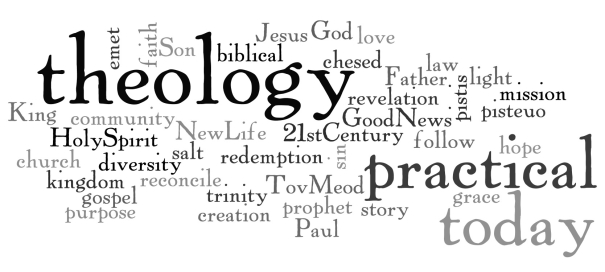
Feeling hopelessly lost in the bigness of Jesus, my first attempt to summarize his life was to start a list of simple, yet often paradoxical, descriptors. It’s now in the form of a “word cloud.” I offer it below, aware that only a ludicrous person would attempt to place Jesus in a box.  

One more time…

I grew up hearing the idiom (axiom?) “one more time around the mountain” used often by the adults in my life. Similar idioms like “same old, same old” and “more the same” were often interchanged. I knew they meant the same thing – that nothing’s changed.

As I continue reading through the book of Acts, the idioms keep coming to mind as I follow the Apostle Paul and his entourage’s footsteps (Luke, Timothy, Silas, et al). It seems like no matter where they landed, neither jealous Jews nor irate idol-makers were too eager to roll out the red carpet for them.

In Philippi, Paul and Silas were beaten because Paul had freed a young slave woman of her sorcery powers, depriving her owners of their fortune-telling income. In Thessalonica, jealous Jews formed a mob and started a riot against them. Paul and Silas escaped by the cover of darkness and went off to Berea. The Bereans were receptive to the gospel. However, once the jealous Thessalonian Jews discovered that Paul was preaching about Jesus in Berea a contingency arrived, “agitating the crowds and stirring them up” (Acts 17:13). Paul was put on a ship for Athens. Similar stories in other communities throughout his ministry.

One more time around the mountain!

In Acts 21, we find Paul and company arriving in Jerusalem. He delivered a collection of monies from the various churches of Asia and Greece as famine relief for the Jerusalem Christians. Upon arriving in Jerusalem, he was welcomed by James (Jesus’ brother) and the other elders of the Jerusalem Church. They were excited to hear about the propagation of the gospel through Paul’s travels. And then, “one more time”…

You see, brother,” they said, “that there are many thousands of Jews who have believed. They are all of them fiercely enthusiastic for the law. But what they have heard about you is that you teach all the Jews who live among the nations to abandon Moses, telling them not to circumcise their children and not to keep the customs. Where does this leave us? They will certainly hear that you have come.” (Acts 21:20-22, KNT)

So a plan was devised: Paul was to act like a full-fledged Jew and undergo the accepted ritual of purification. Paul was apparently not opposed to the plan – it fit his philosophy of ministry: “I became like a Jew to the Jews, to win Jews. I became like someone under the law to the people who are under the law, even though I’m not myself under the law, so that I could win those under the law” (1 Corinthians 9:20). However, in this case, he was in need of winning over the many Jewish Christians.

The plan failed. Paul was spotted in the Temple. James and the elders were right – the zealous Christian Jews immediately went after Paul. Accompanied by non-Christian Jews, they dragged him out of the Temple and shut the gates to him, inciting a riot. They beat Paul with the intent to kill him, thwarted only by the intervention of the Roman tribune.

One more time around the mountain!

By now one would suspect Paul was getting used to this “one more time around the mountain” routine. But this was different. His past experiences were with jealous Jews. This time zealous Christians joined in. What does that do to one’s faith? How does one keep on keeping on? Did Paul waver in his faith? Would I waver in similar circumstances? Would you?

We aren’t privy to whether he wavered or not. What we are privy to is his theology and worldview which is evident in his writings. Paul desired to live a life of contentment, regardless of circumstances deriving strength from Jesus (see Philippians 4:11-13). But deeper than a sense of contentment was a deep understanding of the love of God…

For I have come through a process of persuasion to the settled conclusion that neither death nor life, nor angels, nor principalities, nor things present, nor things about to come, nor powers, nor height, nor depth, nor any other created thing will be able to separate us from the love of God which is in Christ Jesus our Lord. (Romans 8:38-39, Wuest)

I have come through a process of persuasion…” What was the process? Turns out the process was those many times around the mountain as Paul described in his letter to the Corinthian Christians…

24 Five times I received at the hands of the Jews the forty lashes less one. 25 Three times I was beaten with rods. Once I was stoned. Three times I was shipwrecked; a night and a day I was adrift at sea; 26 on frequent journeys, in danger from rivers, danger from robbers, danger from my own people, danger from Gentiles, danger in the city, danger in the wilderness, danger at sea, danger from false brothers; 27 in toil and hardship, through many a sleepless night, in hunger and thirst, often without food, in cold and exposure. 28 And, apart from other things, there is the daily pressure on me of my anxiety for all the churches. (2 Corinthians 11:24-28)

Maybe “one more time around the mountain” isn’t such a bad thing. After all, each time around can result in one step closer to the summit.

Conversatio Morum!

I love history. Several times I have read or listened to Shelby Foote’s The Civil War: A Narrative – his 3-volume, ~3000-page narrative of the war between the states. I have also worked through Flavious Josephus’ Antiquities of the Jews, the first-century, 20-volume historiographical account of the Jewish people from creation to the 70 AD siege and fall of Jerusalem. You might say I’m a bit of a geek when it comes to history.

I am also drawn to Church history. I have read Justo Gonzalez’s 2-volume work, The Story of Christianity (a very good read, by the way). I have read it twice and listened to it a couple of times (while working in my wood shop)!

Historically, early Christian thought and behavior were influenced by the desert fathers, the monastics who literally stole away to the Egyptian wilderness area to learn spiritual formation. You might be familiar with The Rule of Benedict (circa AD 530) which has become popular in recent years thanks to people like John Mark Comer. The Rule is a basic plan to follow Jesus, to hold true to a commitment to be a disciple. “Rule” was Benedict’s term. It described the way of life of the serious Christ-follower. Remember that the early Christian movement was initially described as The Way.

While reading about Benedict, the term conversatio morum surfaced.

Conversatio morum is a term that is difficult to translate into English. Scholars debate Benedict’s intent as they study and interpret his Rule. Some of the various translations include conversion of life, reformation of life, and constant conversion. Benedict appears to have used conversatio morum to describe fidelity to a “monastic way of life” signifying a life-long commitment to spiritual growth and transformation. In non-monastic terms, it represents a life-long commitment to be a disciple of Jesus with the associated transformation.

Of the translated phrases, the related terms conversion of life and constant conversion, piqued my interest. In Western thinking, conversion tends to be viewed as a one-time, transactional event. An example is the accepted view that the Apostle Paul was “converted” on the road to Damascus (Acts 9). Paul was not converted from unbelief to belief. He was a believer in God who started thinking differently after meeting Jesus. (See also Here I Am).

Conversatio is the root of the English word conversation. At its core, conversation has more to do with listening than speaking – listening with the understanding that conversation can lead to a change of thought and mind (not how we tend to view conversation today!).

Change of mind? The word repent comes to mind.

The English word repent used throughout the New Testament is a translation of the Greek word metanoeō, which simply means “think differently.” When we bring these aspects together, our focus will be on maintaining a constant state of conversion, remaining open to reevaluating our beliefs. And remaining in continuous conversation with God, the one who can change our minds if we have ears to hear.

However, the concept of constant conversion is a bit unnerving, especially for us Western thinkers. We want things neat and tidy. We want to discover and nail down “the truth.” We want certainty. God doesn’t often provide the certainty we desire. If he did, we wouldn’t need him anymore. We wouldn’t need to be in constant conversation with him. We wouldn’t need to continue in his word. We wouldn’t have to risk a change of mind.

The concept of constant conversion should keep us humble. It should help us to listen to one another. It should keep us curious and asking questions. Once we convince ourselves that we know all we need to about God, we are further away from the truth than when we started.

“We are closer to God when we are asking questions than when we think we have the answers.” (Abraham Joshua Heschel)1

I remember a New Testament scholar,* in speaking of the concept of constant conversion, saying that we must be born again, again. Until we truly get comfortable with not knowing, we’ll have a hard time seeing/entering the Kingdom that demands us to be constantly rethinking, constantly converting, and declaring death to our personal status quo. Maybe that’s what Jesus was intimating when he told the Pharisee, Nicodemus…

Very truly I tell you, no one can see the kingdom of God unless they are born again. (John 3:3)

A ministry colleague of mine has a standard question he includes during job interviews: “Tell me about something you used to believe but then you changed your mind” or the corollary, “Tell me about something you believe today that you didn’t use to.” He wants people on his team who are still searching, learning, and open to change. Constant conversion.

The time has come. The kingdom of God has come near. Repent and believe the good news! (Jesus, Mark 1:15)

1Heschel, A. J. (2005). Who is man? Stanford University Press.

* I don’t remember who said this and have been unable to find the source in my notes on my laptop or hard drives. 🫤

Vindication & Plethora

This is a continuation of the previous post, Vindication & Humor. Acts 12 brought to close God’s vindication concerning King Herod (Agrippa I) and the beginning of the expansion of the new movement outside of Judea. It’s an interesting story…

Previously we saw Peter, the leader of the new movement often referred to as The Way, arrested by Herod and imprisoned for trial. It appeared that Herod intended to execute Peter as he did James. I’m guessing Peter and the early believers assumed as much.

Peter was rescued by an angel of the Lord, boldly releasing him from prison in the middle of the night. Peter and the Church were vindicated. In a (likely) fit of rage, Herod ordered the execution of the 16 soldiers responsible for guarding Peter while in custody. Herod then left Jerusalem for his palace in Caesarea on the Mediterranean coast. Built to appease Caesar Augustus, the city and palace were one of the major construction projects of Herod the Great (Agrippa I’s grandfather). Agrippa never returned to Jerusalem. The rest of his story…

Bust of Herod Agrippa I (11 BC – AD 44)

We don’t know why Agrippa left Jerusalem for Caesarea. We do know that while there, representatives of the cities of Tyre and Sidon requested an audience with him. Located up the coast from Caesarea and not part of Herod’s domain, these cities and their people relied on Judea for their food supply. Herod had apparently been at odds with the people of Tyre and Sidon. It was to be an economic summit.

Herod, probably to remind the people he was in charge, wore his royal robes, and sat on his throne to address the people. Royal robes were an important part of a king’s wardrobe. Though Scripture gives us little information about Herod’s royal robes, some assumptions commensurate with the period can be made. It would have been made of luxurious, high-quality silk, linen, or finely woven wool adorned with intricate embroidery. It would have included regal accessories – crown, jeweled belts, sashes, etc. And maybe some Roman-influenced bling. Always an embellisher, the Roman historian Josephus described the design of Herod’s robe as glittering to catch the sun, adding to his royal radiance:

He put on a garment made wholly of silver, and of a contexture truly wonderful, and came into the theater early in the morning; at which time the silver of his garment being illuminated by the fresh reflection of the sun’s rays upon it, shone out after a surprising manner, and was so resplendent as to spread a horror over those that looked intently upon him1

Scripture doesn’t reveal details of Agrippa’s address but the people were either impressed or responded in collective flattery shouting, “This is the voice of a god, not of a mere mortal.” They were mistaken. Agrippa apparently ate it up…

Immediately, because Herod did not give praise to God, an angel of the Lord struck him down, and he was eaten by worms and died. (Acts 12:23)

It appears that Luke felt Herod Agrippa’s sickness and demise warranted just a single sentence. Josephus was not so succinct…

His flatterers cried out, one from one place, and another from another, that he was a god; and they added, “Be thou merciful to us; for although we have hitherto reverenced thee only as a man, yet shall we henceforth own thee as superior to mortal nature.” Upon this the king did neither rebuke them, nor reject their impious flattery. But as he presently afterward looked up, he saw an owl sitting on a certain rope over his head, and immediately understood that this bird was the messenger of ill tidings, as it had once been the messenger of good tidings to him; and fell into the deepest sorrow. A severe pain also arose in his belly, and began in a most violent manner. He therefore looked upon his friends, and said, “I, whom you call a god, am commanded presently to depart this life; while Providence thus reproves the lying words you just now said to me; and I, who was by you called immortal, am immediately to be hurried away by death.1

Caesar had commissioned Josephus’ writing of the Jewish people’s history. At times his embellishment of historical accounts was accompanied by political flattery. He depicted Agrippa’s death as honorable, noting a dignified acceptance of God’s providence (while blaming the crowd, by the way). I lean toward embellishment and flattery.

No matter the details, Herod Agrippa I was dead and would no longer be able to persecute the believers. God is not mocked. Peter and the early Christian movement were vindicated.,,

And the word of God continued to spread and flourish (v. 24)

Here’s a bit of fun: The Greek word for flourish is πληθύνω (plēthunō) from which the English word plethora is derived. I had NO idea when I wrote the previous post. Full circle! Mic drop!

1Josephus, Flavius. The Works of Josephus: Complete and Unabridged (pp. 3996-4000). http://www.DelmarvaPublications.com. Kindle Edition.

Vindication & Humor

We all like stories of vindication – good triumphing over evil, the bad guy getting just rewards. Personally, I want a good vindication story laced with good humor. A few come to mind: Mrs. Doubtfire, School of Rock, The Grand Budapest Hotel, and an old classic, The Three Amigos. Quotes from Amigos come to mind regularly, an all-time favorite exchange being…

Scripture is laced with stories of vindication. It’s core to God’s project of redeeming his creation. The story of Joseph certainly comes to mind. So do the stories of Esther, Daniel, Shadrach, Meshach, and Abednego. Of course, the greatest vindication story is the resurrection of Jesus.

Scripture is also laced with humor. The Chosen has done a great job of depicting Jesus’ sense of humor. If you don’t see the humor as you read scripture, start looking for it. (Remember, God has a sense of humor – that’s where we get it, being made in his image and all that.)

As I journey through the Acts of the Apostles, I see a plethora of stories of vindication for the new ecclesia of Christ-followers. In Acts 12, we find King Herod exercising his power as the king of Judea. There are many mentions of a King Herod in Acts and the gospels, so we should clarify. Herod the Great (reigned 37-4 BC) was the Roman client or vassal king in power over Judea at the time of Jesus’ birth. He was a brutal tyrant who ordered the massacre of children after the Magi left the country without informing Herod of the location of the new king of the Jews. His known brutality led to Mary, Joseph, and Jesus becoming refugees in Egypt.

Herod the Great’s brutality extended to immediate family as well. According to the Roman historian Josephus, Herod had three of his sons killed: his first-born, Antipater, and two sons with his second wife, Miriamne: Aristobul and Alexander. He also had Miriamne executed. What then made him great we may ask? Great question…

Herod the Great was politically savvy, maintaining favor with Rome and Augustus Caesar, leading to peace and economic stability. He was known as the great architect of Judea, building the city of Caesarea (to honor and gain Caesar’s favor), pagan cities (to gain the favor of non-Jewish people), many fortresses (for self-protection), and, of course, the Second Jewish Temple (gaining the support of the Jewish people). Though his projects bolstered the economy, they also resulted in heavy taxation and labor inscription.

The full name of the Herod of Acts 12 was Herod Julius Agrippa (sometimes referred to as Agrippa I). He was the nephew of the brooding and nefarious Herod Antipas who arrested and executed John the Baptist. Agrippa I came to power ~40 AD following Antipas’ fall from grace with Rome, ruling over the entire known Judaea territory (Antipas only ruled over about a fourth of Judea). He was well-connected with Rome (note his middle name) and was also popular with the people, thus able to wield significant power.

Agrippa I began arresting believers in Jerusalem, probably to appease both the Jews and Rome. Persecution was his intent. For some reason (we don’t know why) he had James, the brother of John, executed with a sword. This was significantly different than the stoning of Stephen. Stephen’s death was because the new movement was seen as a religious threat. Herod apparently viewed it as a political threat.

Realizing that James’ execution met with Jewish approval, Herod arrested Peter (who was known as the main leader of the Way in Jerusalem) for trial. Interestingly, this took place at Passover time (compare to Jesus’ arrest and Peter’s denial). Peter was heavily guarded by 16 soldiers – two of whom were bound to him with chains. He was probably in prison for a few days since Herod intended a public trial after Passover. As you can imagine, the young church went into hiding and prayed, fully aware that Peter was likely to face execution.

The night before trial an angel of the Lord appeared in the prison cell, not stealthily but with a bright light (humor)! The angel slapped Peter on the side to wake him up. I chuckle every time I read this. The chains fell off (I assume noisily), Peter got dressed (no hurry to get out apparently) and the angel led him past the other 14 guards out into the dark and disappeared.

The vindicated Peter, coming to his senses, made his way to the house of John Mark’s mom which was where a lot of people were gathered, praying. Peter knocked on the gate door which was answered by Rhoda the maid who, caught up in the excitement, left him standing at the gate as she ran to tell the others (more humor). Though they had been praying for Peter’s safety, apparently his release from prison was not in their thinking as they tried to convince Rhoda she was mistaken and probably heard a dead Peter’s ghost, meaning they assumed their prayers were to no avail. Meanwhile, Peter kept on knocking!

Peter, after sharing the story of his “escape” with the gathering, said, “Tell James (presumably Jesus’ brother) and the other brothers about this.” Peter then left Jerusalem, a wanted man. But he left vindicated – the leader of the family of the true King had frustrated the plans and intent of the “official” king. Herod was not a happy man!

The story continues in the next blog post…

Here I Am!

I loved playing hide and seek when our kids were toddlers. They didn’t totally understand the concept, though. I would send them off to hide as I counted. With their inability for stealthiness, I always knew exactly where they were hiding. Pretending that I couldn’t find them, I would say out loud, “I wonder where (name) could be?” Unable to contain their excitement, they would jump out and exclaim, “Here I am, Daddy!”

I recently spent time reading and pondering Acts 9 – the “conversion” of Saul (later known as Paul). I say “conversion” because he wasn’t actually converted as we tend to use the term. We usually associate conversion from non-belief to belief in something. Saul was not an unbeliever. In fact, he was a zealous believer, learner, and adherent of the Mosaic law.

As you might remember, Saul had received permission (along with appropriate documentation) from the Jewish high priest to travel from Jerusalem to Damascus to arrest followers of the Way for trial before the ruling council, the Sanhedrin, back in Jerusalem. As Saul and his entourage set out for Damascus (a 3-4 day journey by mule or horseback), it would be fair to assume that some believers in Jerusalem high-tailed it to Damascus to warn the believers of Saul’s impending arrival and intent.

What if you lived in Damascus and belonged to the Way?

What would you do? Would you leave the city until the threat was over? Not everyone had the means or ability to do so. Would you go into hiding? Who could you trust? I have read various World War II accounts of the reactions of the Jewish people in cities soon to be overrun by the Nazis. The Wehrmacht’s reputation along with the authority to mistreat Jews bred fear as people escaped the city or went into hiding. I assume a similar fear spread through the young Christian community.

As we know, Jesus intercepted Saul, spoke to him directly (“Saul, Saul! Why are you persecuting me?”), blinded him with the brightness of his presence, and sent him into the city to await further instructions. In a great reversal, Saul found himself hiding in the city. Picking up the story from Acts 9…

In Damascus, there was a disciple named Ananias. The Lord spoke to him in a vision. “Ananias!” he said. “Here I am, Lord,” he replied. (Acts 9:10, NTFE)

“Here I am, Lord.” Where have we heard this before? We find Isaiah speaking similar words in Isaiah 6. In a vision, Isaiah saw the Lord in full glory and responded, “Woe to me! I am ruined!” Then the Lord spoke directly: “Whom shall I send? Who will go for us?” Isaiah’s well-known response…

“Here I am. Send me.”

The same Lord spoke to Ananias in a vision. Visions tend to happen when someone is in intimate communion with God. We can assume that Ananias might have been praying when the Lord spoke to him. What was he praying about? We have no idea, but I suspect protection from Saul and his cohort might have been part of the conversation. In the vision, God gave Ananias the address where Saul was hiding and instructed him to go lay hands on Saul so he could see again.

Saul was anticipating Ananias’ arrival – he had received a vision, too. So, Saul was praying? I suspect so. He had just had a visit from the resurrected Jesus. I suspect he prayed a lot! He probably had a lot of questions to which he needed clarification. For three days he fasted and prayed. And probably meditated as well. The meditation practices of the Pharisees in the first century were deeply rooted in the Hebrew Bible and Jewish tradition. I imagine Saul pondered his memorized scriptures, wondering how Jesus fit into what he thought he understood.

Naturally, Ananias objected to God’s directive. The word was out of Saul’s reputation, his arrival in Damascus, and that he came with the authority of the chief priests to arrest Christians. “Just go,” replied the Lord. “He is a chosen vessel for me [like Isaiah?], to carry my Name before the nations and kings – and the children Israel, too.”

Conversion of St. Paul. Benjamin West, ca 1786

17 So Ananias set off, went into the house, and laid his hands on him. “Brother Saul,” he said, “the Lord has sent me—yes, Jesus, who appeared to you on the road as you were coming here—so that you may be able to see again, and receive the Holy Spirit.” 18 At once something like scales fell off his eyes, and he was able to see. He got up and was baptized.

Saul subsequently went on to become a most significant person of the new movement, starting churches across the Roman Empire. He also provided deep theological thought connecting the Hebrew Scriptures* with the life and work of the resurrected Jesus. Nearly half of the books in the New Testament are attributed to his later writings. And what of Ananias? We know no more than this short encounter. What we do know is that he was available. And obedient. May we always be postured to be able to say…

Here I am, Lord.

* From NT Wright regarding Saul’s discoveries: It confirmed everything Saul had been taught; it overturned everything he had been taught. The law and the prophets had come true; the law and the prophets had been torn to pieces and put back together in a totally new way.1

1 Wright, N. T.. Acts for Everyone, Part One: Chapters 1-12 (The New Testament for Everyone) (pp. 140-141). Presbyterian Publishing Corporation. Kindle Edition.

The Songs of Jesus

Ten years ago Timothy and Kathy Keller wrote the book, The Songs of Jesus: A Year of Daily Devotions in the Psalms. We tend to forget that the Psalms written in antiquity were part of the Hebrew Scripture which Jewish worshipers would have known well. They were the contemporary music of Jesus’ first-century world. Just as we have songs connected to the Christian holiday seasons today (e.g., Advent, Lent, Easter, etc.), so did they.

What immediately comes to mind are the Psalms of Accent (Psalms 120-134). These are Psalms that the people sang as they ascended up into Jerusalem to annually attend the three mandated festivals (Passover, Pentecost [or Weeks], Booths [or Tabernacles]). Jesus and his fellow Israelites would have known many (if not all) 150 Psalms by heart as they were incorporated into regular times of worship. Keller’s book was designed to draw us to the same songs Jesus sang.

As I have mentioned elsewhere, I have been in the habit of reading and praying the Psalms for close to 30 years – sometimes one per day or one per week. Or, as with the past couple of years, I park on a Psalm for a time, gleaning what I can, then moving on to the next one. I just spent a week in Psalm 82, a relatively unknown but significant song.

As you may know, the 150 Psalms are really a collection of five books as follows:

  1. Book 1 (Psalms 1-41). Primarily attributed to David, these psalms focus on covenantal faithfulness.
  2. Book 2 (Psalms 42-72). The psalms of Book 2 focus primarily on a hope for a Messianic kingdom.
  3. Book 3 (Psalms 73-89). Attributed to Aspah, the psalms in this section of songs are a mix of communal lament and post-exilic Messianic hope.
  4. Book 4 (Psalms 90-106). The focus? Yahweh, the God of Israel, is the true King of all creation, who can thus bring healing justice to his rule, his Kingdom.
  5. Book 5 (Psalms 107-150). This final book includes psalms of thanksgiving, praise, and celebration. It concludes with a series of Hallelujah psalms (146–150), each beginning and ending with “Praise the Lord” (Hallelujah).

Interestingly, each book ends with a doxological prayer, blessing the God of Israel, the everlasting Lord. Example: Praise be to the Lord God, the God of Israel, who alone does marvelous deeds. Praise be to his glorious name forever; may the whole earth be filled with his glory. Amen and Amen. (Psalm 72:18-19). See also, Psalm 41:13; 89:52; 106:48; and Psalm 150)

Psalm 82 is in the middle of Book 3. Amid psalms of lament related to exile and pleas for God to come to the aid of his people, we find this seemingly free-standing song. The psalm contains concepts that have perplexed theologians for centuries. But the main thrust of the psalm seems to be absolutely clear: Yahweh is the God of all “gods” and he expects nations and societies to operate justly. And if they don’t, they will have him to contend with…

2 “How long will you [plural] defend the unjust
    and show partiality to the wicked?
Defend the weak and the fatherless;
    uphold the cause of the poor and the oppressed.
Rescue the weak and the needy;
    deliver them from the hand of the wicked.

In the world of the ancients (Mesopotamia, Palestine, Egypt, etc.), deities and nations were entwined. Other nations knew that the national god of Babylon was Marduk; Egypt was Ra; and, of course, Israel was Yahweh, the one true God. The people of the exile lamented because, to the watching nations, it appeared that Marduk was more powerful than Yahweh. Yet, we don’t hear much of the Babylonians these days. Nor their God, Marduk. Why? Because…

5 “The ‘gods’ know nothing, they understand nothing. They walk about in darkness; all the foundations of the earth are shaken… But you will die like mere mortals; you will fall like every other ruler.”

The gods were tried and found wanting. The criteria for Yahweh’s judgment of the gods was justice. The national gods supported imperialistic domination and cruelty imposed on the conquered people. Weak, fatherless, poor, and oppressed people are a natural outcome of national domination. “Psalm 82 tells us how we are to be judged by God but also how God wants to be judged by us. Everything else that God says or does in the Bible should be judged by that job description.”1 Social justice that is basic to Yahweh, the God of the Bible can be seen in Jesus, God in the flesh. Luke 4 immediately comes to mind…

18 “The Spirit of the Lord is on me,
    because he has anointed me
    to proclaim good news to the poor.
He has sent me to proclaim freedom for the prisoners
    and recovery of sight for the blind,
to set the oppressed free,
19 to proclaim the year of the Lord’s favor.”

20 Then he rolled up the scroll, gave it back to the attendant and sat down. The eyes of everyone in the synagogue were fastened on him. 21 He began by saying to them, “Today this scripture is fulfilled in your hearing.”

“Everything else that God says or does in the Bible should be judged by [this] job description.”

1 Crossan, J. D. (1998). The birth of Christianity: discovering what happened in the years immediately after the execution of Jesus (1st ed). HarperSanFrancisco.