My friend Kevin – whom I’ve mentioned [here] and [here] – recently shared something he wrote that I really liked. I liked it enough to invite him to be this week’s “guest columnist.” Enjoy!
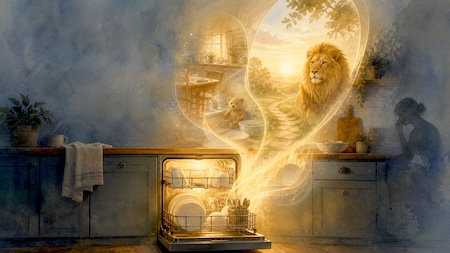
On a perfectly typical Tuesday morning, while standing by the dishwasher and stacking clean dinner plates, a completely unprovoked memory emerges:
All five feet, one inch of seventh-grade Kevin is standing in front of his English class. It’s time for the annual season of poetry recitation. For my contribution, I had chosen the wildly popular, annoyingly overused Alexander and the Terrible, Horrible, No Good, Very Bad Day. (Note to seventh-grade self: Jabberwocky would have been a far superior poetic art form.) After absolutely nailing the opening three lines with confidence and aplomb, my mind goes blank. I gaze at the floor tiles beneath my feet, look nervously around the room, and stare back at my teacher, desperately waiting for her to throw out the lifeline of a prompt.
There’s a truly good reason my mind went blank. I didn’t prepare. Thus, an awkward liturgical call-and-response ensues: Ms. English Teacher recites each line, and I mumble it back with decreasing volume and enthusiasm. As this public ordeal mercilessly comes to a humiliating conclusion, my teacher states the obvious: “You need to prepare more diligently next time, Kevin.” She’s not wrong.
As this scene spins across my consciousness, an emotional trigger-fest ensues:
- Embarrassment: Yep, there’s pathetic little Kevin, stammering in front of a jury of his middle school peers.
- Indignation: Why the heck didn’t I spend ten minutes each evening memorizing the @#$% poem? I’m good at memorizing things. Why didn’t I employ my mnemonic powers for good?
- Resentment: Why do English teachers coerce their students into this tortuous form of public humiliation? Don’t they understand the permanent damage this could cause?
I gotta wonder: Of all the memories stored in my data banks, why did THAT memory suddenly reemerge? It hadn’t crossed my mind in 48 years. Why now? What is this memory attempting to say to me?
I will spare you the boredom of trying to explain neural pathways and frontal-lobe recall. Recalling this memory wasn’t a science experiment. It turns out it was a rather mystical experience. I’m left wondering: what does this all mean for 5’9¾”, 60-year-old Kevin?
For those few moments, the dishwasher became my own Narnian wardrobe—a passageway back into my land of past memories. Though these memories have certainly morphed over time, they somehow remain alarmingly fresh and alive.
Through this scene in my personal Narnia, my first encounter was all too predictable: The Witch grabbed me by the ear, yanked me down the classroom aisle, and dumped me into a chair at the front of the room.
“Take a close look, you little turd,” she jeered. “See how you respond to pressure? You caved.
Again. You can’t be trusted, can you?”
With this terse accusation, she slipped away—her voice still echoing in my little heart. “Yep, she’s right,” I say to myself. “I cave under pressure. I don’t prepare adequately. I’m always disappointing people.” OUCH. Ouch. ouch.
As my head drops and I gaze into those ubiquitous gray 12-by-12-inch classroom floor tiles, I sense a large shadow brushing up behind me. Turning slowly, I catch sight of what’s moving: a very large Lion, obviously quite capable of eating a 5’1” middle schooler.
“Hello?” I say, trying to be polite.
“Hello,” says the Lion in return, staring me straight in the eyes while his tail swishes happily.
“Um, may I help you?” I ask.
“Oh, I was just curious,” the Lion offers.
“Curious?”
“Yes, curious. What do you think of that little guy in front of the classroom?”
“Him? Honestly? I’d rather not think about middle school Kevin at all. It’s all rather embarrassing, don’t you think?”
“Not to me. I really like that little guy.”
“Really? You really like him?”
“Yes, of course.”
And with this declaration of deep, quiet confidence, the very large Lion slowly turns and begins to walk away, almost as if inviting me to follow him into a future of grace, love, and acceptance.
I’d rather not undersell the poetic irony of this seventh-grade English scene. That insecure little dude somehow grew up to love standing before groups and reciting what he had carefully prepared. It’s quite true that the Lion may, at times, appear solemn. Yet the Lion also possesses a rather wicked sense of humor, somersaulting past failures into present-day breakthroughs.
Whether standing at the dishwasher, mowing the lawn, or staring into a mirror, unexpected memories might emerge for each of us. With each recollection, the Witch lures us into a world of shame, embarrassment, despair, and defeat, while the Lion invites us toward insight, courage, strength, and peace. The Witch revels in a good ol’ walk of shame, but the Lion enjoys a peaceful stroll through his patience, compassion, and kindhearted joy.
We may all soon inhale a past memory before our minds can adequately process it. We might then ask: “Where did that memory come from? Why now? What does it mean?”
My simple prayer for us all:
May we brush aside the voice of the Witch and calmly enjoy the presence of the Lion.


