Old Faithful

Time spent with our grandkids causes me to reflect back to “when I was their age,” reminiscing what life was like for me decades ago. Much has changed, but kids are kids and the kinds of things that intrigued me intrigue them as well. I love watching them with their nose in books or as they learn to draw. I loved to read and draw. What I read was different (Hardy Boys mysteries versus Harry Potter). I drew horses and tractors. Our grandkids draw Pokémon figures.

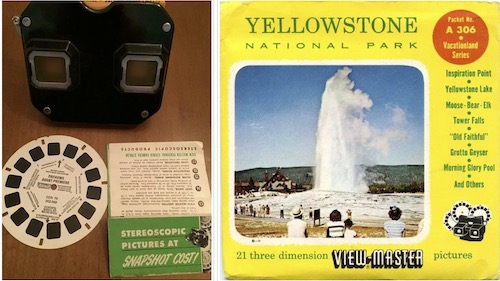
One of the most intriguing things I played with as a kid was a View-Master. For those unfamiliar, a precursor to 3-D glasses the View-Master was a popular stereoscopic toy that allowed me to view images in a three-dimensional format. It consisted of a handheld plastic viewer and a series of circular cardboard “reels,” each containing a set of paired images (see below).

We had a series of reels ranging from Hopalong Cassidy to a variety of national parks. My favorite was Yellowstone National Park. For a dairy farm kid for which a “vacation” consisted of a day trip to Taylors Falls or Duluth squeezed between milkings, the View-Master gave me the opportunity to experience the majesty of our parks – in 3-D!

The “Old Faithful” geyser was particularly captivating. The View-Master reel had a series of time-lapse photos showing the faithful geyser in various stages of eruption. All in 3-D! I studied each of the slides. I couldn’t get enough!
In the previous post, we discussed faith, a word that occurs over 250 times in the New Testament. It derives from the Greek word pistis and can easily be translated as trust (see I Gotta Have Faith). What about faithful – how are faith and faithful related and/or different?

For starters, faith is a noun and faithful is an adjective. Faith refers to the belief or trust in something, particularly God, while faithful describes a person characterized by loyalty, devotion, and reliability. Faith is the foundation or conviction, while faithful reflects the actions and qualities associated with steadfastness and trustworthiness.

Faithful is a translation of the Greek word pistos, which, as you can see, is a derivation of pistis (faith) and pisteoū (believe). These are Greek words found in the New Testament. Looking into the word pistos, what piques my interest are the English words that describe faithful – loyalty, devotion, reliability, steadfastness, trustworthiness, etc. These smack of the Old Testament characterization of God’s covenant loyalty and reliability, hesed and emet (see Hesed and Emet and Veritas).

In a similar fashion to our quantification of faith, I suspect we view being faithful as some form of perfection, success, or “getting it right.” Loyalty and perfection are not the same. I am loyal to my wife but far from perfect and don’t get it right all the time (as she would likely agree 😬). Though she might like it if I got it right more often, I know that loyalty is far more important to her. I suspect God is more interested in our pistos than our successes, our getting-it-rightness.

I am reminded of a story about Mother Theresa. When orphans were starving in India at a greater rate than her little orphanage could possibly serve, Mother Theresa was asked by a reporter how she could feel any sense of success. Her response?  God does not require that we be successful, only that we be faithful. In Western thought, we have equated success and faithfulness. God wants our pistos, our loyalty and our devotion.

We must also remember that loyalty is covenantal. While I am faithful to my wife, she is also faithful to me – she makes it easy to be loyal to her. The Old Testament narrative is a story about God’s covenant loyalty. With Jesus, God provided forgiveness of sin making loyalty a possibility. God’s loyalty makes us want to be loyal/faithful in return. The Apostle Paul summed it up for his friend and apprentice Timothy like this (2 Timothy 2:11-13):

Here is a trustworthy (pistos) saying: 

If we died with him,
    we will also live with him;
if we endure,
    we will also reign with him.
If we disown him,
    he will also disown us;
if we are faithless,
    he remains faithful (pistos),
    for he cannot disown himself.

God’s pistos trumps our pistoslessness

Addendum 7/23/2023. Reading 1 Thessalonians 5 this morning, I came across this: The one who calls you is faithful, and he will do it (5:24). Greek for “The one who calls you is faithful” – Pistos ho kalon,

I Gotta Have Faith*

My daughter and I were recently talking about faith, trust, belief, faithfulness, etc. Faith is one of those religious terms that we assume to understand, but deeper consideration might suggest otherwise. Consider this oft-heard statement: “If you just have (or had) enough faith, then _____ (fill in the blank).” There is a sense of a threshold of faith that once reached, God will grant us our desires. And if those desires aren’t fulfilled, then we assume we are at fault – we didn’t have enough faith, didn’t reach that elusive threshold. (And unfortunately, there are a number of people that are willing to remind us of our lack of faith.)

I suspect we tend to quantify faith, thus “enough” and “threshold” thinking. Personally, I realized that when I quantify faith, then I become the focus, not God. My faith makes the difference. My faith results in _____ (again, fill in the blank). The focus is on me and my ability. I’m pretty sure that if I am the focal point, then surely something must be amiss.

In addition, a quantified approach to faith not only focuses on me but also on the outcome. If the desired outcome happens, then we say “They had enough faith,” But what if the desired outcome doesn’t happen, then what?

Consider the many times Jesus commended and affirmed people’s faith. I think of his response to the faith of the centurion: “Truly I tell you, I have not found anyone in Israel with such great faith.” (Matt. 8:10). Or the faith of the paralyzed man’s friends: “When Jesus saw their faith, he said, ‘Friend, your sins are forgiven.'” (Luke 5:20).

As I look at the many occurrences of Jesus commending people for their faith, I see a theme that I hadn’t really noticed before. Most of those lauded didn’t qualify as people with any sort of faith at all, according to the religious traditions.

Many, if not most, were in need of healing. The religious culture labeled, oppressed, and ostracized people with diseases and physical infirmities – they lacked a measurable amount of faith, I suspect. Some were members of the wrong tribe, like the Roman centurion (above) or the Syrophoenician / Canaanite woman who came to Jesus despite the tribal distinctions (see Matt. 15:21-28 and Mark 7:24-30).

In the passages describing Jesus’ commendation of people’s faith, the Greek word translated as faith is pistis. As we typically find to be true with translations from Greek, a single English word is often not sufficient. In their use of pistis, Plato and other Greek philosophers referred to the conviction of the truth of anything, of belief. (Pistis is related to pisteoū, often translated as “belief.”)

The new testament writers used pistis to describe our relationship to God and to Christ. When it relates to God, pistis is “the conviction that God exists and is the creator and ruler of all things.” In reference to Christ, it denotes “a strong and welcome conviction or belief that Jesus is the Messiah, through whom we obtain eternal salvation in the kingdom of God” (Thayer’s Lexicon). The predominant idea is one of trust (or confidence) in the one true God and/or that Jesus is the Christ (Messiah).

Central to faith is the object of one’s faith.

So what was this faith that outsiders possessed and Jesus lauded? They simply trusted Him. He was the object of their faith. When we think in terms of quantified faith, we become the object. When we think of faith in terms of trust, God becomes the focus. Can he be trusted? Is he reliable? Does he have my best interests in mind? Regardless of the outcome?

A couple of great stories…

From Esther. Esther needed to speak to the king on behalf of the Israelites but it was unlawful for her to approach the king without being summoned – the law said she should be put to death. But she knew that she was the one that needed to speak on behalf of the people. She did not say “I have faith that God will protect me.” Her words? “I will go to the king, even though it is against the law. And if I perish, I perish.” TRUST.

From Daniel (esp. chapter 3). Shadrach, Meshach, and Abednego refused to worship the king’s idols and were promised that they’d be tossed in a furnace if they didn’t. They did not say “We have enough faith and we know God will protect us.” Their reply? “O Nebuchadnezzar…if we are thrown into the blazing furnace, the God we serve is able to save us from it… But even if he does not, we want you to know, O king, that we will not serve your gods or worship the image of gold you have set up.” TRUST.

Faith: Just plain trust. Not quantified. Not outcome dependent. Just plain TRUST!!!

* “Apologies” for the unashamed use of lyrics from the 1980s George Michael song, Faith.

Zoe

Let’s talk about Zoe. Not Zoe from Sesame Street, not Zoey of Pokémon fame, not Zooey Deschanel (New Girl), and not Zoe, Rudolph’s love interest in Rudolph the Red-Nosed Reindeer: The Movie. Let’s discuss the Greek word zoe that the writer of the Gospel of John deemed important enough to use over 30 times. It’s fair to conclude that, to him, zoe had deep theological significance in describing Jesus and his vocation.

Ask a number of people Jesus’ purpose for coming to earth and we will get a number of different responses. However most will intimate something about clearing the path so we can go to heaven when we die. Though that is certainly an outcome, Jesus offered far more than simply going to heaven, which John captured well, with zoe at the core. Along with ushering in God’s kingdom, Jesus purposed to offer people zoe…

Many of us are familiar with the passage in which Jesus said, “I came that they may have life and have it abundantly” (John 10:10, ESV) or, as stated in the New Living Translation, “My purpose is to give them a rich and satisfying life.” There it is. Jesus’ purpose for coming was to provide an abundant, rich and satisfying life. The Greek word translated as “life” is zoe.

Zoe is rich with meaning: absolute fullness of life that belongs to (and comes from) God, life that is real and genuine, life that is active and vigorous. Here are a few examples of the 30 some cases where John used zoe to describe what Jesus was offering…

  • John 1:4 – In him was life (zoe), and that life (zoe) was the light of all mankind.
  • John 3:16 – Whoever believes in Him will have eternal life (zoe)
  • John 5:24 – Very truly I tell you, whoever hears my word and believes him who sent me has eternal life (zoe) and will not be judged but has crossed over from death to life (zoe).
  • John 5:39-40 – You study the Scriptures diligently because you think that in them you have eternal life (zoe). These are the very Scriptures that testify about me, yet you refuse to come to me to have life (zoe).
  • John 10:10 – The thief comes only to steal and kill and destroy; I have come that they may have life (zoe), and have it to the full (or abundantly).
  • John 17:3 – Now this is eternal life (zoe): that they know you, the only true God, and Jesus Christ, whom you have sent.

I think it’s fairly clear Jesus purposed that we might have life now, not far into the future when we die and go to heaven. Zoe describes a blessed life that is portioned even in this world to those who put their trust in Jesus and then is consummated after death. Noticed that Jesus did not say “I have come that you will have life someday in the future” (i.e, in heaven). How unappealing if he enticed us with something we can’t possess until after death.

Jesus purposed that we would experience life (zoe) now, on earth as in heaven. Revisiting John 5:24, above: Very truly I tell you, whoever hears my word and believes him who sent me has eternal life (zoe). Quite often Jesus used the term Very truly, (in some translations, verily, verily). In each case he was effectively saying to his listeners to lean in, you don’t want to miss this! Notice he said has eternal zoe. Has. Present tense. Jesus made it very clear that the full and rich life is available now, today, in the midst of normal, everyday life (and pandemics, by the way).

How do we access this zoe? Jesus was quite clear – by believing in the one true God who sent him. Believe. The Greek word for believe is pisteuō. The best way to describe pisteuō is “rely on, trust in, and adhere to,” words that imply following. When we chose to follow Jesus, we have zoe. It’s not something we strive to obtain. Someone once emailed me the story of a friend that had searched for years looking for this ‘abundant life’ only to discover she already possessed it – in Jesus!  In Jesus we already have life (zoe) – complete, full, abundant, real, genuine, active, and purposeful life NOW – which is what we all want isn’t it?

Let me briefly tell you about another Zoë. Several of us have been working on a web-based app to help our young people better prepare for a life of meaning, of purpose. We call the tool Zoë. Though not faith-based, Zoë was designed with the care and concern for young people we feel Jesus would demonstrate. Zoë GOES LIVE TODAY, April 22. Launching in the middle of a pandemic? Yes! Especially important during the uncertainty in our world right now, we want to help teens and students to find their purpose in life! Check it out. We would love to hear your thoughts.

Which Jesus do we “Follow?”

Over the past 15-20 years, many people have preferred to refer to themselves as Christ-followers rather than Christians, of which I am one. However, what following looks like has everything to do with who we understand Jesus to be and what he is up to in the 21st century.

In the last post, I suggested that there is a significant difference between “believing” and “following.” I would further suggest that we consider the difference to be related to who we understand Jesus to be, rather than a mere definition differentiation of the two terms. It is important that we distinguish between cognitive belief, typical of 21st century western thought, and pisteuō, the Greek New Testament word often translated as “believe.” It might have more to do with who we want Jesus to be in our day-to-day lives.

What if I view Jesus in a transactional manner – meaning, he came, died and rose for the forgiveness of my sins with my acceptance of his action as a completion of the transaction? How might that affect who Jesus is to me? How might that affect daily life? I would propose that a transactional understanding of faith leads to a ‘static’ Jesus – he came to earth, did his job, and returned to heaven awaiting our arrival (unless he comes back to get us first). It’s the Jesus of Moralistic Therapeutic Deism! Consider what a static Jesus looks like…

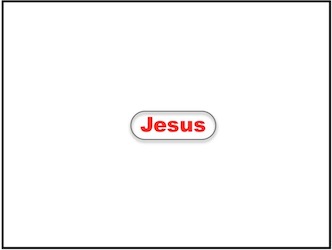
In truth, the “Jesus card” (above) that we gave the confirmation kids depicts a static Jesus – he’s not moving. Since he’s not moving, I can move toward and away from with ease and regularity. If I need him, I know where to find him – he’s right where I left him (i.e., I can leave him at Church and come back to see him the following week(s)). A static Jesus is safe and predictable and will not mess with my world. This is the Jesus of western cultural Christianity, the one we manipulate* so we can live a nice, civilized life. His job is to make us happy. With this Jesus, it’s mostly about me and sometimes about him. This Jesus won’t ask much of me. This Jesus will randomly ask us to serve others to appease him and to feel better about ourselves. I can’t follow a static Jesus (he’s not moving!). I can only “believe” in him. This all begs the question: “How can I have a dynamic relationship with a static Jesus?”

In reality, Jesus is on the move, advancing the kingdom work he inaugurated 2000+ years ago. As confirmation classes progressed, we helped the kids understand this. What changes for me if I see Jesus as present and on the move? Everything!

The Jesus depicted above is not static. He invaded our world 2000 years ago and turned things upside down.  This Jesus is on the move and has invited me to join him in his movement – the advancement of his kingdom.  If I choose to walk away from this Jesus for a while, he moves on without me because it’s not about me – it’s all about Him.  This Jesus asks for a lot – all of me.  This Jesus says that our primary purpose on earth is to serve others.  This is the Jesus of Christ-followers.  This Jesus is worth following and makes my following worthwhile.  This is the Jesus of scripture.  THIS IS THE REAL JESUS. Oh, and I can have a dynamic relationship with this Jesus!

I would suggest that if we find ourselves with a static Jesus, we don’t really know him. We have built a faith primarily on knowing about him. Consider that the Pharisees primarily had a static view of God. We certainly don’t want to align our theology with the Pharisees, but many of us have. How we follow is affected by how we view Jesus. Which Jesus do you “follow?”


For Your Consideration:

“It was the good (and extremely dangerous) news that the living God was on the move. Jesus came to Galilee as a wandering prophet, not a stationary one. Jesus’s contemporaries trusted all sorts of things: their ancestry, their land, their Temple, their laws.  Even their God – provided this God did exactly as they expected him to” (my emphasis). (From NT Wright in Mark for Everyone – comments regarding Mark 1:14-20.)


* The most accurate definition of idolatry is “conscious manipulation of God.”

Getting Close to Jesus…

Spoiler alert. This is part one of a two (or more) part series of posts. I am committed to keeping posts short for readability, thus the need for multiple editions. You’ll understand the reason as we continue…

A dozen years ago, I was prepping for a confirmation retreat for about 50 kids and their leaders. The intent of the retreat was to provide the kids with the opportunity to respond to what they were discovering about Jesus. Our hope was that they might choose to follow the Jesus that came for us – the One who died on the cross for the forgiveness of sin and was resurrected, paving the way to life eternal. In light of the discussions of the last post, we did NOT want to present them with the typical invitation to declare a cognitive belief. We did not want to lead to the misconception that the Christian faith is primarily a transactional act. So we tried something different…

At the beginning of the weekend, we gave the kids a card with “Jesus” on the center. We asked the kids to put an “X” on the card to describe how close they thought they were to Jesus, then discuss with their small group. There was a girl in the group who knew all the Jesus stories, having attended Sunday School all her life and now confirmation. She placed her “X” right next to Jesus, a bit proud of her knowledge of what Jesus had done for her in dying for her sins so that she could go to heaven.

Then there was Levi (not his real name). He placed a tiny “x” in the lower left-hand corner, as far away from Jesus as possible. I think he might have actually placed it on the backside of the card, had that been an option. When asked about the placement of his “x” on the “Jesus Card,” Levi explained to his small group that he knew very little about Jesus and what he did know came mostly from his first semester of confirmation. He wasn’t opposed to Jesus, just far away.

As the weekend progressed, we helped the kids understand belief/faith in terms of pisteuō (trust, reliance, adherence). We helped them understand that pisteuō is really a following term and that following implies direction (i.e., if I’m following someone, then I need to go where they are going). So we had the kids put an arrow on their “X” indicating direction in relation to Jesus. The exercise was transformative for many of the kids, especially Levi and the girl (we should give her a name – let’s call her Judy).

Judy sadly had to admit that she was actually moving away from Jesus. Though she was knowledgeable about Jesus, the exercise caused her to realize that she had no interest in following Him. She was focused on what Jesus could do for her (see Moralistic Therapeutic Deism) and wasn’t interested in giving him permission to run her life. Levi, on the other hand, was elated to to discover that he was actually moving toward Jesus. In fact, his arrow was fat and long in order to communicate to his small group that he was well on his way.

Yes, Levi was well on his way. He began to follow Jesus that weekend, learning to pisteuō Him, continuing the journey today. Judy struggled. She wanted to stand on what she cognitively believed, but did not want to give Jesus the reigns. Transactional (or positional) belief in God is not what Jesus calls us to. In fact, I would suggest that it gets it the way of actually following Him. You’ll want to come back to the next posting in which we will compare and contrast “belief” with “following.” In the meantime, think about how you might have marked the “Jesus Card” in the past. Or in the present.

It’s all Greek to me!

I took Greek 101 during my junior year of college at NDSU, the bastion of theological education. 🙂 NDSU, known mostly for its Ag-related and engineering curriculum, also had a religion department. It was actually a pretty decent religion department. One of the best courses I ever took was The Teachings of Jesus at NDSU.

Back to Greek 101. I thoroughly enjoyed my introduction to Greek – I still have the course book (see below). I learned that a plethora of our English words has Greek origins. (Example: The Greek word for horse is hippo; for river – potamos; combined – hippopotamus). My NDSU introduction to Greek whet my appetite for further discovery – discovery that has subsequently impacted my theology and faith.

One of the things I learned in Greek 101 is that the ancient Greek of the New Testament was an exacting language. A Greek word had one meaning and one meaning only. There were few, if any, exceptions to the rules. On the other hand, English is one of the weaker languages, containing words with multiple meanings and many exceptions to the rules. So, how does one translate an exacting language into a weak language? It’s difficult at best. That’s why I often access biblical passages online, looking at multiple translations simultaneously (example). It’s also why I like using the Amplified Bible (AMP). As we’ve discussed previously, it expands the English to better align with the richness and exactness of the original Greek. The Wuest New Testament does a similar treatment.

Greek 101, as well as the Amplified Bible, compelled me to learn some key biblical Greek words that have shaped my theology and faith. One of the first words I discovered is pisteuō (pist-yoo’-o), most often translated throughout the New Testament as believe. An example is the famous John 3:16 (For God so loved the world that he gave his one and only Son, that whoever believes in him shall not perish but have eternal life). The Greek word translated as believe is pisteuō. Belief implies a cognitive acceptance of something as true. In this case, it’s an acceptance of Jesus as God’s son, leading to eternal life.

Pisteuō is a stronger and richer word than believe. Pisteuō suggests a trust in, reliance on, and adherence to Jesus – a much more powerful concept. When I help young people understand the significance of pisteuō versus believe, I ask them what percentage of students at their school might say they believe in God. They typically agree on a high percentage – say 60 to 70%. After explaining that pisteuō means “trusting in, relying on, and adhering to” God, they lower their estimation significantly, usually well under 25%.

When we rely simply on the English version of believe, our faith can become transactional. Pisteuō is not a transactional term. It smacks of following (i.e., adhere to). Jesus didn’t invite people into a transaction. He invited people to follow him. Transactions tend to be clean and clear-cut. Following is messy (ask the original disciples!). Transactions are not relational. Following is highly relational. In my observation, western Christianity tends to lean transactional. I suspect it’s not what God intended.

Next time you read scripture, I encourage you to substitute “trust in, rely on, adhere to” each time you come across the word believe. It will bring your scripture reading to life. And likely your faith!