Believe: Not What You Think It Means


When many people hear the word believe, they think of agreeing that something is true.

Do you believe in gravity?
Do you believe George Washington was the first president?
Do you believe the Earth orbits the sun?

In everyday English, belief usually means accepting a fact or holding an opinion.

But when Jesus announced, “The time has come… The kingdom of God has come near. Repent and believe the gospel.”(Mark 1:15), he was not inviting people merely to accept information about God.

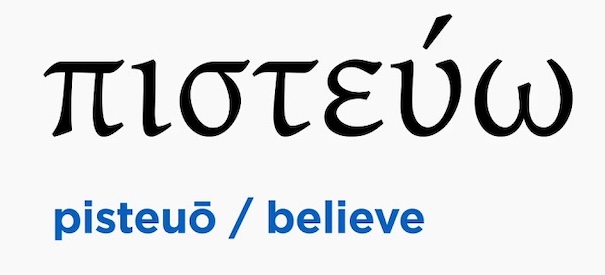
The Greek word translated believe is pisteuō (πιστεύω). And it carries a much richer meaning than simple mental agreement.  It means to trust, rely upon, entrust oneself to, and align one’s life with someone.

In other words, pisteuō is closer to commitment than opinion.

More Than Agreement

The Greek language had ways to describe simple acknowledgment of facts. But pisteuō describes something deeper: placing confidence in someone in a way that shapes one’s actions.

At its heart, the word involves three intertwined ideas:

Trust – placing confidence in someone’s reliability
Reliance – depending on that person
Adherence – orienting one’s life around them

When Jesus called people to “believe the gospel (good news),” he was not asking them merely to agree that the kingdom existed. He was inviting them to trust the king and begin living under his reign.

Belief That Moves Your Feet

One way to understand pisteuō is to notice how belief naturally leads to action.

Imagine standing on the edge of a frozen lake in winter. You might say, “I believe the ice is thick enough.” But if you never step onto the ice, your belief is really just a theory.  Real belief happens when you step out and put your weight on it.  That step – that act of trust – is much closer to the meaning of pisteuō.

Biblical belief is trust that moves your feet.

What Belief Looked Like for Israel

The people who first heard Jesus say “believe the good news” already had a long history of learning what trust in God looked like.  For Israel, belief was never merely intellectual. It was lived out through covenant trust and obedience.

When Abraham left his homeland because God called him to go somewhere he had never seen, that was belief. When Israel stepped into the waters of the Jordan, trusting God to lead them into the land, that was belief. When the prophets called the nation to return to the Lord and trust him rather than political alliances or military strength, they were calling the people back to belief.

In other words, belief meant placing their confidence in God and ordering their lives around his covenant rule.

This helps explain why the Hebrew Scriptures often speak of trusting the Lord rather than simply believing certain truths about him. Faith showed itself in dependence and obedience.

So, when Jesus announced that the kingdom of God had drawn near, he was not introducing a completely new idea. He was calling Israel to renew the very kind of trust God had always sought from his people.

Belief in the First-Century World

There is another dimension to this word that we modern readers sometimes miss.

In the first-century world, belief often carried the sense of loyalty or allegiance. People lived under kings and emperors, and public life involved recognizing and aligning oneself with a ruler’s authority.

To trust a king meant more than believing he existed. It meant acknowledging his rule, relying on his protection, and ordering your life under his authority.

Against that backdrop, the early Christian confession “Jesus is Lord” was profound. It signaled a shift in ultimate loyalty.

Seen in that light, believing in Jesus meant transferring allegiance – entrusting oneself to the king whose kingdom had drawn near.

The Pattern in the New Testament

Throughout the New Testament, belief consistently looks like trustful reliance rather than mere agreement.

In John 5:24, Jesus said that whoever hears his word and believes the one who sent him “has crossed over from death to life.” Belief here describes entrusting oneself to God in a way that results in a change of realm.

In Mark 5:36, when Jairus learned his daughter had died, Jesus told him, “Don’t be afraid; just believe.” In that moment, belief clearly means trusting Jesus enough to rely on him in the middle of fear.

And in Romans 10:9, belief is paired with the confession “Jesus is Lord,” language that points toward recognizing and entrusting oneself to the authority of the risen king.

Again and again, belief is not merely agreement – it is entrusting oneself to a person.

Hearing Jesus’ Words Again

Now listen again to Jesus’ announcement in Mark 1:15:

“The kingdom of God has come near. Repent and believe the gospel (good news).”

Notice the movement…

First, repent – turn around, reorient your life.
Then believe – place your trust in the good news of God’s reign.

Repentance turns us away from the old order.
Belief entrusts us to the new king.

Jesus was not asking people simply to agree with a message.

He was inviting them to step into a kingdom.

The Question Jesus Still Asks

Over time, the English word believe has become thinner than the biblical idea behind it. Today, someone might say, “I believe in Jesus,” and mean little more than agreeing with certain ideas about him.  Or that he existed.

But in the language of the New Testament, belief carried relational weight.

It meant trusting Jesus.
Relying on him.
Aligning one’s life with his reign.

Not just thinking differently but living differently.  Which means the question Jesus asked in Galilee still echoes today.

Not simply:

“Do you agree with this information about me?”

But rather:

“Will you trust me enough to live as if God’s kingdom is truly here?”

Because in the New Testament, belief is not just something that happens in your head…

It is something that eventually shows up in your life.

Which Jesus do we “Follow?”

Over the past 15-20 years, many people have preferred to refer to themselves as Christ-followers rather than Christians, of which I am one. However, what following looks like has everything to do with who we understand Jesus to be and what he is up to in the 21st century.

In the last post, I suggested that there is a significant difference between “believing” and “following.” I would further suggest that we consider the difference to be related to who we understand Jesus to be, rather than a mere definition differentiation of the two terms. It is important that we distinguish between cognitive belief, typical of 21st century western thought, and pisteuō, the Greek New Testament word often translated as “believe.” It might have more to do with who we want Jesus to be in our day-to-day lives.

What if I view Jesus in a transactional manner – meaning, he came, died and rose for the forgiveness of my sins with my acceptance of his action as a completion of the transaction? How might that affect who Jesus is to me? How might that affect daily life? I would propose that a transactional understanding of faith leads to a ‘static’ Jesus – he came to earth, did his job, and returned to heaven awaiting our arrival (unless he comes back to get us first). It’s the Jesus of Moralistic Therapeutic Deism! Consider what a static Jesus looks like…

In truth, the “Jesus card” (above) that we gave the confirmation kids depicts a static Jesus – he’s not moving. Since he’s not moving, I can move toward and away from with ease and regularity. If I need him, I know where to find him – he’s right where I left him (i.e., I can leave him at Church and come back to see him the following week(s)). A static Jesus is safe and predictable and will not mess with my world. This is the Jesus of western cultural Christianity, the one we manipulate* so we can live a nice, civilized life. His job is to make us happy. With this Jesus, it’s mostly about me and sometimes about him. This Jesus won’t ask much of me. This Jesus will randomly ask us to serve others to appease him and to feel better about ourselves. I can’t follow a static Jesus (he’s not moving!). I can only “believe” in him. This all begs the question: “How can I have a dynamic relationship with a static Jesus?”

In reality, Jesus is on the move, advancing the kingdom work he inaugurated 2000+ years ago. As confirmation classes progressed, we helped the kids understand this. What changes for me if I see Jesus as present and on the move? Everything!

The Jesus depicted above is not static. He invaded our world 2000 years ago and turned things upside down.  This Jesus is on the move and has invited me to join him in his movement – the advancement of his kingdom.  If I choose to walk away from this Jesus for a while, he moves on without me because it’s not about me – it’s all about Him.  This Jesus asks for a lot – all of me.  This Jesus says that our primary purpose on earth is to serve others.  This is the Jesus of Christ-followers.  This Jesus is worth following and makes my following worthwhile.  This is the Jesus of scripture.  THIS IS THE REAL JESUS. Oh, and I can have a dynamic relationship with this Jesus!

I would suggest that if we find ourselves with a static Jesus, we don’t really know him. We have built a faith primarily on knowing about him. Consider that the Pharisees primarily had a static view of God. We certainly don’t want to align our theology with the Pharisees, but many of us have. How we follow is affected by how we view Jesus. Which Jesus do you “follow?”


For Your Consideration:

“It was the good (and extremely dangerous) news that the living God was on the move. Jesus came to Galilee as a wandering prophet, not a stationary one. Jesus’s contemporaries trusted all sorts of things: their ancestry, their land, their Temple, their laws.  Even their God – provided this God did exactly as they expected him to” (my emphasis). (From NT Wright in Mark for Everyone – comments regarding Mark 1:14-20.)


* The most accurate definition of idolatry is “conscious manipulation of God.”

It’s all Greek to me!

I took Greek 101 during my junior year of college at NDSU, the bastion of theological education. 🙂 NDSU, known mostly for its Ag-related and engineering curriculum, also had a religion department. It was actually a pretty decent religion department. One of the best courses I ever took was The Teachings of Jesus at NDSU.

Back to Greek 101. I thoroughly enjoyed my introduction to Greek – I still have the course book (see below). I learned that a plethora of our English words has Greek origins. (Example: The Greek word for horse is hippo; for river – potamos; combined – hippopotamus). My NDSU introduction to Greek whet my appetite for further discovery – discovery that has subsequently impacted my theology and faith.

One of the things I learned in Greek 101 is that the ancient Greek of the New Testament was an exacting language. A Greek word had one meaning and one meaning only. There were few, if any, exceptions to the rules. On the other hand, English is one of the weaker languages, containing words with multiple meanings and many exceptions to the rules. So, how does one translate an exacting language into a weak language? It’s difficult at best. That’s why I often access biblical passages online, looking at multiple translations simultaneously (example). It’s also why I like using the Amplified Bible (AMP). As we’ve discussed previously, it expands the English to better align with the richness and exactness of the original Greek. The Wuest New Testament does a similar treatment.

Greek 101, as well as the Amplified Bible, compelled me to learn some key biblical Greek words that have shaped my theology and faith. One of the first words I discovered is pisteuō (pist-yoo’-o), most often translated throughout the New Testament as believe. An example is the famous John 3:16 (For God so loved the world that he gave his one and only Son, that whoever believes in him shall not perish but have eternal life). The Greek word translated as believe is pisteuō. Belief implies a cognitive acceptance of something as true. In this case, it’s an acceptance of Jesus as God’s son, leading to eternal life.

Pisteuō is a stronger and richer word than believe. Pisteuō suggests a trust in, reliance on, and adherence to Jesus – a much more powerful concept. When I help young people understand the significance of pisteuō versus believe, I ask them what percentage of students at their school might say they believe in God. They typically agree on a high percentage – say 60 to 70%. After explaining that pisteuō means “trusting in, relying on, and adhering to” God, they lower their estimation significantly, usually well under 25%.

When we rely simply on the English version of believe, our faith can become transactional. Pisteuō is not a transactional term. It smacks of following (i.e., adhere to). Jesus didn’t invite people into a transaction. He invited people to follow him. Transactions tend to be clean and clear-cut. Following is messy (ask the original disciples!). Transactions are not relational. Following is highly relational. In my observation, western Christianity tends to lean transactional. I suspect it’s not what God intended.

Next time you read scripture, I encourage you to substitute “trust in, rely on, adhere to” each time you come across the word believe. It will bring your scripture reading to life. And likely your faith!