Getting It…

Some years ago, I was sitting with a group of colleagues, discussing our roles as youth ministry professionals. The discussion at hand was centered on recruitment and development of volunteer leaders. We had immersed ourselves in Gospel reading, which led to pondering the types of people Jesus invited to follow him. More specifically, we wondered what he might have seen in the Twelve that separated them from the rest of his followers. It led to a lively discussion.

We then wondered about the qualities and characteristics Peter, James, and John possessed that caused Jesus to spend inordinate amounts of time with them and their development compared to the other nine. Some words we used to describe what Jesus might have seen in them were openness, willingness, teachable/coachable, hunger, authenticity, etc.

Translating to youth ministry, I asked what we looked for when recruiting volunteers to join us in our ministries. We agreed that the same general characteristics applied. I followed with this question: “Considering our existing leaders, what qualities do our best leaders possess that others may not?” We concluded they shared the same traits we believed Peter, James, and John had. We noted that other leaders might exhibit some of the traits but not all of them.

We decided to tackle a simple, one-sentence definition or descriptor of this x-factor that our best leaders seemed to have. After wrestling with several renditions, one in our group said, “I don’t know how to describe it. They just ‘get it’.” But what do we mean when we say someone “gets it?” Wrestling with that question for a while, we somehow landed on this:

If someone gets it, no definition is required. If they don’t get it, no definition will suffice.

I wonder if this is what Jesus meant when he said, “Whoever has ears to hear, let them hear.” Thinking back to the previous post (Best Prof Ever…), I wonder if some of Jesus’ brilliance in his teaching style was that he didn’t seem to be overly concerned with making sure people “got it.” He would tell stories about the nature of the kingdom of God to the crowds, sometimes feed them, and then go somewhere else.

Did he leave their questions unanswered? Did they even have questions in the first place? Did he simply give them something worth pondering and wondering about?

Maybe that’s why Jesus was such a good question-asker. “Getting it” doesn’t come simply with the provision of a definition or answer. Getting it usually happens when we ponder and wrestle with a question(s) over time. Looking at the youth minister example above, we wrestled with a number of questions. Jesus wanted people to reexamine their understanding of God and their cultural presuppositions of the nature of the kingdom. People do want answers but often seek answers to the wrong questions. Jesus would often do a reversal and ask a question that wasn’t even on their radar.

Jesus’ questions usually show up as blimps on our radars that we cannot ignore!

Looking back over my journey, I can remember several great questions asked by wise people that caused me to pause and do some rethinking. One in particular comes to mind: Early in my journey, I was wrestling with the manifestation of some of the spiritual gifts that well-meaning people suggested were missing in my life. Lots of people were providing “answers,” telling me what I ought to believe. However…

It was a wise sage in my life that asked me the exact right question: “Are you seeking the gift or the Giver?” That’s all I remember him saying. (I wonder if he might have been thinking, “Well, if he has ears to hear…”). Whatever he was thinking, it was transformative.

I wonder if it might behoove us to emulate Jesus’ approach when helping people get it, whatever “it” happens to be. I remember someone lamenting that their adult kids weren’t as connected to God the way they had hoped. I asked what they thought was the disconnect. Their response? “I don’t know. I certainly told them [what to believe] enough.” Our Western approach of telling people “how it is”1 doesn’t naturally lead to transformation, especially if they don’t have ears to hear. But a well-formed question can lead to discovery. I know a group of youth ministers who will never forget the discovery…

If someone gets it, no definition is required. If they don’t get it, no definition will suffice.

1Borrowed from Dallas Willard: Willard, D. (2024). The scandal of the kingdom : how the parables of Jesus revolutionize life with God. Zondervan Books.

Best Prof Ever…

As you may know, I took the looong route to obtaining my bachelor’s degree in Structural Engineering. I call it “The Nine-Year” plan. I started my higher ed journey quite traditionally, attending a reputable engineering school. But after the first quarter of my junior year, I dropped out, precipitated by various circumstances related to finances, lack of a sense of purpose, the Vietnam War, etc. I took a position with a local company with whom I had been employed in the engineering department (drafting) since my junior year of high school.

Within a few months of leaving school, I continued my pursuit of a degree in engineering. I commuted an hour after work to the University of Minnesota, taking many degree-fulfilling courses available through the extension program. Unfortunately, some of the required courses were unavailable through the extension program.

So, to complete the final 30 credits toward a degree, I took a two-quarter leave of absence. One of the required courses unavailable via the extension program was engineering physics. Physics proved to be a larger challenge than I had anticipated. I was several years removed from using calculus and the metric system. The pace was break-neck with a rhythm of 1-2 chapters/topics per week and an exam every two weeks. I knew the key to surviving and thriving in college-level math and engineering classes was to work problems – as many as possible, especially via a study group. Amazingly, I knew a couple guys in the class of 150 and we formed such a group.

My physics professor proved to be one of the best professors I ever had. I don’t remember his name, but I surely remember him. He knew his physics, but more importantly, he knew his audience. I remember him dedicating class the day before an exam to address questions we had. We were free to ask about the practice problems from the book that stumped us (“we,” of course, meaning all 150 of us).

He was brilliant in his approach. He would merely set up a problem, then casually remark, “You will be able to take it from here.” His approach allowed him to address 15-20 different problems – exactly what we needed. We didn’t need him to work a problem out to completion. We only needed him to get us started, sketch out the problem, and point us in the right direction. He set us up to “get it.” He didn’t do the work for us – he merely pointed us in the right direction.

How good of a professor was he? He made dreaded physics enjoyable. I learned! I started to “get it.” My presuppositions of engineering physics faded. He set me up to get an “A” in the class, a grade that didn’t come easy for me in college.

Two of my favorite authors, Dallas Willard and Howard Hendricks, both reminded readers that Jesus is the smartest person in the universe and that we would do well to learn from him. He was the best prof (rabbi) ever. He knew his material (the Hebrew Scriptures) and his audience (his apprentices, the religious leaders, and the general populous). He also stayed true to his purpose as a teacher—the proclamation and explanation of the nature of the kingdom of God which had arrived with his appearance.

The kingdom of God is an elusive concept lost on most of us for various reasons. Two-thirds of Jesus’ parables and most of his main discourses (i.e., the Sermon on the Mount) focused on the good news (gospel) of the kingdom’s arrival. Unfortunately, the kingdom of God has become equated to simply “heaven,” a place we go after we die. Such reduction of the gospel does injustice to the kingdom Jesus ushered in. Reading scripture through this narrow lens hinders our ability to fully grasp the true nature of God’s kingdom.

The same was true for the first-century adherents of Judaism. The people were familiar with a coming kingdom but didn’t fully grasp its true nature. They were aware, through less than stellar professors (the religious leaders), that God’s kingdom would arrive someday, but it would arrive in power and glory, overthrowing the pagan kingdoms. The kingdom of God had been reduced to a form of nationalism. Jesus’ teaching aimed to dismantle and challenge their false presuppositions.

For 30-40 years, I found it challenging to reconcile Jesus’ central message about the arrival of God’s kingdom with the teaching I often heard, which emphasized getting to heaven. Closely following the means to heaven attainment were sets of ethics to follow until we finally get to depart this earth. There was no kingdom. There was no explanation of the kingdom’s nature. Most of Jesus’ kingdom teaching was reduced to moralism—behavior modification. There was no transformation. There was no life.

In his recent posthumously written book, The Scandal of the Kingdom, Dallas Willard offers a conceptual understanding of a kingdom…

A kingdom is a society of people with a structure in which there is one person, a king or queen, to whom all the citizens offer loyalty, service and respect.  The sovereign’s part of this relationship is to provide care, protection, and service for the good of the people.

The Hebrew Scriptures contain the story of God and his people, warts and all. Threaded through the narrative are stories that point people to an understanding of a King who provided care, protection, and service for the good of the people (think righteousness, justice, love, and faithfulness—see It’s Foundational). We know this story—the people struggled to embrace God as their king.

The foundational story was highjacked in favor of sets of ethical rules to ensure correct behavior. The professors became moral guardians. No transformation and certainly not life-giving. Jesus’ task was to wrestle the false concept of God’s kingdom away from the highjackers and help the people understand the nature of what was really at hand. Wrestle away? It appears Jesus suggested that’s exactly what he needed to do…

From the days of John the Baptist until now, the kingdom of [God] has been subjected to violence, and violent people have been raiding it. (Matthew 11:12, NIV)

How was Jesus a stellar professor? He brought people back to the story of God and his people. He pointed people to the intent and nature of the Torah, not just the letter of the law, as the highjackers had done. He pointed people to an understanding of a kingdom where the King offered a covenant loyalty and asked the people to respond accordingly.

His stories and discourses wrestled a moralistic and ethical kingdom concept from the moral guardians and gave the people a different kingdom concept. He didn’t provide people with exacting instructions on how to live. Instead, he told stories of what life in the kingdom could look like and invited hearers to become subjects. He told stories that reversed the moralistic view of the kingdom and pointed to a different “ethic.” Oh, and his stories indicated that the kingdom was for anyone and everyone. All were invited.

Like my physics professor, Jesus didn’t work out all the details. He told stories that described the nature of God’s kingdom. He sketched out the concept of the presence of God’s kingdom and let them “take it from there.” And many “got it”—those who had ears to hear. He simply pointed people in the right direction and then said…

“Follow me.”

Silo-Filling

I have always loved autumn for a variety of reasons. In Minnesota, we get to experience warm days and cool nights. At night, the AC is turned off, and the windows are opened again, capturing all the outdoor sounds as we sleep. During the day I can fling open my shop doors and enjoy the smells of fall as I do my woodworking.

Growing up on the farm, autumn also meant harvesting the fall crops. After waiting all summer for our spring planting efforts to come to fruition, we enjoyed the fruits of our labor and patience (I think of Mark 4). By far, my all-time favorite harvest was chopping corn for silage, especially the associated smell of fresh chopped corn. It’s the same smell you get when husking out sweet corn.

When the corn stocks were still mostly green and the kernels beginning to dent, we took to the fields with a chopper and wagons to harvest the crop that would ultimately become silage (think sauerkraut). Wagonload after wagonload of chopped corn were taken out of the field and brought to the farm yard to be blown 50′ up into a silo. We called the whole process, “silo-filling.”

Part of the enjoyment of silo-filling for me during my junior high and high school days was getting to miss school for several days to man a tractor and wagon. I made several trips per hour out to the field, returning to the silo with a loaded wagon for emptying into the blower. I loved every bit of it and have great memories as I write this.

Year after year, I lived with one hope – that I would “happen” to be bringing a loaded wagon up to the silo at the same time that the school bus came by at the end of the day. How glorious to have my peers see me at work while missing school. I would strategically try to make it happen. It did happen, but only once. But it was glorious! I felt rewarded for all my work and strategy.

For the last several weeks I have been working my way through the Sermon on the Mount in Matthew’s gospel. I recently read Jesus’ admonition regarding prayer…

Whenever you pray, you must not be like the hypocrites, because they love to pray standing in the synagogues and on the street corners to be seen by people. Truly I tell you, they have their reward. (Matt. 6:5, CSB)

It’s my understanding that in the first century, at the time of Jesus’ earthly ministry, Jewish religious practice and traditions included fixed times of prayer – morning, afternoon, and evening. Modern Hasidic Jews still observe the fixed prayer times. When we were in Jerusalem several years ago, we found ourselves at the western wall of the Temple Mount (the “wailing wall”) around 3:00p, where many Orthodox Jews had gathered for prayer. Interestingly, at the same time, Muslims were gathered in the mosque on the Temple Mount for their time of afternoon prayer.

In the first century, if a worshiper could not get to a synagogue for prayer, they stopped where they found themselves, faced the Temple, and recited their prayers. I was once on a train from Minneapolis to Chicago when at 9:00a several Hasidic Jews stepped out into the aisle to recite their prayers (known as davening), including the traditional rhythmic swaying back and forth.

I understand that in Jesus’ day, religious leaders would strategically position themselves for the best possible exposure at prayer time, hoping they might find themselves on a busy street corner for all to see. They were praying, as they should, but their motives were wrong. Their piousness was a pretense. Etymologically, pretense and pretend are connected.

So, Jesus rightly referred to these strategizers and hypocrites, as pretenders. The point Jesus made to his disciples and the crowd listening in this discourse was that the righteousness of the religious leaders was insufficient and incomplete. In God’s economy, the righteousness of kingdom people must (will?) surpass that of the religious leaders who did the right things but for the wrong reasons (see Matt. 5:20).

Here’s the thing that’s a bit scary to consider: the religious leaders did not see themselves as pretenders. They were faithfully practicing standard-fare pious acts religiously (giving to the poor, praying, fasting, etc). They were probably completely stunned to be called pretenders. And, as we discover, they were angered to no end.

Jesus encouraged pious practices but sans strategy. In the same section, Jesus discussed the practice of giving to the needy. In their “righteousness,” the pious leaders practiced giving to the poor. It was a good thing to do. But in their incomplete righteousness, they were doing the right thing but only pretending they cared about the needy. Jesus was teaching that in God’s economy, the righteousness of kingdom people will exceed that of the calculating religious leaders.

We think of hypocrisy as “saying one thing and doing another.” Jesus seems to view hypocrisy as doing something with wrong motives – pretending. And that’s scary because our motives are always a bit suspect. But there is good news. As kingdom people, we are being transformed into the image of the King in which a modus operandi of pretending fades. But when it does surface, we can declare confidently with the Apostle Paul…

Who will free me from this life that is dominated by sin and death? Thank God! The answer is in Jesus Christ our Lord. (Romans 7:24-25, NLT)

“Jesus!”

Billy attended school with me during my early Junior High days. He was in most of my classes. He was also our pastor’s son. He clued me in on something in seventh grade that might have had a larger impact on my life than I might have expected.

We were part of a Sunday School class of all boys (at least, that’s what I remember). I also remember that we were a typical group of seventh graders with built-in ADHHHD. Paying attention to the teacher or lesson was not high on our abilities or agendas (I suspect most of us were not in the class by choice). Billy’s clue was related to our Sunday School class. He told me he learned from his dad that if asked a question by the teacher and unsure of the answer, “Jesus” was always a safe response – a “Sunday School answer.”

One Sunday I was particularly distracted when, toward the end of class-time, our teacher asked me point-blank if I knew the answer to the question he had just asked. I had no idea what he had asked! And I was pretty sure he knew I hadn’t been paying attention – I suspect the question was his way of letting me know. Remembering Billy’s suggestion, I said, “Jesus!” emphatically and with confidence. The teacher looked a bit surprised and said something like, “Yes! And don’t ever forget it!” Class was over. I got the answer right and I didn’t even know what the question was!

“You can’t get second things by putting them first; you can get second things only by putting first things first.”  C. S. Lewis, God in the Dock

C. S. Lewis spoke of first things throughout his writings. Just yesterday I was speaking with someone who had recently stumbled onto one of his essays that pointed readers to first things. I wonder what Lewis’ answer would have been if asked, “What is the first thing?” I suspect he would have said, “Jesus!” emphatically and with confidence. And he wouldn’t have been offering up a Sunday School answer.

Today if asked about the first thing, I answer emphatically and with confidence, “Jesus!” Many would agree with me. However, the answer begs a follow-up question: “Which Jesus?” Sounds like an odd question, but not really. One could be talking about the Jesus of Moralistic Therapeutic Deism, whose job is to make us happy and show up when we need him. Or the Jesus of economic prosperity who lavishes us with material blessings. Or the Jesus we draw into our political bents to help us gain control over the ‘other.’ Or the western version of Jesus (or eastern). Or a Jesus whose main role is to simply get us to heaven. These incomplete Jesuses are a result of putting second things first – which is what he can do for us.

The first thing must be the Jesus of scripture, the real Jesus, not a ‘Jesus’ informed by culture, ideologies, or what he can do for us. The first thing must be Jesus only. Period. It takes concerted time and effort to see past the pseudo-Jesuses to the Jesus of scripture. I speak from experience. This is why I require young people that I mentor to be immersed in the Gospels (Matthew, Mark, Luke, John). I can say from experience that it is worth the time and effort. It’s transformative.

It all starts with an open, honest perspective of where one is now.

So, ponder for a bit: In what ways might the ‘Jesus’ you know be shaped by outside ideologies?

The least of these…

The king will answer, “Whenever you did it for any of my people, no matter how unimportant they seemed, you did it for me.” (CEV)

After a hiatus of several years, I’m looking to serve and volunteer at our local Alternative Learning Center (ALC). A little primer if you are unfamiliar with the ALC approach to helping students learn, graduate, and flourish. A few decades ago, some top-notch educators recognized that there was a population of young people who traditional secondary schools did not/could not serve well. Alternative approaches were piloted and birthed.

ALC students don’t do well in traditional settings for a variety of reasons – learning disorders, broken homes and broken lives, chemical dependency (theirs and/or their parents), residual fetal drug and alcohol effects, etc., etc.

My road to serving at our local ALC over 15 years ago, was precipitated by the tragic death of Johnny*, a student in our community. Johnny’s circle of friends included students at both the traditional high school and the ALC. Having previously helped facilitate grief & loss groups at the high school, I decided to lead a group off-site so I could serve kids from both schools. Amazing relationships grew out of our time together.

Wanting to stay connected with the students from the ALC, I decided to stop by at lunchtime one day. The school had a closed-campus policy related to the presence of youth ministers. Upon entering the school I immediately ran into the principal. She was rightfully interested as to why I showed up in her building of 100 students. I explained that I had facilitated a grief & loss group of some of Johnny’s friends and wanted to check in with them to see how they were doing. No more questions. She took me right to the lunchroom to see the kids I knew. The closed campus was apparently open to those willing to serve “their kids.”

Over the next dozen or so years, I served in that school in a variety of capacities – tutoring, mentoring, administering Acclaro (a values clarification process I honed for students), starting a chess club, serving at Holiday meals, and leading grief & loss groups regularly (there was a lot of grief and loss among the students!). One of my favorite capacities was serving in an English/Leadership class. Attending a couple of times a week, I became part of the fabric of the class.   

In the Leadership Class, the students gave several topical speeches throughout the semester.  They wanted me to join them and give speeches as well.  After each speech, the floor was open for encouragement and follow-up questions.  One time, after giving my speech and the kids had exhausted their questions, the teacher said, “I have a question.  Why do you do this?  Why did you choose to serve in this class?”  I asked her if she wanted my real and honest answer.  She said, “Yes.”

The honest answer I gave?  “I do this because I think Jesus would have.  He displayed a big heart for ‘the least of these’ and encouraged his followers to do likewise.”  Gesturing to the students I said, “You know I don’t see you as the least of these” to which they responded, “No, but everyone else does.”  The teacher concurred.

One of the great privileges during my tenure serving our local ALC was the collaborative establishment of a one-on-one mentoring program between the school and Young Life. People of faith committed to meeting with a mentee weekly on campus, encouraging him/her as they struggled to navigate the difficulties of life and school. We called the program Walk With Me. Once matched with a student, the Walk With Me mentors committed to walking with them until they graduated. It was transformative – for both the mentors and students.**

As I said earlier, after a hiatus of several years, I sense the need to find a way to serve the kids at our local ALC again. Why? I can’t not. The Jesus I follow and serve is tugging on my heart to step into the lives of some kids I don’t even know yet.

“Whenever you did it for any of my people, no matter how unimportant they seemed, you did it for me.”

* Not his real name.

** Unfortunately Walk With Me didn’t survive the effects of COVID at our local ALC. It was replicated and continues to thrive at the ALC in Fergus Falls, MN.

Ludicrous

A couple of years ago, my friend Kevin inspired the blog post Enamored. Over the past few years, he has been on a journey through the four gospels, discovering the Jesus of scripture, a Jesus he never knew. Last week Kevin shared with me a summary of his discoveries from his gospel immersion. It is something worthy of sharing, so here it is (by Kevin Thomas, Regional Initiatives Coordinator, Young Life North Star Region)…

Ludicrous

It’s an unquestionably ludicrous task to attempt to summarize the life of Jesus in a short essay.  Over the centuries the life of Jesus has been analyzed, critiqued, deconstructed, and reconstructed countless times, with each writer attempting to offer a clear, compelling, and accurate view of this man’s short life on earth. Everyone who has attempted this endeavor inevitably falls rather short of their original intention (see John 21:25).

Having completed 34 years as a local church pastor who preached through Scripture each Sunday, I had to ask myself a rather uncomfortable question: do I really know Jesus? Oh sure, I could adequately explain how Jesus Christ fit into God’s plan for human redemption and the restoration of all things. Yet did I know Jesus the way his disciples did? The Jesus with whom they ate meals, took long walks, listened to stories, witnessed miracles, and shared day after day together?  

Thus, throughout the past four years, I journaled my way through Matthew, Mark, Luke, and John by writing out pretty much every word of these texts, with notes, ideas, and questions listed all over the available page margins. Having completed this endeavor, I figured I had better present some type of summary of my discoveries. I offer here a surprise, a caution, and an encouragement along the pathway to a somewhat better understanding of Jesus. 

My Surprise:  The guy desperately needed a PR agent. Repeatedly throughout the gospels, Jesus had people eating up his words, mesmerized by his powers and personal aura. And repeatedly he “wasted” these opportunities by doing or saying something off-putting, confounding, or offensive. He lived in a time when people were desperate for a leader portraying compassion, authority, and a compelling vision of life and society. Yet, when multiple moments offered him the opportunity to sweep up the masses in a ravenous rapture of fervor and devotion, he simply walked away while tossing out a bizarre comment or an offensive demand that stopped the crowds in their tracks. (John chapters 5-6 illustrate this theme in full technicolor.)

My Caution:  Don’t even try. Try what? DO NOT TRY to get Jesus to side with you. Lots of people worked their angles in an attempt to rally Jesus to their holy cause—to join their theological, religious, political, social, moral, economic, national program to fix the world. He never bit, much less nibbled at their propositions. (Consider John 18:28-19:16 as a portrayal of Jesus’s shocking aloofness as his life hung in the balance.) Jesus presented himself to be “wholly other”—a person whose unique vision for life, faith, church, and society will never fit neatly within the categories others have defined. Whatever surety of intellectual positions I held before delving deeply into Jesus’ life and teachings, I now find myself sitting with only my toes in the ocean of the mystery of God’s work in our world. Maybe someday I’ll be able to wade out ankle-deep in the unknown fathoms of God.  Yet despite my best efforts, I don’t think that’s likely to happen anytime soon. 

My Encouragement: You really can meet your hero. While certainly not a voracious reader, over the years I’ve soaked in a few biographies of the famous people of our nation’s past—those 500-page biographies of people like Washington, Jefferson, Lincoln, Grant, Douglas. It’s always with trepidation that one venture into the life of the famous. You are certain to discover the dark side of their character—some underlying compulsion that undermines their success and taints their legacy. With Jesus, I found no such underbelly. His vision is clear, his integrity is all-encompassing, and his commitment to sacrifice himself for the good of others is nothing short of astounding. I couldn’t unearth a single thought or act that tainted his life and legacy. It’s unthinkable, really. (John 13 offers a compelling example of Jesus’ love in the face of personal betrayal.) 

Feeling hopelessly lost in the bigness of Jesus, my first attempt to summarize his life was to start a list of simple, yet often paradoxical, descriptors. It’s now in the form of a “word cloud.” I offer it below, aware that only a ludicrous person would attempt to place Jesus in a box.  

Conversatio Morum!

I love history. Several times I have read or listened to Shelby Foote’s The Civil War: A Narrative – his 3-volume, ~3000-page narrative of the war between the states. I have also worked through Flavious Josephus’ Antiquities of the Jews, the first-century, 20-volume historiographical account of the Jewish people from creation to the 70 AD siege and fall of Jerusalem. You might say I’m a bit of a geek when it comes to history.

I am also drawn to Church history. I have read Justo Gonzalez’s 2-volume work, The Story of Christianity (a very good read, by the way). I have read it twice and listened to it a couple of times (while working in my wood shop)!

Historically, early Christian thought and behavior were influenced by the desert fathers, the monastics who literally stole away to the Egyptian wilderness area to learn spiritual formation. You might be familiar with The Rule of Benedict (circa AD 530) which has become popular in recent years thanks to people like John Mark Comer. The Rule is a basic plan to follow Jesus, to hold true to a commitment to be a disciple. “Rule” was Benedict’s term. It described the way of life of the serious Christ-follower. Remember that the early Christian movement was initially described as The Way.

While reading about Benedict, the term conversatio morum surfaced.

Conversatio morum is a term that is difficult to translate into English. Scholars debate Benedict’s intent as they study and interpret his Rule. Some of the various translations include conversion of life, reformation of life, and constant conversion. Benedict appears to have used conversatio morum to describe fidelity to a “monastic way of life” signifying a life-long commitment to spiritual growth and transformation. In non-monastic terms, it represents a life-long commitment to be a disciple of Jesus with the associated transformation.

Of the translated phrases, the related terms conversion of life and constant conversion, piqued my interest. In Western thinking, conversion tends to be viewed as a one-time, transactional event. An example is the accepted view that the Apostle Paul was “converted” on the road to Damascus (Acts 9). Paul was not converted from unbelief to belief. He was a believer in God who started thinking differently after meeting Jesus. (See also Here I Am).

Conversatio is the root of the English word conversation. At its core, conversation has more to do with listening than speaking – listening with the understanding that conversation can lead to a change of thought and mind (not how we tend to view conversation today!).

Change of mind? The word repent comes to mind.

The English word repent used throughout the New Testament is a translation of the Greek word metanoeō, which simply means “think differently.” When we bring these aspects together, our focus will be on maintaining a constant state of conversion, remaining open to reevaluating our beliefs. And remaining in continuous conversation with God, the one who can change our minds if we have ears to hear.

However, the concept of constant conversion is a bit unnerving, especially for us Western thinkers. We want things neat and tidy. We want to discover and nail down “the truth.” We want certainty. God doesn’t often provide the certainty we desire. If he did, we wouldn’t need him anymore. We wouldn’t need to be in constant conversation with him. We wouldn’t need to continue in his word. We wouldn’t have to risk a change of mind.

The concept of constant conversion should keep us humble. It should help us to listen to one another. It should keep us curious and asking questions. Once we convince ourselves that we know all we need to about God, we are further away from the truth than when we started.

“We are closer to God when we are asking questions than when we think we have the answers.” (Abraham Joshua Heschel)1

I remember a New Testament scholar,* in speaking of the concept of constant conversion, saying that we must be born again, again. Until we truly get comfortable with not knowing, we’ll have a hard time seeing/entering the Kingdom that demands us to be constantly rethinking, constantly converting, and declaring death to our personal status quo. Maybe that’s what Jesus was intimating when he told the Pharisee, Nicodemus…

Very truly I tell you, no one can see the kingdom of God unless they are born again. (John 3:3)

A ministry colleague of mine has a standard question he includes during job interviews: “Tell me about something you used to believe but then you changed your mind” or the corollary, “Tell me about something you believe today that you didn’t use to.” He wants people on his team who are still searching, learning, and open to change. Constant conversion.

The time has come. The kingdom of God has come near. Repent and believe the good news! (Jesus, Mark 1:15)

1Heschel, A. J. (2005). Who is man? Stanford University Press.

* I don’t remember who said this and have been unable to find the source in my notes on my laptop or hard drives. 🫤

Here I Am!

I loved playing hide and seek when our kids were toddlers. They didn’t totally understand the concept, though. I would send them off to hide as I counted. With their inability for stealthiness, I always knew exactly where they were hiding. Pretending that I couldn’t find them, I would say out loud, “I wonder where (name) could be?” Unable to contain their excitement, they would jump out and exclaim, “Here I am, Daddy!”

I recently spent time reading and pondering Acts 9 – the “conversion” of Saul (later known as Paul). I say “conversion” because he wasn’t actually converted as we tend to use the term. We usually associate conversion from non-belief to belief in something. Saul was not an unbeliever. In fact, he was a zealous believer, learner, and adherent of the Mosaic law.

As you might remember, Saul had received permission (along with appropriate documentation) from the Jewish high priest to travel from Jerusalem to Damascus to arrest followers of the Way for trial before the ruling council, the Sanhedrin, back in Jerusalem. As Saul and his entourage set out for Damascus (a 3-4 day journey by mule or horseback), it would be fair to assume that some believers in Jerusalem high-tailed it to Damascus to warn the believers of Saul’s impending arrival and intent.

What if you lived in Damascus and belonged to the Way?

What would you do? Would you leave the city until the threat was over? Not everyone had the means or ability to do so. Would you go into hiding? Who could you trust? I have read various World War II accounts of the reactions of the Jewish people in cities soon to be overrun by the Nazis. The Wehrmacht’s reputation along with the authority to mistreat Jews bred fear as people escaped the city or went into hiding. I assume a similar fear spread through the young Christian community.

As we know, Jesus intercepted Saul, spoke to him directly (“Saul, Saul! Why are you persecuting me?”), blinded him with the brightness of his presence, and sent him into the city to await further instructions. In a great reversal, Saul found himself hiding in the city. Picking up the story from Acts 9…

In Damascus, there was a disciple named Ananias. The Lord spoke to him in a vision. “Ananias!” he said. “Here I am, Lord,” he replied. (Acts 9:10, NTFE)

“Here I am, Lord.” Where have we heard this before? We find Isaiah speaking similar words in Isaiah 6. In a vision, Isaiah saw the Lord in full glory and responded, “Woe to me! I am ruined!” Then the Lord spoke directly: “Whom shall I send? Who will go for us?” Isaiah’s well-known response…

“Here I am. Send me.”

The same Lord spoke to Ananias in a vision. Visions tend to happen when someone is in intimate communion with God. We can assume that Ananias might have been praying when the Lord spoke to him. What was he praying about? We have no idea, but I suspect protection from Saul and his cohort might have been part of the conversation. In the vision, God gave Ananias the address where Saul was hiding and instructed him to go lay hands on Saul so he could see again.

Saul was anticipating Ananias’ arrival – he had received a vision, too. So, Saul was praying? I suspect so. He had just had a visit from the resurrected Jesus. I suspect he prayed a lot! He probably had a lot of questions to which he needed clarification. For three days he fasted and prayed. And probably meditated as well. The meditation practices of the Pharisees in the first century were deeply rooted in the Hebrew Bible and Jewish tradition. I imagine Saul pondered his memorized scriptures, wondering how Jesus fit into what he thought he understood.

Naturally, Ananias objected to God’s directive. The word was out of Saul’s reputation, his arrival in Damascus, and that he came with the authority of the chief priests to arrest Christians. “Just go,” replied the Lord. “He is a chosen vessel for me [like Isaiah?], to carry my Name before the nations and kings – and the children Israel, too.”

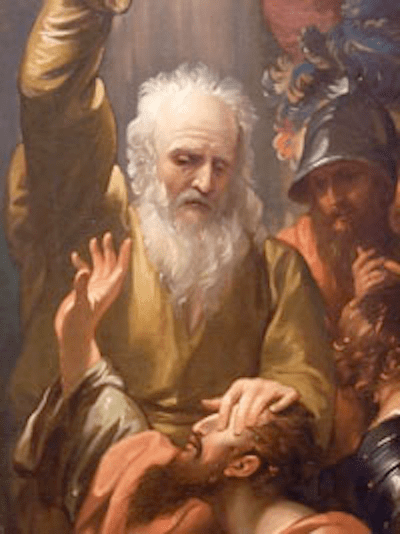
Conversion of St. Paul. Benjamin West, ca 1786

17 So Ananias set off, went into the house, and laid his hands on him. “Brother Saul,” he said, “the Lord has sent me—yes, Jesus, who appeared to you on the road as you were coming here—so that you may be able to see again, and receive the Holy Spirit.” 18 At once something like scales fell off his eyes, and he was able to see. He got up and was baptized.

Saul subsequently went on to become a most significant person of the new movement, starting churches across the Roman Empire. He also provided deep theological thought connecting the Hebrew Scriptures* with the life and work of the resurrected Jesus. Nearly half of the books in the New Testament are attributed to his later writings. And what of Ananias? We know no more than this short encounter. What we do know is that he was available. And obedient. May we always be postured to be able to say…

Here I am, Lord.

* From NT Wright regarding Saul’s discoveries: It confirmed everything Saul had been taught; it overturned everything he had been taught. The law and the prophets had come true; the law and the prophets had been torn to pieces and put back together in a totally new way.1

1 Wright, N. T.. Acts for Everyone, Part One: Chapters 1-12 (The New Testament for Everyone) (pp. 140-141). Presbyterian Publishing Corporation. Kindle Edition.

Read the Introduction

I discovered that no one reads introductions to books. A few years ago, my son sent me a photo of a footnote in a work-related book he was reading. The footnote concluded with something like, “This information should have been included in the introduction, but since no one reads introductions…”

I did not habitually read introductions until after reading the Celebration of Discipline, by Richard Foster, some 45 years ago. It was a blockbuster that all serious Christ-followers would/should want to read. A wanna-be serious Christ-follower, I bought it and dove in. Celebration of Discipline explores the “classic disciplines,” or central spiritual practices of the Christian faith – the inward disciplines of meditation, prayer, fasting, and study; the outward disciplines of simplicity, solitude, submission, and service; and the corporate disciplines of confession, worship, guidance, and celebration.

Reading this well-acclaimed book was to have resulted in a rich spiritual life infused with joy, peace, and a deeper understanding of God. That did not happen. The opposite happened as you can read in a previous post, Circa 1981…I Quit! The twelve disciplines overwhelmed me to the point of giving up. I could never juggle all twelve, so why try? A few years later as I shared my frustration with the book to a friend, he asked if I had read the introduction. Of course not! I wanted to jump into the meat of the book.

Wondering if I might have missed something, I read the introduction, where Foster laid out the purpose of the disciplines. They were not disciplines as we tend to think (i.e.,, “She’s really disciplined in how she lives her life.”). The disciplines weren’t things to do or accomplish. They weren’t a means of self-transformation as I mistakingly thought. The disciplines had one purpose and one purpose only – to position us before God so that he could transform us into his image. Information that would have been good to know before reading the book! After that experience, I have not failed to first read a book’s introduction!

I recently began a read-through/study of the Gospel of John. Though I’ve read this gospel many times over the years, I realized that the first 18 verses of chapter one are John’s introduction to the rest of the story. The New Living Translation refers to the section as Prologue: Christ, the Eternal Word. John’s introduction/prologue sets a powerful stage for the remainder and essence of his gospel. How powerful? Some examples…

1In the beginning was the Word, and the Word was with God, and the Word was God. He was with God in the beginning. Through him all things were made; without him nothing was made that has been made.

Composed about 60 years after Jesus’ resurrection, John wrote his gospel in Greek and chose logos (think logo) which is translated as “Word” in English. First-century readers would have been familiar with the use of logos from Greek philosophy. Heraclitus was one of the earliest philosophers to use the term logos extensively. For him, logos represented the underlying order and reason in the universe, stating that all things came into being according to this logos. John personified and deified logos, a significant introductory statement that would play out through his narrative.

In him was life, and that life was the light of all mankind.

John employed the word zoe, another word not lost to Greek philosophy. Zoe describes an absolute fullness of life, both essential and ethical – a real and genuine life, a life active, vigorous, and blessed. The Logos was the source of zoe for humanity. Think John 10:10, “I have come that they may have life (zoe), and have it to the full.” John, as did some of the Greek philosophers, connected zoe to logos. Again, no insignificant move. Zoe appears over 30 times in John’s gospel.

12 To all who did receive him, to those who believed in his name, he gave the right to become children of God…

Believe is such a varied word in the English language. It is context-dependent, ranging from degrees of hope (e.g., “I believe the Timberwolves will make the NBA finals”) to degrees of certainly (e.g., “I believe this chair will support me when I sit on it”). The Greek word that John uses here is pisteuo and is very specific. Believe is not an adequate translation of pisteuo. A more accurate translation would include the phrases, “rely on, trust in, adhere to.”

Think about this: I like to ask people what percent of people that they go to school or work with would say they believe in God. The response is usually a large percentage – upwards of 50%. A second question: What percent would say they rely on, trust in, and adhere to God. A much smaller estimation. English “believe” does not do pisteuo justice. Why is this important? John utilizes pisteuo close to 100 times in his gospel so it’s important that we grasp its full meaning. (Here’s a suggestion: When reading the New Testament scriptures, translate “believe” to a form of “trust” and see what that does to your understanding.)

14a The Word became flesh and made his dwelling among us.

Literally, “the Logos became flesh and tabernacled among us.” In his introduction, John made it clear that the Nazarene Jesus was, in fact, the Logos, God in the flesh. Equally important was his use of the term tabernacle. All first-century Hebrew readers knew the significance of the Tabernacle – it’s where God resided with his people. Their final tabernacle was the recently destroyed, idolized Temple of Jerusalem. In this introductory statement, John made clear that God took up residence among his people as a human being. This informs the rest of his gospel.

14bWe have seen his glory, the glory of the one and only Son, who came from the Father, full of grace and truth.

Full of grace and truth! I have previously written about hesed and emet (see The Two Biggies). Grace and truth are the Greek equivalents of hesed and emet. John has attributed these two strong attributes of God to Jesus, the Word that had become flesh. People often ask about the God of the Old Testament versus the God of the New Testament. In these introductory statements, John was clearly saying there is no difference.

This is merely a primer of what John has packed into these introductory verses (of course, his gospel did not contain chapters or verses). Encapsulating the essence of John’s epilogue, I suspect entire books could be (probably have been) written regarding this prologue. Hopefully, this is useful for you – it was for me. And going forward…

Read introductions first!

Everything’s a Surprise…

Throughout my ministry career, I have always used the philosophical “Modus operandi” that everything’s a surprise at _______ (fill in the blank). This was certainly the MO of Young Life over the years. Heck, my introduction to the ministry came from taking ten kids to a Young Life camp in Colorado – and everything was truly a surprise. We did mystery road trips where kids had no idea what to expect. We told them what they should pack and the rest was a surprise.

That philosophy translated when serving in Church youth ministry opportunities as well. I wanted the leaders (and the kids) to understand that “everything’s a surprise” is theologically solid.

We read a book to our own kids as they were growing up – Theirs is the Kingdom. It is a wonderfully written story of Jesus. It is not a children’s Bible, per se. It is more of an aggregate narrative of all the gospel writings. The title of one of the sections of the book particularly captured my attention: The Surprise of the Kingdom. I remember thinking the title was apropos of God’s character displayed through the centuries and especially through Jesus. Everything Jesus did and said was a complete surprise to all witnesses.

Living the Christian life is not a well-laid-out journey. We really don’t know what each hour/day/week/years(s) might hold. It’s a journey full of surprises. If we want otherwise, we might want to pick a different religion!

Why don’t we like surprises? I’m guessing because then things are out of our control and that’s pretty uncomfortable. We prefer comfort and control. But in our preference for comfort and control, Jesus has to be pushed to the wings. They aren’t congruent.

Think of Jesus calling people to follow him, especially the fishermen. Come follow me and I’ll make you fishers of people. That’s all he told them, The rest was… wait for it, a surprise. We have no indication that other disciples had even that much definition as to what lay ahead when he invited them to follow. They didn’t know what was going on half the time, but they followed anyway because Jesus’ words had the ring of eternal life (John 6:68-69, JB Phillips).

What I think might relate to Christ-followers in the 21st century is Jesus’ discourse with the Pharisee Nicodemus. It was a bit of a primer of the life in the Spirit. As Jesus spoke with Nicodemus, he metaphorically related the Spirit of God with the wind that blows where it pleases…

The wind [or spirit] blows all around us as if it has a will of its own; we feel and hear it, but we do not understand where it has come from or where it will end up. Life in the Spirit is as if it were the wind of God (John 3:8, The Voice).

The wind of God, carrying us along where He wants to take us. In following Jesus, God’s Spirit, the Holy Spirit, takes us places we don’t expect or anticipate. Following Jesus, being led by the Holy Spirit, is the penultimate mystery road trip, full of surprises. Read the book of Acts and pay close attention to how the Holy Spirit directed the lives of the first followers. Nothing was as they thought it would/should be.

Everything was a surprise for the early followers

At Pentecost they spoke about Jesus in languages they never learned. Peter never thought he would eat non-kosher food. Surprise, he did. Especially follow the life of the Apostle Paul. Jesus surprised him while on a literal road trip to Damascus to arrest Christians and bring them back to Jerusalem for trial. On that trip the wind started to blow in a different direction for him. That same wind, the Holy Spirit, directed the remainder of his life taking him to places he never anticipated.

Think about it. Paul had his life all figured out at a young age. He was a graduate theology student under the tutelage of Gamaliel, one of the greatest first-century rabbis. Paul’s credentials according to the Jewish objective rubric of righteousness:

 Circumcised? On the eighth day. Race? Israelite. Tribe? Benjamin. Descent? Hebrew through and through. Torah-observance? A Pharisee. Zealous? I persecuted the church! Official status under the law? Blameless. (Philippians 3:5-6, New Testament for Everyone).

Paul had comfort and control. He knew the Torah and its implications. He knew and banked on God’s promises. Cause and effect. A statement David Hubbard made in the introduction of his commentary on Proverbs comes to mind…

“We cannot use Proverbs like subway tokens to open the turnstile every time.  They are guidelines, not mechanical formulas.  They are procedures to follow, not promises we claim.  We heed them the best we can, try to gain the wisdom that experience can teach, and then leave large amounts of room for God to surprise us with outcomes different from what our plans prescribe.1 (My emphasis)

God surprised Paul with outcomes different than his plans and objective approach to faith prescribed. God introduced him to the Holy Spirit and to a subjective experience.2 The rest is, as we say, history. The Holy Spirit took Paul on a mystery road trip that was substantially different than he probably anticipated. Some of the surprises of that road trip…

24 Five times I received the forty lashes minus one from the Jews. 25 Three times I was beaten with rods. Once I received a stoning. Three times I was shipwrecked. I have spent a night and a day in the open sea. 26 On frequent journeys, I faced dangers from rivers, dangers from robbers, dangers from my own people, dangers from Gentiles, dangers in the city, dangers in the wilderness, dangers at sea, and dangers among false brothers; 27 toil and hardship, many sleepless nights, hunger and thirst, often without food, cold, and without clothing. 28 Not to mention[a] other things, there is the daily pressure on me: my concern for all the churches (2 Corinthians 11:24-28, CSB).

Though God surprised him with outcomes different than his plans prescribed, Paul had no regrets…

“Whatever former things were gains to me [as I thought then], these things [once regarded as advancements in merit] I have come to consider as loss [absolutely worthless] for the sake of Christ [and the purpose which He has given my life]” (Philippians 3:7, Amplified Bible

May we, like Paul, allow God to surprise us with outcomes different than our plans prescribed. Experience suggests we will have no regrets.

1Hubbard, D. A. (1989). The communicator’s commentary. Proverbs. Word Books.

2In his book, Galatians for You, Timothy Keller suggests, “The Spirit brings us a radically subjective experience” (p. 99). I think I will want to dig into this idea more!