Isaiah’s Kingdom Message


We would be remiss in this “kingdom journey” if we didn’t spend time with Isaiah and his 60-year ministry as a prophet. His prophetic voice rang out in one of Israel’s darkest seasons. His book spans decades of judgment, grief, promises, and breathtaking visions of God’s kingdom breaking in.

Isaiah’s ministry began in the eighth century B.C. during the reign of Uzziah (Isaiah 6:1). He served as a prophet in Jerusalem, speaking to kings and common people alike. His call was both daunting and exhilarating as he announced God’s word to a people who largely did not want to hear it. He saw firsthand their idolatry, injustice, and false worship. He warned them that Assyria, and later Babylon, would be instruments of God’s judgment.

Isaiah was not simply a prophet of doom. He was also a prophet of hope. His message unfolds in a rhythm of judgment and restoration, not an uncommon theme in the Hebrew scriptures. Israel would be cut down like a tree, but “the holy seed will be the stump in the land” (Isaiah 6:13). In other words, God’s kingdom story and the role of his people were far from over.

Isaiah in the Shadow of Exile

Isaiah straddled a critical time in Israel’s history. Some of his prophecies addressed the immediate threat of Assyria, but his vision stretched far beyond. He foresaw Babylon’s rise and the devastating exile that would follow (Isaiah 39:5–7). For Judah, this meant the unimaginable: the temple destroyed, the land lost, the people scattered.

What do you say to a people stripped of their identity and hope? Isaiah’s answer was to re-anchor them in the character of God. He reminded them that the Holy One of Israel was not confined to stone walls or earthly thrones. Even in exile, God was King.

Comfort, comfort my people, says your God” (Isaiah 40:1). These words echo like cool water in the desert. Isaiah dared to declare that exile was not the end. God was still writing the story, still keeping covenant, still shaping a people for Himself. The kingdom would come, not by human might but by God’s own faithful hand.
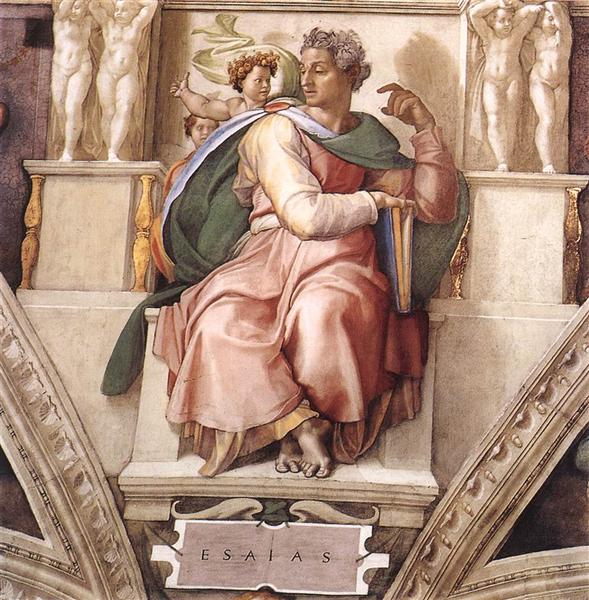
The Prophet Isaiah, Michelangelo (1509, Sistine Chapel)

The Kingdom Vision

Isaiah’s prophecies pulse with kingdom language. He envisioned a day when swords would be beaten into plowshares, and nations would learn war no more (Isaiah 2:4). He pictured a highway in the wilderness, where God Himself would lead His people home (Isaiah 35:8–10). He described a feast of rich food for all peoples, where death is swallowed up forever (Isaiah 25:6–8).

These aren’t just nice images. They are glimpses of God’s reign breaking into human history. Isaiah insisted that God’s kingdom is not limited to Israel’s borders – it is global, cosmic, and eternal.

But who could possibly bring such a kingdom?

Pointing to the King

Isaiah repeatedly pointed forward to a figure who would embody and establish God’s reign. Sometimes he called Him the shoot from Jesse’s stump, a Spirit-filled ruler who delights in righteousness and justice (Isaiah 11:1–5). Other times, He is the Servant of the Lord, who suffers on behalf of His people, bearing their sins to bring them peace (Isaiah 53:4–6).

For Christians, these words unmistakably point to Jesus. He is the child born, the son given, the one called Wonderful Counselor, Mighty God, Everlasting Father, Prince of Peace (Isaiah 9:6). He is the Servant who was pierced for our transgressions and crushed for our iniquities. He is the Spirit-anointed King who announces good news to the poor and freedom for the captives (Isaiah 61:1–2; see Luke 4:18–21).

Isaiah, centuries before Bethlehem, gave Israel a vocabulary of hope that would only make full sense in Jesus.

Kingdom People Then and Now

Isaiah’s voice continues to call out across the centuries. His message to exiles is just as relevant to us. We may not be dragged off to Babylon, but we know what it is to live in a fractured world where kingdoms rise and fall, where injustice festers, and where hope feels fragile.

Isaiah’s kingdom vision re-centers us. It reminds us that our story is not defined by loss or despair but by the faithful God who keeps His promises. It challenges us to live as kingdom people even in exile (both real and perceived) – to pursue justice, to care for the oppressed, to keep our eyes fixed on the coming King.

The same King that Isaiah saw in the temple, high and exalted, with the train of His robe filling the sanctuary (Isaiah 6:1), is the King who took on flesh and walked among us. He is the crucified and risen Lord who promises, “Behold, I am making all things new” (Revelation 21:5).

Living Isaiah’s Hope

To read Isaiah is to be both unsettled and comforted. We are unsettled by his honesty about sin, judgment, and the futility of our false securities. But we are comforted by his relentless insistence that God is faithful, that exile is not the end, and that a King has come – and will come again.

Like the exiles who first heard Isaiah’s words, we are invited to trust, to wait, to hope. To beat our swords into plowshares in anticipation of peace. To walk the highway of holiness with joy. To live as witnesses to a kingdom that is already here and yet still to come.

Isaiah helps us see what’s true: God is King, His kingdom is and has broken in, and Jesus is the fulfillment of the promises. And in that kingdom we find our home.



David: A Shepherd, A King, A Foreshadow of Christ


In the previous post, we discussed what happened when the people rejected God and asked Him to “Appoint a king to lead us, such as all the other nations have” (1 Sam. 8:5). They got Saul, the tall, farmer-turned-king, who rallied Israel’s tribes against their enemies and shone with early promise. But pride, fear, and disobedience consumed him, and the once-chosen ruler fell by his own sword on Mount Gilboa. Then came David.

In Saul, God gave the Israelites what they clamored for. With David He gave them what they needed.

Michelangelo’s “David”

David’s story didn’t begin in a palace or on the battlefield but in the pastures outside Bethlehem. The youngest son of Jesse, he was given the lowly work of tending sheep. Alone under the stars, he learned to sing psalms of worship and to trust God’s presence. He also learned courage, protecting his flock from wild animals – a courage that would one day defend Israel itself.

After Saul’s demise, the prophet Samuel was sent to Jesse’s house to anoint a new king. Jesse presented his older sons, but God whispered, “The Lord does not look at the things people look at. People look at the outward appearance, but the Lord looks at the heart” (1 Samuel 16:7). Finally, David was called in from the fields, and, to everyone’s surprise, was anointed by Samuel as the successor-king. God has a habit of raising up the overlooked.

At first David’s service was small. He played the harp in Saul’s court to soothe the troubled king. But then came the defining moment against the Philistine giant, Goliath. Armed with only a sling, five smooth stones, and faith, David declared, “The battle is the Lord’s” (1 Samuel 17:47). One stone was enough. The shepherd boy became a hero.

David’s fame sparked Saul’s jealousy. The people sang, “Saul has slain his thousands, and David his tens of thousands” (1 Samuel 18:7). Consumed with envy, Saul pursued David. Years of exile followed, with David hiding in caves, leading outcasts, and refusing to kill Saul when given the chance. At times, David leaned on cunning or fear instead of faith, even pretending madness before foreign kings (1 Samuel 21:13). Brave and trusting, and, yes, deeply human.

When Saul fell in battle, David grieved. He mourned Saul and his son Jonathan, his dearest friend. Soon, the tribe of Judah anointed him king, and after years of conflict, all Israel followed. He captured Jerusalem, made it his capital, and brought the Ark of the Covenant into the city with rejoicing. Then came God’s promise through the prophet Nathan: “Your house and your kingdom will endure forever before me; your throne will be established forever” (2 Samuel 7:16). This “Davidic covenant” became the heartbeat of Israel’s hope.

But David’s reign was far from spotless. One evening, while others were at war, David lingered in Jerusalem. From his rooftop, he saw Bathsheba bathing. He summoned her, slept with her, and when she became pregnant, arranged the death of her husband Uriah to cover it (2 Samuel 11). It was an abuse of power. Nathan confronted him, and David confessed. Out of that brokenness came Psalm 51: “Create in me a pure heart, O God, and renew a steadfast spirit within me” (Psalm 51:10). 

In his later years, David faltered again. He ordered a census, placing confidence in numbers rather than God. A plague followed, another reminder that Israel’s security rested in Yahweh, not its king. As his death approached, palace intrigue swirled. One son, Adonijah, tried to seize the throne. But David named Solomon – Bathsheba’s son – as his rightful heir. On his deathbed, he charged Solomon: “Walk in obedience to him, and keep his decrees and commands… do this so that you may prosper in all you do” (1 Kings 2:3). After forty years of reign, David died and was buried in Jerusalem.

So how do we remember him? Scripture calls him “a man after God’s own heart” (Acts 13:22), yet his sins were grievous. He was faithful yet flawed, victorious yet vulnerable. His life shows both the heights of devotion and the depths of failure. But more importantly, it shows God’s faithfulness.

David’s story always pointed forward. His psalms give prophetic glimpses of Christ. Psalm 110 speaks of a king-priest greater than David. The angel’s announcement to Mary echoed God’s covenant: “The Lord God will give him the throne of his father David, and he will reign… his kingdom will never end” (Luke 1:32-33).

David’s reign ended in the grave. But the Son of David rose from the grave. Where David’s failures brought brokenness, Jesus’ obedience brought salvation. Where David’s kingdom crumbled, Jesus’ kingdom stands forever. David was a shepherd-king whose songs still teach us to pray. Jesus is the Good Shepherd, the King of kings, who answers those prayers with life.

David’s story, warts and all, is good news for us. If God’s grace could work through someone like David – flawed, repentant, forgiven – then there is hope* for us too. His life reminds us that no earthly king can save us. Only the Son of David can.


* I wrote this blog post on August 27, 2025, the day of yet another school shooting, this time at Annunciation Catholic School in Minneapolis. The school’s theme for the year is one of hope: “A Future Filled with HOPE!” A website message to the Annunciation family was posted by the principal and pastor with the closing salutation, “In partnership, in community, in Christ” – HOPE!

Hope

Hope is a word we use all the time, yet its meaning is a bit elusive as is hope itself. I was recently thinking back of things I have hoped for over the years. There were the simple hopes, like Christmas coming sooner. The first Christmas hope I remember that came to fruition was a Tonka Firetruck (which I still have). As I reached adolescence, my hopes moved beyond firetrucks. I had hoped to be nominated to the Air Force Academy (which did happen) and to be selected (which didn’t happen).

Moving into my 20s, I hoped (beyond hopes) that I might be privileged with a beautiful wife (which certainly happened). As we raised a family, my hopes turned more external, more God-influenced. I hoped that our kids would grow into adulthood as Christ-followers (which has happened). With prayer at the center, that hope was accompanied by doing the hard work necessary to not screw it up. The wishful thinking of our younger years doesn’t serve us well in adulthood nor as Christ-followers, leaving us to wonder, “What is hope, anyway?”

The dictionary definition of hope suggests wishful thinking, a desire for something good to happen. While Biblical hope certainly includes a desire for something good to happen, it is much more than that. We discover that a variety of Hebrew words are often translated into the single English word “hope.” An aggregation of the various Hebrew words provides us with a description of hope that includes, “to trust in, wait for, look for, or desire something or someone; or to expect something beneficial in the future.”

Notice that Biblical hope implies trust. And the focus of that trust is Yahweh, the Lord God – on who he is and what he has done. We western Christians struggle to trust and hope in God simply for who he is. We tend to focus of our hope and trust on what he can do for us (here we think of Moralistic Therapeutic Deism). In Scripture, on the other hand, we see hope and trust focused on God himself…

  • Psalm 25:2-3 (NIV) – I trust in you; do not let me be put to shame, nor let my enemies triumph over me.  No one who hopes in you will ever be put to shame… The Hebrew word here implies not only hope and trust but also security.
  • Psalm 33:22 (a mix of ESV & AMP) – Let your steadfast love [hesed], O Lord, be upon us, even as we hope [placed our confidence] in you. Notice that trust (confidence) is placed on God and his character, his covenant love for his people.
  • Jeremiah 14:22 (AMP) – Are there any among the idols of the nations who can send rain?  Or can the heavens [of their own will] give showers?  Is it not You, O Lord our God?  Therefore we will wait and hope [confidently] in You, for You are the one who has made all these things [the heavens and the rain]. Again, the bracketed confidence implies trust.

Biblical hope also holds an element of waiting, which we see in the Amplified translation of Jeremiah 14:22, above. One of our go-to passages that speaks of waiting is Isaiah 40:31they who wait for the Lord shall renew their strength; they shall mount up with wings like eagles; they shall run and not be weary; they shall walk and not faint. The word ‘wait’ could easily be translated as hope. Read the passage with hope inserted: they who hope in the Lord shall renew their strength; they shall mount up with wings like eagles; they shall run and not be weary; they shall walk and not faint. It comes to life!

The origin of the Hebrew term in the Isaiah passage suggests a twisting, stretching, and tension during the time of waiting and hoping. Ah, we do not want to hear that! We want hope to be positive, not twisting, stretching, or causing tension. We want a quick sprint that leads to soaring like eagles. We aren’t interested in a marathon. It doesn’t fit our western Christian thinking or culture.

But life has changed, hasn’t it? We are actually living out Isaiah 40:31. We may be in a marathon without an established finish line. We are experiencing twisting, stretching, and tension from all sides. And we wait in hope. Our ability to navigate these days is fully dependent on that which we place our hope as we wait. Are we hoping and waiting for this to get over, for improved circumstances? Or do we settle in for a marathon, placing our hope, trust, and confidence in the one true God as we wait?

Likely we waffle between the two and thus a cause of much tension. God is well aware of our waffling and wants to hold us, not scold us! I recall Jesus not scolding the father of a son desperately in need of healing: “The father of the boy cried out [with a desperate, piercing cry], saying, ‘I do believe [trust]; help [me overcome] my unbelief [lack of trust].'” (Mark 9:24) God, we believe! Help us in our unbelief!

We continue to shout our praise even when we’re hemmed in with troubles, because we know how troubles can develop passionate patience in us, and how that patience in turn forges the tempered steel of virtue, keeping us alert for whatever God will do next. In alert expectancy such as this, we’re never left feeling shortchanged. Quite the contrary—we can’t round up enough containers to hold everything God generously pours into our lives through the Holy Spirit! (Romans 5:3-5, The Message)

Advent (or, Parousia)

This past Sunday, December 1, was the first Sunday of the Western Christian tradition of Advent.* My experience with the season of Advent is limited to more recent years of worshiping at churches with “mainline” denominational influence. Friends who worship in non-denominational settings are often less familiar with Advent and may not observe the tradition.

No matter our traditions, as a minimum most of us understand Advent to be a time of looking forward to and anticipating the birth of Christ. But how do we anticipate something that took place a couple thousand years ago? (This is the type of question typical of young people trying to reconcile tradition and present reality.) Therefore, it might be helpful to examine Advent in order to gain a better understanding the season and its value.

The dictionary defines “advent” as the arrival of a notable person, thing, or event (as in “the advent of cheesy Hallmark Christmas movies?”). The “Advent” of the Christian calendar is derived from the Latin word adventus which means “coming, arrival, or visit.” Scholars think adventus is a translation of the Greek word parousia. Parousia is a word that is usually connected to the second coming of Christ. At the Care Center where my mom resides, the Eucharist is celebrated during weekly chapel, administered by an Anglican priest. The Anglican words of institution are, “Christ has died, Christ is risen; Christ will come again.” Parousia.

But this is the 21st century. How was parousia used a couple thousand years ago in the days leading up to Jesus’ birth? The Jewish historian, Josephus, sometimes used parousia when speaking of YHWH coming to rescue Israel. For many years prior to Jesus’ birth, the Israelites had been longing for YHWH’s intervention as they suffered under the domination of other empires, this time under Roman control. He was their hope – their scriptures (our Old Testament) were laced with longing and hope (some examples: Psalm 25, Psalm 42, Psalm 130, Isaiah 40, Lamentations 3).

Josephus wrote his Jewish history in Greek and thus the usage of parousia. However, Greek was not the language of the Israelites. Their scriptures were written in Hebrew. So, what did parousia mean in a non-Jewish, non-religious context? The term was used when a high ranking official made a visit to a subject state. If Queen Elizabeth were to visit that Falkland Islands, a British territory, the Falkland inhabitants would experience royal presence. The ancient Greek word for royal presence is parousia.

God must be frustrated with Christmas songs that sanitize and domesticate Jesus’ birth. I think of Away in the Manger, depicting a cute little, perfect baby who doesn’t even cry. What the shepherds witnessed that night in the manger was royal presence, parousia. And to be sure parousia had political implications! Emperors are usually not open to sharing their kingdom with others. The significance of parousia was not lost on the puppet king, Herod. When he discovered the possible whereabouts of the baby Jesus, he dispatched troops to slaughter baby boys, hoping to snuff out a potential rival.

We must remember that Christ has died and Christ has risen. And though we certainly look forward to a second coming, we don’t want to forget that he is alive and well on planet earth. The message of the early believers was that Jesus is King and Caesar is not. The message today is that Jesus is King and _________ is not (fill in the blank). We are blessed with royal presence. May we not take for granted parousia. May we learn to live as people in the presence of royalty! **

* The tradition of Eastern Orthodox Christians is the celebration of the 40-day Nativity Fast as they prepare for Christmas.

** Old Christmas hymn writers understood this. We can see references to the birth of a king in many of the familiar carols (e.g., Joy to the World, O Come All Ye Faithful, Hark! The Herald Angels Sing, It Came Upon a Midnight Clear).