A Sweet Aroma

A few years ago, my friend, Crystal Kirgiss, wrote this article for Young Life‘s weekly communique to staff and stakeholders worldwide. It is a perfect reflection as we prepare to celebrate Resurrection Sunday. With her permission, I want to share it with you…


Sometime during what we now call Holy Week, Jesus was eating with His disciples and other friends when a woman approached with an expensive jar filled with expensive perfume. Rather than giving the jar and perfume to Jesus as a gift, like the Magi had 30-some years earlier, the woman shockingly broke the jar open and poured the perfume on Jesus’ head and feet, releasing a sweet aroma.

Essential oils are big business right now. But dousing someone with it during a dinner party is not the norm. We might lightly dab to clear our sinuses or calm our mood. But we do not pour plentifully, no matter what the occasion. This woman, though, poured until there was nothing left to pour.

Jesus’ disciples were neither amused nor impressed.

“What a waste! What nonsense! You could have sold that for good money! You could have made a measurable impact!” Leave it to Jesus’ disciples to deliver a thorough scolding for someone’s act of absolute allegiance and utter worship.
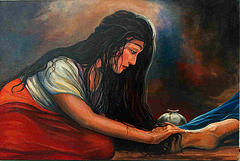
Jesus, though, set the record straight. He called her act beautiful. He praised her — not for something impressive like converting an entire village, or investing and making a profit, or planning and pulling off a large event, or increasing her ministry output. Instead, He praised her for humbly and faithfully anointing Him for burial.

For months, Jesus had been telling His friends He would soon die. Just days earlier, as He’d entered Jerusalem, He’d told them that now was that time. Maybe He’d even talked about it during this very meal.

But this woman seems to be the only one who truly believed what He said, in which case her strange, extravagant act makes great sense — for how else could she possibly respond but to pour onto Jesus the most valuable thing she had, knowing He would soon pour out for all of humanity the most valuable thing He had.

Both Matthew and Mark note that Jesus said to everyone in the room: “I tell you the truth; wherever the good news is preached throughout the world, this woman’s deed will be remembered and discussed.”

But that’s not usually the case. It’s a weird story, after all. And it lacks a neat and tidy takeaway. If we’re always in search of neat and tidy takeaways, Scripture will often disappoint us. But if we’re willing to read it for what it is, and consider the larger story of the Bible, Scripture will always feed us.

At face value, this story is mostly about something a real woman did, in a real place, during a real moment in time, when it was exactly the right thing for her to do in response to Jesus. Are we as aware of things we’re called to do, in this place and at this moment, in response to Jesus? And if that thing is costly, would we be as willing as this woman was to actually do it, knowing others might misunderstand and call us foolish?

As we read the bigger message of God’s Word beyond this story, it becomes clear why this narrative should be remembered and discussed. This woman’s actions are a reminder that in response to Jesus’ death, resurrection, and Lordship, we’re called to break open and pour out the costliest thing we have — our very lives — as we die to ourselves daily, surrender to our Lord, and honor our King. Hopefully, our acts of sacrificial obedience and worship will release a sweet aroma into the world just like the woman’s perfume did thousands of years ago — but now it will be the sweet aroma of Christ Himself.

By Crystal Kirgiss, Director of Discipleship Content and Partnerships, Young Life

Walking the Talk

We are moving toward the week in Christendom we refer to as Holy Week and/or the Passion Week.  By passion we mean ‘suffer,’ and thus focus on the suffering Jesus experienced leading up to and including his crucifixion.  Assuming I was somewhat alert at 5-6 years old, I have read or heard the passion story every year for 65 years.  In my last posting (Reliving the Passion), I intimated that the passion story might be all-too familiar to us.  I think if we have ears and eyes that are open, we can see and hear this world-changing story anew every time we wander into it.  This year has been no exception for me. 

At Young Life College, we would always joke about our conversations coming full circle each week.  As we read the Gospels, moving into the passion week, it becomes apparent that there is a full-circleness to Jesus’ life, culminating at the cross.  His experiences that last week were opportunities for him to live out what he had been teaching his followers for three years. Some thoughts on that…

Jesus’ ministry started with the temptation to take a shortcut to usher in God’s kingdom, seen in Matthew’s and Luke’s Gospels (Matthew 4:1-11, Luke 4:1-13).  The devil taunted Jesus with “if you are the Son of God…”  While on the cross, the people (including the chief priests and the elders) taunted him with “If you are the Son of God, come down from the cross.”  Again, the temptation to shortcut the process.  The writers of the gospels often inserted the phrase, “Let the reader understand.”  It seems like Matthew and Luke may have wanted the reader to understand the connection of these two taunts/temptations. 

Jesus’ followers witnessed the admonitions of the Sermon on the Mount played out those last days leading up to and including his crucifixion.  Some examples…

In the Sermon Jesus outlined what prayer of kingdom people might look like (what we call The Lord’s Prayer).  In that prayer he suggested we pray for God’s will to be done and for protection from the evil one and from temptation.  In the garden he asked that the cup might pass, ultimately praying ‘thy will be done.’  And I’m sure throughout the twelve hours of mock trial and beating, there was many a prayer to not succumb to the temptation to do some ‘holy smiting!’

The beatitudes from the Sermon speak of what kingdom living looks like.  Jesus lived that out in front of his followers daily, but it especially showed up during this time.  Blessed are the peacemakers. Jesus told Peter to put his sword away and reminded him that those who live by the sword will die by the sword.

In the Sermon, Jesus told his followers not to resist evil or retaliate when slapped about.  He had the opportunity to ‘practice what he preached’ when mocked and slapped about by both the religious leaders and the representatives of the Roman Empire (Mark 14:65, Matt. 27: 27-31). 

You are the light of the world—like a city on a hilltop that cannot be hidden.  No one lights a lamp and then puts it under a basket. Instead, a lamp is placed on a stand, where it gives light to everyone in the house. (Matt 5:14-15)  The Romans made absolutely sure that crucifixions took place for ALL to see, as a reminder that the same thing could happen to those watching.  On the hill called ‘The Skull,’ Jesus, the light of the world, was hoisted up for all to see!  In the same way, let your good deeds shine out for all to see, so that everyone will praise your heavenly Father. (Matt 5:16)

I’m sure there are many other examples of Jesus, God’s true Israel (to borrow a phrase from NT Wright), showing and teaching his followers how to live during the first three years of his ministry THEN ‘walking the talk’ those final few days.  I am grateful that every year God has been faithful in helping me look at Holy Week, the week that changed history, in a new light.  This year has been no different.  Thanks be to God!