He is Risen!


“On the same night in which he was betrayed,” or some form thereof, are familiar words to Christians the world over. They are the beginning of the words of institution of the Eucharist – the Lord’s Supper or Communion. The wording comes from the Apostle Paul, found in 1 Corinthians 11:23-26 as he describes what took place during Jesus’s last Passover supper with his beloved Twelve. As we focus on that last meal, we don’t want to lose sight of the fact that a lot more happened on the same night in which he was betrayed.
I have mentioned previously that Jesus showed us how to live. In a similar fashion, on the same night in which he was betrayed, Jesus also showed us how to live the Lord’s Prayer…

This year I have been traveling through Lent using Walter Wangerin’s Reliving the Passion, an amazing ‘crawl into the story’ treatise of the passion week as recorded in the Gospel of Mark. I have used it off and on over the past 20 years, experiencing new thoughts and emotions each year of its use. This year I saw, for the first time, the way in which Jesus lived out the Lord’s Prayer as he prayed in the Garden of Gethsemane on the same night in which he was betrayed.
Wangerin reminds his readers that Jesus often taught the same thing twice – first with words and then reinforced with actions and deeds.* On the same night in which he was betrayed, as we watch Jesus praying alone in the garden, we have a glimpse of the Lord’s Prayer actually lived out. With a deep and desperate desire, Jesus pleads with his Father, his Abba, to be saved (rescued) and to be spared of what he knew was coming. He was living out, in raw honesty, the sixth petition of the Prayer…
Lead us not into temptation – Save us from this time of trial.
Jesus pleads not once, not twice, but three times, “Remove this cup from me,” embodying the plea of the seventh petition of the Prayer…
Deliver us (me!) from evil, from the evil one.
As Jesus pleads with his Father, he displays a posture and attitude of faithful and complete obedience saying, “Yet not what I will, but what you will.” Jesus is living out before our eyes the third petition, “which prepares us properly for any answer God may give to all [our] other petitions” (Wangerin)…
Thy will be done on earth as it is in heaven.
Wangerin continues: “Implicit, hereafter, in his entering into ‘the hour’ of trial after all is his personal conviction that ‘the time is fulfilled, and the kingdom of God is at hand.’ Jesus, now more than ever in his ministry, is the living embodiment of the second petition, Thy kingdom come. Right now, his acceptance of the Father’s will is the coming of that kingdom here!”
Thy kingdom come.
Jesus begins both prayers addressing God as Father, with the garden prayer showing a deep intimacy – Abba, Father. It’s the expression a child has when her father comes home from work – Daddy!
Today is Maundy Thursday, the same day in which he was betrayed. During a worldwide pandemic, we struggle for words to articulate our deep, raw and desperate feelings. May the Lord’s Prayer be of comfort – especially in light of Jesus’ deep, raw and desperate prayers in the garden. Maybe during this time we, too, are learning to live the Prayer. That would be a good thing!

* A great experience would be the comparison of Jesus’ own deeds and actions with his Sermon on the Mount exhortations.
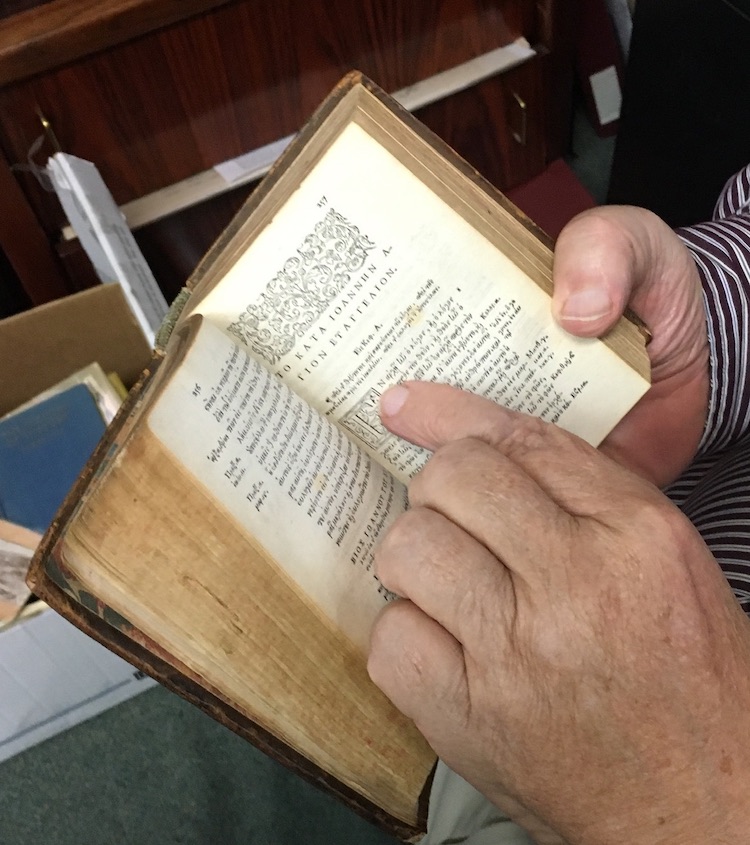
Ever heard of fore-edge painting? I hadn’t until I stumbled onto the Alcuin Scholarly and Rare Books store when I was in Scottsdale, AZ, in February. My friend Bruce and I spent three hours browsing through some really old books, including an 1885 Huckleberry Finn ($15,000) and a Greek New Testament printed in 1533, the same year Martin Luther published A Mighty Fortress is Our God. In addition, there were several 18th and 19th century books with fore-edge paintings. A fore-edge painting is a scene painted on the edges of the pages of a book. When the pages are fanned, a painting appears (check out this 30 second YouTube video).

My grandma created her own version of fore-edge painting. About 25 years ago, when she was approaching 100 years of age and living in a nursing home, I picked up her thick, large-print Bible. The edges were white except for a dirty-looking thin band around the middle of her Bible. It looked like someone had marked her Bible with a grey Sharpie. When I fanned the pages, I discovered the band coincided with the location of the Book of Psalms, evidence that’s where she spent a majority of her time reading – an indicator of her confidence in God in the waning years of her life. We are living in a time when we could use some confidence in the midst of uncertainty.


For the past 25 or so years, I have been in the habit of reading a psalm a week. There are 150 psalms in the Bible, so simple math tells me I have read the Book of Psalms 8-9 times over that span (markups and highlights as clear evidence). As I’ve continued in the Psalms, they have provided a wonderful glimpse of who God is and who we are in relation to him. The Psalms are full of praise and lament, gratitude and sorrow. The psalmists wrote songs that expressed their raw feelings and thoughts as they navigated life that often felt pandemic-like.
One of my favorite scripture readings during this disrupted time in our lives is Psalm 121. Psalms 120 through 134 are known as Songs of Ascent. These are songs the people of Israel sang as they traveled together on foot up into Jerusalem to celebrate the various festivals, like the Passover. That means Jesus would have sang these same songs as he journeyed to Jerusalem with his family, friends, and early followers. It means that he likely sang some of these songs as he headed to Jerusalem on what we just celebrated – Palm Sunday. Psalm 121 (ESV)…
1 I lift up my eyes to the hills.
From where does my help come?
2 My help comes from the Lord,
who made heaven and earth.
3 He will not let your foot be moved;
he who keeps you will not slumber.
4 Behold, he who keeps Israel
will neither slumber nor sleep.
5 The Lord is your keeper;
the Lord is your shade on your right hand.
6 The sun shall not strike you by day,
nor the moon by night.
7 The Lord will keep you from all evil;
he will keep your life.
8 The Lord will keep
your going out and your coming in
from this time forth and forevermore.
I think it would be fair to say this song refers to God as our keeper. The Hebrew term for keeper requires a number of English words to do it justice. It suggests God as a guardian who looks after us and takes responsibility for us. It implies that as he watches over us he is very aware of the things that give us reason to lament. It speaks of God as our protector and defender; as preserver. Bottom line: God has our back. He has our best interests in mind. He is worthy of our praise. And of our lament. As our keeper, he certainly wants to hear both. Of this we can be confident. I suspect my grandma knew God as her keeper.
To him who is able to keep you from stumbling and to present you before his glorious presence without fault and with great joy – to the only God our Savior be glory, majesty, power and authority, through Jesus Christ our Lord, before all ages, now and forevermore! Amen. (Jude 24-25)
Earlier this week, I was in a conversation with a young man with whom I have a mentoring relationship. As we discussed how COVID-19 has impacted (disrupted) our lives, including our ministries, we wondered aloud if things would ever get back to normal. Or would we find ourselves transitioning into what we commonly hear these days as the “new normal.” As we conversed, he said, “I wonder what normal actually means?”
So, as I’m wont to do, I looked up “normal” in the New Oxford Dictionary that resides on my laptop. This is what I found: “a town in central Illinois, home to Illinois State University.” That didn’t help. Searching further, I found the definition of the noun, normal – “the usual, average, or typical state or condition.” As I read the definition aloud to my friend, we both responded, almost in unison, “Why would we settle for normal? Why would we settle for the usual? For just average or typical?” There must be more to life than “typical.” I think Jesus calls us to more than typical…

Jesus constantly pushed back against the normal of his day. Have you ever noticed how often Jesus said, “You have heard it said …, but I say you…?” Many such statements were contained in what we know as the Sermon on the Mount (Matthew 5-7). Here are a few examples:
Jesus was communicating to his hearers that with the arrival of the kingdom of God through his person, everything was now different – new creation! The old had gone and the new had arrived. The Apostle Paul reiterated this to the early Christ-followers (see 2 Corinthians 5:17). Please note that in the above passages, Jesus was not suggesting a new ethic, a new way to act. If that’s all we hear, then we have settled for a typical and usual approach to the Christian faith whose focus is behavior modification. Jesus did NOT suggest we ACT differently. His desire for us is to LIVE differently – as people who have stepped into God’s kingdom.
Jesus’ Sermon was not about how to live, but rather what life looks like in God’s kingdom, his realm, his rule. Quite frankly, Jesus was describing what life would look like if God were in charge. God broke into history through Jesus, ushering in the kingdom. God was taking charge. This was Jesus’ main message, that the kingdom was at hand (had arrived), to which he called people to repent (change their mind and direction) and believe this incredibly good news, or gospel (see Mark 1:14-15, Amplified Bible). Thus the words in the Lord’s Prayer – “Thy kingdom come.”
So what does this have to do with “new normal” thinking? I think this: We live in a time of inbetweeness. The kingdom that Jesus ushered in has been advancing and will continue to advance, coming to fruition upon his return. In the meantime, as Christ-followers, we figure out how to live with one foot in the kingdom of this world and one foot in the kingdom of God. I suspect Christian maturity is learning how to live in the world as a kingdom of God person (notice I said “learning how to live,” not how to act).
History and experience tells us that such maturity (which I think most really desire) is difficult to realize when life is “usual, average, or typical” – normal. It’s during times of disruption that we get to rethink what we want our life to be like, and that’s a very good thing. During this pandemic, we have no idea what the new normal will look like in the kingdom of this world. But we do have an idea what the new normal will look like in the kingdom of God. It will look like Jesus. I pick new!
When in grade school, I was fascinated with 15th-16th century nautical explorers and the ships they sailed into uncharted waters. I was particularly fascinated with Columbus and Magellan and the courage it took to sail off into the wild blue yonder, not knowing what awaited them on the other end of the journey. In their travels they had a general idea where they were headed (or, at least, where they thought they were headed). However, they were at the mercy of the elements that tossed them to and fro, often driving them off course.
I have often heard the phrase “we are navigating uncharted waters” to describe our world as we know it today. Uncharted indeed! We don’t know exactly where we are headed, we are tossed about daily as news changes, and we have no idea what is on the other end of the journey. Uncharted waters and we feel a bit overwhelmed.
Overwhelmed. A few years ago I wondered, “If one can be overwhelmed, is it possible to be whelmed? Is there such a word?” I discovered there is such a word as whelmed! It’s a nautical term that basically means to engulf or submerge. Its root relates to the overturning of a vessel in a storm. As bad as being in an overturned vessel might seem, we might still be alive and rescue still possible. Overwhelmed, on the other hand, implies complete defeat. We are on the way to the bottom!

One of my favorite gospel stories is found in Matthew 14 where our friend Peter walked on water. If Mathew’s narrative is chronological, then this is what led up to the event…
John the Baptist was beheaded by Herod, the puppet Jewish king set up by the Roman empire. John was the prophet that called people to repentance (including Herod) and prepared the way for Jesus’ ministry. He was also Jesus’ cousin. When Jesus heard of his cousin’s death, “he withdrew by boat privately to a solitary place.” The people figured out where he was and his solitude was interrupted by 15-20,000 people! Filled with compassion, he healed people all day long. He wrapped up his interrupted day by feeding all of them, then sneaking off to continue his time of solitude, sending his disciples by boat to the other side of the lake.
So off sailed the disciples, into the wind, beaten about by the waves. Sometime between 3:00a and 6:00a, after struggling to get half-way across the lake, Jesus approached their boat walking on the water. They were terrified (an understatement!) and cried out in fear, to which Jesus reassured them that it was he and they need not be afraid. (Have you ever noticed how often Jesus told people not to be afraid, to “fear not?”)
Peter, as he was wont to do, spoke first asking Jesus if he, too, could walk on the water. So Jesus (I’m sure with a twinkle in his eye) said “Sure.” As Peter walked on the water toward Jesus, he looked around at the waves with fear and started to sink. He was whelmed by the waves crashing around him (not overwhelmed yet – his head was still above water) and cried to Jesus for help. “Lord save me” were his exact words. Jesus extended his hand which Peter wisely grabbed before he became overwhelmed!
As we navigate the uncharted waters of a world-wide pandemic, we might be feeling a bit overwhelmed. Truth be told, as long as we have our head above water, we are simply whelmed, able to see Jesus’ extended hand. This is where trust comes into the picture. Can I trust Him in my state of whelmness? Or do I double down – work harder, try harder, tread harder? No doubt, there is certainly hard work for us in the days, weeks, and months ahead. I don’t know about you, but I’d rather navigate uncharted waters from on top, rather than the ocean floor.
I never got to play baseball (as I have mentioned previously). It wasn’t conducive to life on a dairy farm. So, I never learned how to field ground-balls or hit fastballs and curveballs. My college roommate was a really good fast-pitch softball pitcher. I asked him how good. Russ’ response: “You’d never be able to get a hit off me. In fact, I bet you never even get a piece of the ball.” Game on! How fast could he possibly be?
I was soon to discover that speed wasn’t his strength. It was his curveball. I stepped to the plate ready for a fastball. But Russ threw me a curveball. Keep in mind that as a batter, I’d never seen a curveball in my life. I swear it moved 3-4′ left to right as it came to the plate. Since I hadn’t ever seen a curveball, my instinct was to get out of the way of the ball that I was sure was headed right for me. I took one step forward and, thud, the 80 mph ball hit me square in the thigh.
Fast forward to March 2020 – life has certainly thrown us a curveball! A curveball, indeed! A mere three months ago, an animal novel virus mutated and infected a human. Now, a few mutations later, we are experiencing a pandemic that has disrupted life as we know (knew) it.

I have often wondered what attracted first century followers to Jesus. I suspect one of the attractions was the way he lived life. He lived and ministered during a time of tumult and uncertainty – religiously, politically, and economically. He lived amidst urgency. Thousands flocked to him for healing and comfort – many more than he could accommodate. Yet he never appeared frantic or overwhelmed.*
Recall Jesus sleeping in the stern of the small fishing boat that was about to be swamped by a storm (Mark 4:37-40), causing his friends to ask, “Who is this guy?” He possessed a peace that transcended normal understanding – a peace which people desired. He passed that peace onto his followers, anticipating they could live likewise – “Peace be unto you. As the father has sent me, I am sending you” (John 20:21) with the charge to develop other disciples (see Matthew 28). So, how do we, as subsequent Disciples/Christ-followers/apprentices, do life during a life-disrupting pandemic?
Two of my grandson’s play baseball through the MN Blizzard Baseball Academy. Since I have accompanied them to various out-of-town tournaments, I receive some of the same Blizzard emails that my grandsons receive. This week Adam Barta, the owner of the MN Blizzard, sent an email to the kids with some reminders of who they are as young leaders and how they can live well during this time of uncertainty. I want to share a few of his thoughts, based on the Blizzard Academy’s Big 5:
I can imagine Jesus giving his followers a similar talk as he prepared them to spread the message of the Good News of God’s Kingdom having broken into history, an adversarial history at that. He at no point suggested it would be without trouble. In fact he warned them that there would likely be trouble and no one would be immune. He also told them that he would be with them in the middle of it all: “And surely I am with you always, to the very end of the age” (Matt. 28:20). Keep the faith. Keep fouling off those curveballs.
* Look for an upcoming post entitled “Uncharted Waters.”


This is a follow-up to the previous post about Perspective. I could say a lot about the illustration below, but I fear I might detract from it’s value. So I won’t!

Several years ago I facilitated a training session of volunteer youth ministry people in the community in which I lived. We talked about how perspective is important to what we do and to the outcomes we hope for. In an earlier post I included a worthy saying that reminds us that perspective affects how we see things, which in turn affects what we do, which naturally impacts outcomes. My point was this: If we want to experience different outcomes in life or ministry, that only happens with a changed perspective, not just by doing things different.
To drive the point home, I showed the group the drawing of the woman below. The participants were given the task of planning an evening with her. What might they do and talk about? One younger person said she would ask this older woman what life was like as a teenager “back in the day.” An older gentleman (60ish) in the group, looking puzzled, said, “I was thinking of asking her, as a young woman, what she thinks her life might look like when she is my age.” Each person planned an evening for the woman based on their perception of her age. What they planned to do was based on their perspective.

Our perspective as to why Jesus came to our planet has a huge impact on how we do life, on all that we do. Of course the orthodox understanding is related to our salvation (or soteriology, to use the theological term). I suspect the overarching soteriological perspective of western evangelical Christians is this: Jesus came to save us so that we can go to heaven when we die. Actually, it probably sounds more like this: Jesus came to save me so that I can go to heaven when I die. We call this good news because it is. But the Good News of Jesus is much bigger.
If my perspective is “Jesus came to save me so I can go to heaven when I die” then what do I do with the rest of my life while I wait to go to heaven? If I have already accepted Jesus into my life or given my life to Him (or whatever terminology we choose to describe how we participate in his saving work), then what is there left to do? I suspect if we are honest, far too many of us simply live out life, waiting to go to heaven, maybe wishing we could go sooner than later. We hear it all the time – life will be so much better in heaven.
But then guilt sets in. We should be doing something, shouldn’t we? We hear a sermon that suggests we aren’t doing enough. Or we read a scripture that suggests a need to change something we are doing (or not doing). So we try to make changes to what we do. We work on changing the behavior that seems to need tweaking (we all need to change, right?). Problem is that behavior modification leads to moralism and moralism doesn’t work!
What if our perspective is wrong or, at least, incomplete? What if being a Christian is much bigger than simply going to heaven when we die? What if heaven is only a slice of a bigger pie? NT Wright would suggest a perspective amiss: “people often imagine the main purpose of Christianity to be getting people to heaven and teaching them to behave along the way.” * He goes on to reminds us that heaven is a big deal, but it’s not the end of the world.
So, what perspective did Jesus want his followers to come away with after hanging out with him for three years? It’s important to understand because it affected all they did and said as they went “into all the world.” Jesus did not tell his disciples to go into the world and tell people how to get to heaven. It was never his message. Read the Gospels – its not there! Jesus did not leave his disciples with a self-focused perspective of simply getting to heaven.
Here’s the thing – A theological perspective that Jesus simply came to save me so I can go to heaven when I die will not serve me well in this world. Nor will it serve those around me. Moralism is the natural outcome. Moralism doesn’t lead to loving neighbor well. And it certainly doesn’t lead to loving our enemies. We all would agree that American Christians don’t love our enemies well, which should tell us something is amiss. I would suggest it’s our perspective. The result? The Good News simply becomes good advice and the world is left wanting.
* Wright, N. T. (2017). Simply good news: Why the gospel is news and what makes it good. New York:Harper One. P. 22, Kindle Edition
People like to be right and like to get it right. I’m that way and I’m guessing I am not alone. I remember back in high school and college the standard question was asked, “Will this be on the test?” I certainly asked the question as well as others. Truth be told, we were more focused on “getting it right” than on learning.
I went back to school a few years ago in pursuit of a doctorate in education. It was one of the best learning experiences of my life. I honestly think I was beginning to toggle over from “getting it right” to purely wanting to learn. My (much) younger cohort were always referring to the course rubrics when writing papers. I found myself writing first, based on the assignment prompts, and periodically consulting the rubrics to see if I had some glaring misses. When I was satisfied with what I was learning, grades become secondary.
The more I dig into the adverse effects of moralism, the more I realize that we naturally tend to focus on the rubrics and miss the intent of the prompts, especially Jesus’ prompts.

Moralism doesn’t work for a variety of reason, primary of which is a natural tenancy toward law and legalism. If we have a bent toward wanting to “get it right,” then we naturally want to know what the rules are, the rubric which defines right living. God provided a rubric for his people, the Israelites, which we know as the Law. However, the law was not to be an end in itself. The purpose of the law was to provide a framework for people who were learning to live in a covenant relationship with the one true God. When the law, especially the 10 commandments, were given to the people, living in a covenant relationship with any god was foreign to their ears and lives. Prior to leaving Egypt, their religious understanding was of many deities, none of which desired a covenant relationship with their subjects.
The law was a framework, a rubric, for learning – learning how to live in a covenant relationship with God and with each other. God didn’t desire the law to become an end in itself. It was to lead to something more. In learning to live in a covenant relationship with God and each other, the rescued Israelites could then become the good news (blessing) to the rest of the world, as intended. Love of God and neighbor was embedded in the law (see Deuteronomy 6:5 and Leviticus 19:18). The law, seen as an end in itself, actually kills love.
Good parents develop a rubric for how their family can live in a covenant relationship. “We clean up our messes, we do our chores diligently, we treat each other with respect, etc.” If the family members simply see the rubric as an end in itself, then it becomes a checklist that leads nowhere, however they might have the cleanest house and the most (seemingly) polite kids. Yet the house may lack evidence of a loving, covenant relationship. Love is learned and simply keeping the law doesn’t get us there.
Can you see where this leads? The purpose of a rubric is to facilitate learning. I can write a paper to the letter of the rubric (law), get an “A” and miss out on all there is to learn. If moralism is my de facto understanding of the Christian faith, I can look good on the outside and miss all that Jesus is saying about living in a covenant relationship with the one true God and with those around me. And worse, I will only hear Jesus’ prompts and parables as law – checklists that I should try to perform – and never quite learn and become someone who can naturally….
“Love the Lord your God with all your heart and with all your soul and with all your mind.” This is the first and greatest commandment. And the second is like it: “Love your neighbor as yourself.” All the Law and the Prophets hang on these two commandments.” Jesus
Our dishwasher broke a couple weeks ago and just got fixed this week, thanks to CenterPoint Energy’s Home Service Plus program. It wasn’t a huge inconvenience, except that it required us to wash our dishes by hand for a while. The nice part about washing by hand is the built-in opportunity to ponder (as I am wont to do when involved in menial tasks).
One day I was washing glasses that our grandsons had used after eating something sugary. The outsides were sticky, clear evidence of the sugar. As I started to wash the glasses, I realized something interesting was taking place. In the process of washing the inside, the outside naturally became clean. I wasn’t focused on washing the outside. I was focused on washing the inside. The cleansing of the outside was a natural outcome. I began to wonder if Jesus’ dishwasher might have broken once because he talked about the same thing. Sort of…

When Jesus had finished speaking, a Pharisee invited him to eat with him; so he went in and reclined at the table. But the Pharisee was surprised when he noticed that Jesus did not first wash before the meal. Then the Lord said to him, “Now then, you Pharisees clean the outside of the cup and dish, but inside you are full of greed and wickedness. You foolish people! Did not the one who made the outside make the inside also?” (Luke 11:37-40)
In his Gospel, Matthew records a similar discourse between Jesus and some Pharisees in which Jesus concluded, “Blind Pharisee! First clean the inside of the cup and dish, and then the outside also will be clean” (Matthew 23:26). The context of Matthew’s narrative? Prior to 23:26, the editors of the NIV translation added the heading, Seven Woes on the Teachers of the Law and the Pharisees. Seven times Jesus said “Woe to you, teachers of the law and Pharisees, you hypocrites!” Ouch! Jesus wasn’t mincing his words with the religious leaders. Seven times he called them out for their hypocrisy, for missing the mark. And they knew it. It would have been difficult for the hearers to respond, “I wonder what he meant?” They knew exactly what he meant. And they didn’t like it. It was around this time that they stepped up plots to kill Jesus.
What was the sin of the religious leaders? I would suggest moralism. The religious leaders had reduced God’s steadfast love, mercy, and faithfulness (hesed and emet) to a recipe for moral improvement. In the 21st century, we can also succumb to the (some would say seductive) false gospel of moralism. Moralism in our context is the reduction of the Gospel – the outrageous, extravagant, radical, unconditional, love of Jesus – to moral improvement.
How might we know if we have culturally or personally succumbed to the false gospel of moralism? What might be some indicators? We might have been seduced by “christian” moralism:
Read the tenets of Moralistic Therapeutic Deism and you can see the results of 50 or so years of the presence of the false gospel of moralism. Listen to sermons. Are they about who Jesus is – his character? – or do they lean toward moral improvement and how we should act? The Gospel of Jesus and the “gospel” of moralism are diametrically opposed to each other. Don’t be fooled into believing the false gospel of moralism. It’s more prevalent than one might suspect. Be aware. Be wise as serpents. I don’t know about you, but I would never want to hear Jesus say to me, “Woe unto you!”