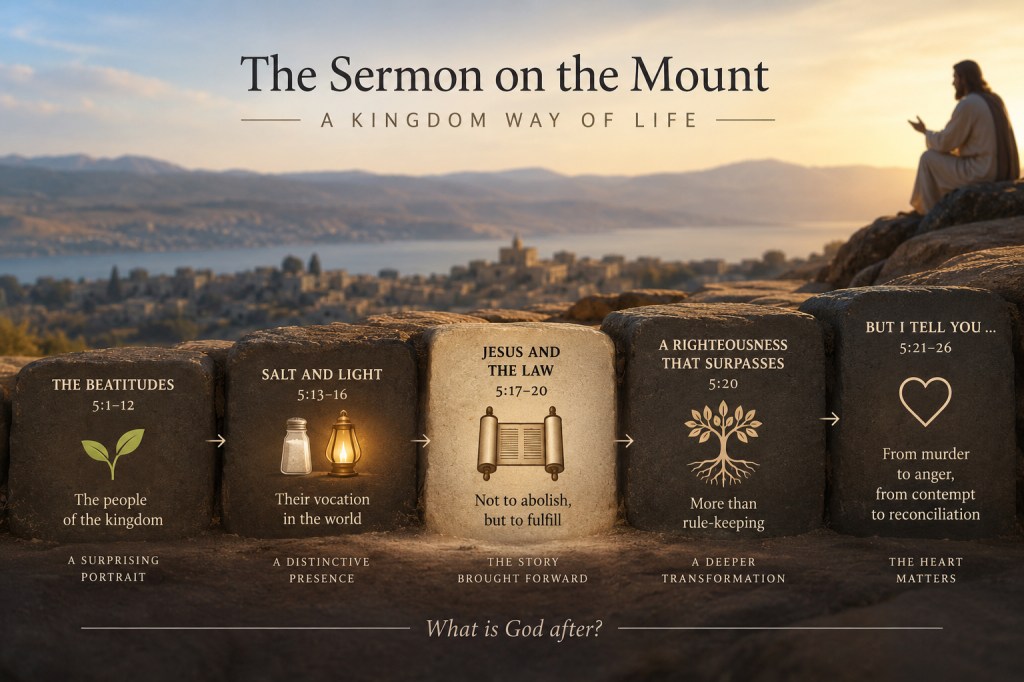
The Beatitudes described the people of the kingdom. Salt and light described their vocation in the world. Now Jesus turned to what may have been an obvious question:
If these people were to embody Israel’s calling in the world, what becomes of Torah?
Israel already had a way of life. God had given them the Law centuries earlier. Torah shaped their worship, relationships, community life, and understanding of what it meant to be God’s covenant people.
But Jesus had already begun raising eyebrows.
His approach to the Sabbath, his association with the wrong kinds of people, and his willingness to challenge accepted interpretations of Torah could easily have created the impression that he was playing fast and loose with Scripture.
So, Jesus said: “Do not think that I have come to abolish the Law or the Prophets.” (Matthew 5:17)
The opening almost sounds defensive: Whatever else you have heard about me, don’t misunderstand this.
Jesus had not come to dismantle Torah. But neither had he come simply to preserve an inherited system of interpretation that could obscure the very purposes Torah was meant to serve.
He had come to fulfill it. He came to bring out the real meaning of the Law, its original intent.
Not Tearing It Down
The Greek word Matthew used for “abolish,” katalyō, could mean to tear down, destroy, or dismantle.
Jesus said plainly: That is not what I am doing.
“The Law and the Prophets” was a common way of referring to Israel’s Scriptures – the story of what God had done and what God desired for his covenant people. That matters in light of what Jesus had just said about salt and light.
Centuries earlier, Israel had been called to be a “kingdom of priests and a holy nation” (Exodus 19:6) – a people through whom the nations could see what life with Yahweh looked like.
Then Jesus told his disciples, “You are the light of the world.”
He wasn’t abandoning Israel’s calling. He was bringing it forward.
The question was still the same: What does a people who represent God in the world actually look like?
And Jesus pointed them back to Torah – not simply to repeat what they had heard, but to show them the kind of life God had intended it to form. That was the purpose of the Law.
“I Came to Fulfill It”
But Jesus did more than defend Torah. He said he had come to fulfill it.
But “fulfill” does not simply mean “keep” or “obey.” Jesus was claiming something larger: that in him, the Law and the Prophets were being brought toward their intended purpose. Think consummation, which is the meaning of the Greek word plēroō (fulfill).
Maybe we could say it this way: Jesus didn’t come to erase the story. He came to bring the story where it had always been going.
That makes Matthew 5:17–20 a hinge in the Sermon on the Mount. Jesus had described the people of the kingdom and their vocation. Now he began showing them what life under God’s reign actually looked like.
Not One Dot
Jesus continued: “Until heaven and earth disappear, not the smallest letter, not the least stroke of a pen, will by any means disappear from the Law…” (Matthew 5:18)
Whatever people thought Jesus meant by “fulfill,” he clearly did not mean that Scripture no longer mattered. The sky and earth may have seemed like the most permanent realities imaginable, yet Jesus said God’s purposes were more dependable still.
Not even the smallest stroke could simply be brushed aside.
That same idea continued in the next verse. Jesus warned against setting aside even the “least” of the commandments.
There were plenty of debates in Jesus’ world about greater and lesser commandments. Which mattered most? Which carried less weight? What was central to Torah?
Jesus himself would later speak of the “greatest” commandments. But lesser did not mean disposable.
The question was not, Which commandments can I safely ignore?
A better question was emerging: What kind of people was God seeking to form through Torah?
A Righteousness That Surpasses
Then Jesus dropped the bombshell: “Unless your righteousness surpasses that of the Pharisees and the teachers of the law, you will certainly not enter the kingdom of heaven.” (Matthew 5:20)
That must have sounded nearly impossible. The scribes and Pharisees took Torah seriously. They studied it, debated it, and worked hard to understand how it should be applied to everyday life.
And Jesus said his disciples needed a righteousness that surpassed theirs.
He wasn’t simply calling for more religious requirements, more effort, or stricter behavior. He was pointing toward something deeper.
We have already encountered this word: “Blessed are those who hunger and thirst for righteousness…” (Matthew 5:6)
And Jesus would use it again: “Seek first his kingdom and his righteousness…” (Matthew 6:33)
Righteousness in the Sermon is not merely commandment-keeping. It describes a life aligned with God and God’s way of doing things – doing right by God and doing right by other people, as the BibleProject folks put it.
This was the righteousness Jesus was about to describe.
The Kind of Life God Was After
The temptation with any law is to ask: What exactly am I required to do? Where is the line? What counts as obedience? Or the age-old question: How much can I get away with?
Jesus seemed interested in a different set of questions.
What kind of people was Torah intended to form? What does life look like when God’s desires become more than commands written on a page – when they begin shaping the kind of people we are becoming?
Jesus had not come to set Torah aside. Nor had he come merely to tell people to keep it more carefully. He had come to fulfill it – to bring the story of the Law and the Prophets to its intended destination in himself.
And now he was about to show what that meant for the people of the kingdom.
This is where his words about a “surpassing righteousness” begin to come into focus. Jesus had not lowered the demands of Torah. In some ways, he was about to take them farther than his listeners imagined.
The first commandment he chose was one almost everyone would have assumed they understood: Do not murder. Most of us can read that one and feel pretty good about ourselves.
But Jesus didn’t stop with murder. He went underneath the act itself—to anger, contempt, fractured relationships, and reconciliation.
The command was not smaller than they thought. It was larger. And the question was no longer simply, Have I kept the command?
Jesus was leading them toward an even deeper question:
What kind of person is God forming me to become?


One thought on “Jesus and the Law”