A Word We May Not Understand
If there is one word in the Beatitudes that has almost disappeared from our vocabulary, it is meek.
We simply don’t know what to do with it.
To many of us, meek sounds timid. Passive. Weak. It describes someone who avoids conflict, gets overlooked, or lacks the confidence to lead. And if we’re honest, meekness doesn’t seem like much of an asset in today’s world. We live in a culture that rewards confidence, celebrates self-promotion, and admires people who know how to take charge.
Yet Jesus looked across a hillside full of ordinary people and said, “Blessed are the meek, for they will inherit the earth.”(Matthew 5:5)
Nothing about those words sounded obvious then, and they don’t sound obvious now. Perhaps that is because it may be one of the most misunderstood of Jesus’ Beatitudes.
Strength Under Control
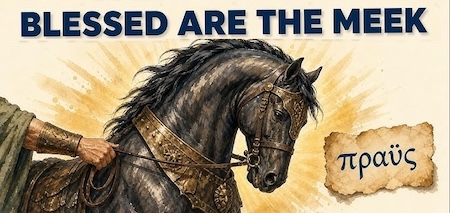
The Greek word translated meek is praüs. It never meant weakness. It referred to strength under control – power that had been disciplined rather than diminished.
One of the clearest pictures of praüs came from the training of Greek warhorses. Trainers selected the strongest, most spirited stallions – not the weakest. Through months of disciplined training, those horses learned complete responsiveness to their rider without losing their courage or strength. When they reached that point, they were described as praüs.
Their power had not disappeared. It had been mastered.
Perhaps a simple definition of meekness is this: Meekness isn’t strength that can’t do harm. It’s strength that won’t do harm. That changes everything.
Jesus was certainly not weak.
He confronted religious hypocrisy. He challenged political powers. He overturned tables in the temple. He spoke with authority that astonished crowds and terrified His opponents.
Yet His strength was never driven by ego or the need to win. It was always tethered to the will of His Father and directed toward the good of others.
That is why Jesus could describe Himself with these remarkable words: “I am gentle and humble in heart.” (Matthew 11:29)
Interestingly, this is the only place in the Gospels where Jesus explicitly describes His own character. Gentle. Humble. Meek.
Trust Instead of Grasping
Perhaps nowhere is strength under control seen more clearly than in Jesus’ temptation in the wilderness. Satan repeatedly invited Him to grasp what the Father had already promised – to seize power instead of trusting God to provide it in His own time.
Jesus refused every shortcut. He trusted rather than grasped. That is meekness.
I wonder if this is where many of us struggle. We say we believe in God. But do we trust Him? Those aren’t always the same thing.
It is possible to believe all the right things about God while quietly depending upon ourselves for security, recognition, success, or control. We pray for God’s help while keeping a firm grip on the outcome.
Maybe that’s why meekness feels so foreign. It requires open hands.
We cannot receive the kingdom while our fists are clenched around something else.
Our world still confuses forcefulness with faithfulness. We are drawn to people who project confidence, command attention, and accumulate influence. But Jesus never blessed those who demanded control.
He blessed those who surrendered it.
An Inheritance, Not a Possession
Which brings us to His surprising promise: “They will inherit the earth.”
Notice the language. They don’t conquer the earth. They don’t seize it. They don’t purchase it.
They inherit it.
An inheritance is received, not taken. Maybe the meek are the only people prepared to inherit the earth because they already know it never belonged to them in the first place (cf. I Almost Bought the Farm).
Everything is gift. Everything belongs to the Father. Everything is received with gratitude.
Eugene Peterson captures the spirit of this Beatitude well:
“You’re blessed when you’re content with just who you are – no more, no less. That’s the moment you find yourselves proud owners of everything that can’t be bought.”
Jesus isn’t blessing weakness. He is blessing people whose strength has been surrendered to the Father – people who no longer need to prove themselves because they trust Him to provide, defend, and accomplish His purposes.
That is exactly what we see in Jesus.
The Character of the King
Paul would later describe Jesus this way in Philippians 2. Although Jesus possessed every right and every privilege, He did not grasp for them. Instead, He emptied Himself, took the form of a servant, humbled Himself, and entrusted Himself completely to the Father. His path was not one of self-assertion but self-giving love.
Meekness is what power looks like after it has been surrendered to love.
That sentence doesn’t simply summarize this Beatitude. It previews the rest of the Sermon on the Mount.
As we continue listening to Jesus, we’ll discover that every command He gives – loving our enemies, turning the other cheek, forgiving instead of retaliating, serving instead of being served – flows from this same kingdom character. They are not isolated moral commands. They are portraits of a life transformed into the likeness of the King.
And that King is meek.

 Practical Theology Today