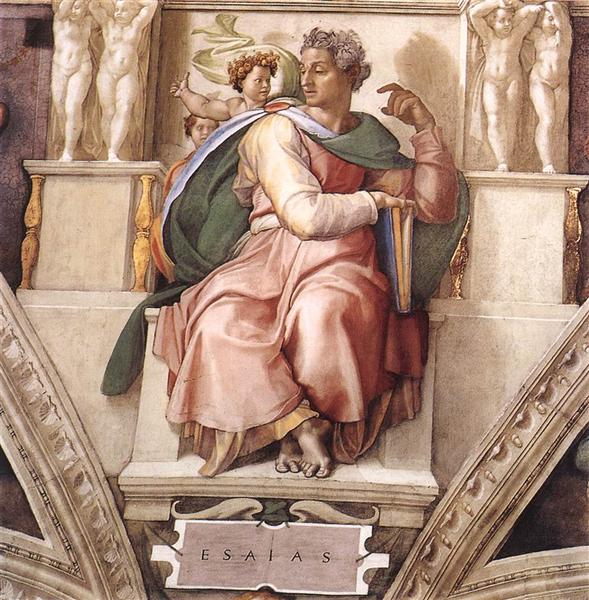
We would be remiss in this “kingdom journey” if we didn’t spend time with Isaiah and his 60-year ministry as a prophet. His prophetic voice rang out in one of Israel’s darkest seasons. His book spans decades of judgment, grief, promises, and breathtaking visions of God’s kingdom breaking in.
Isaiah’s ministry began in the eighth century B.C. during the reign of Uzziah (Isaiah 6:1). He served as a prophet in Jerusalem, speaking to kings and common people alike. His call was both daunting and exhilarating as he announced God’s word to a people who largely did not want to hear it. He saw firsthand their idolatry, injustice, and false worship. He warned them that Assyria, and later Babylon, would be instruments of God’s judgment.
Isaiah was not simply a prophet of doom. He was also a prophet of hope. His message unfolds in a rhythm of judgment and restoration, not an uncommon theme in the Hebrew scriptures. Israel would be cut down like a tree, but “the holy seed will be the stump in the land” (Isaiah 6:13). In other words, God’s kingdom story and the role of his people were far from over.
Isaiah in the Shadow of Exile
Isaiah straddled a critical time in Israel’s history. Some of his prophecies addressed the immediate threat of Assyria, but his vision stretched far beyond. He foresaw Babylon’s rise and the devastating exile that would follow (Isaiah 39:5–7). For Judah, this meant the unimaginable: the temple destroyed, the land lost, the people scattered.
What do you say to a people stripped of their identity and hope? Isaiah’s answer was to re-anchor them in the character of God. He reminded them that the Holy One of Israel was not confined to stone walls or earthly thrones. Even in exile, God was King.
“Comfort, comfort my people, says your God” (Isaiah 40:1). These words echo like cool water in the desert. Isaiah dared to declare that exile was not the end. God was still writing the story, still keeping covenant, still shaping a people for Himself. The kingdom would come, not by human might but by God’s own faithful hand.
The Kingdom Vision
Isaiah’s prophecies pulse with kingdom language. He envisioned a day when swords would be beaten into plowshares, and nations would learn war no more (Isaiah 2:4). He pictured a highway in the wilderness, where God Himself would lead His people home (Isaiah 35:8–10). He described a feast of rich food for all peoples, where death is swallowed up forever (Isaiah 25:6–8).
These aren’t just nice images. They are glimpses of God’s reign breaking into human history. Isaiah insisted that God’s kingdom is not limited to Israel’s borders – it is global, cosmic, and eternal.
But who could possibly bring such a kingdom?
Pointing to the King
Isaiah repeatedly pointed forward to a figure who would embody and establish God’s reign. Sometimes he called Him the shoot from Jesse’s stump, a Spirit-filled ruler who delights in righteousness and justice (Isaiah 11:1–5). Other times, He is the Servant of the Lord, who suffers on behalf of His people, bearing their sins to bring them peace (Isaiah 53:4–6).
For Christians, these words unmistakably point to Jesus. He is the child born, the son given, the one called Wonderful Counselor, Mighty God, Everlasting Father, Prince of Peace (Isaiah 9:6). He is the Servant who was pierced for our transgressions and crushed for our iniquities. He is the Spirit-anointed King who announces good news to the poor and freedom for the captives (Isaiah 61:1–2; see Luke 4:18–21).
Isaiah, centuries before Bethlehem, gave Israel a vocabulary of hope that would only make full sense in Jesus.
Kingdom People Then and Now
Isaiah’s voice continues to call out across the centuries. His message to exiles is just as relevant to us. We may not be dragged off to Babylon, but we know what it is to live in a fractured world where kingdoms rise and fall, where injustice festers, and where hope feels fragile.
Isaiah’s kingdom vision re-centers us. It reminds us that our story is not defined by loss or despair but by the faithful God who keeps His promises. It challenges us to live as kingdom people even in exile (both real and perceived) – to pursue justice, to care for the oppressed, to keep our eyes fixed on the coming King.
The same King that Isaiah saw in the temple, high and exalted, with the train of His robe filling the sanctuary (Isaiah 6:1), is the King who took on flesh and walked among us. He is the crucified and risen Lord who promises, “Behold, I am making all things new” (Revelation 21:5).
Living Isaiah’s Hope
To read Isaiah is to be both unsettled and comforted. We are unsettled by his honesty about sin, judgment, and the futility of our false securities. But we are comforted by his relentless insistence that God is faithful, that exile is not the end, and that a King has come – and will come again.
Like the exiles who first heard Isaiah’s words, we are invited to trust, to wait, to hope. To beat our swords into plowshares in anticipation of peace. To walk the highway of holiness with joy. To live as witnesses to a kingdom that is already here and yet still to come.
Isaiah helps us see what’s true: God is King, His kingdom is and has broken in, and Jesus is the fulfillment of the promises. And in that kingdom we find our home.

 Practical Theology Today