Between Testaments: Israel’s Tumultuous Path to the First Century


The Maccabean Revolt marks one of the most dramatic turning points in Jewish history. It was a period charged with both tragedy and triumph, when faith and identity collided with political power and cultural assimilation. The revolt began in 167 BC under the oppressive rule of Antiochus IV Epiphanes, but its ripples extended far beyond the immediate battles. From the courageous uprising of the Maccabees to the eventual Roman conquest in 63 BC, this chapter of Israel’s history illustrates how God’s people navigated the tension between devotion to Him and the pressures of empire.

Sparks of Revolt

The Seleucid ruler Antiochus IV Epiphanes had attempted to stamp out Jewish religious practice by desecrating the Temple, outlawing Torah observance, and forcing pagan sacrifices (see the previous blog post). These acts lit the fuse of resistance. When the king’s officials demanded that Mattathias, a priest in the Judean town of Modein, offer sacrifice to Zeus, he refused – and struck down the apostate Jew who was willing to comply. His defiance launched an armed movement.

Mattathias’ sons, especially Judas Maccabeus, carried forward the cause. Judas earned the nickname Maccabeus – “the Hammer” – for his ferocity in battle. Using guerrilla tactics, he and his followers struck Seleucid garrisons, routed larger forces, and reclaimed Jewish towns. What drove them was not only national pride but also a holy zeal to preserve covenant faithfulness.

“Machabeusze”, a depiction of the revolt by 19th-century Polish artist Wojciech Korneli Stattler.

Cleansing and Rededication

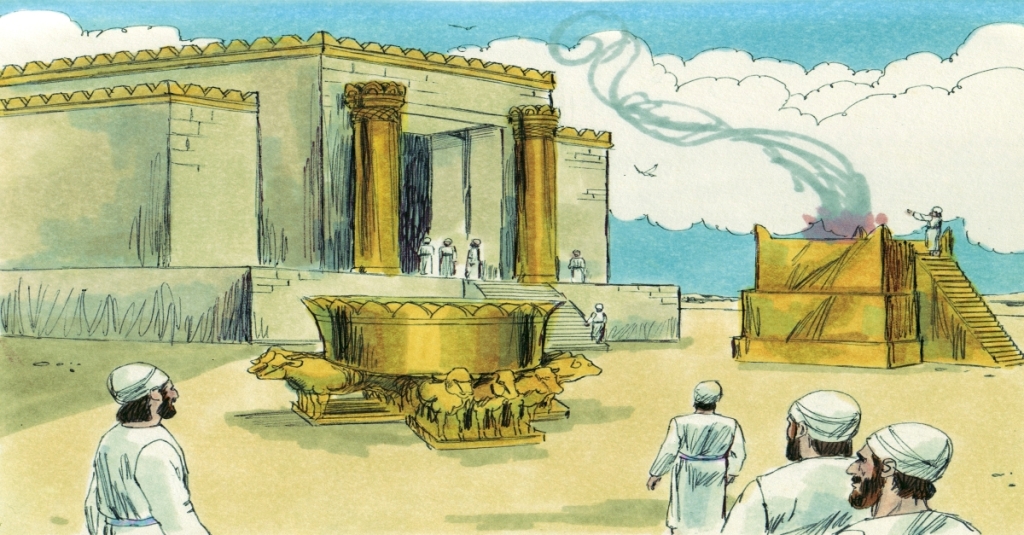
By 164 BC, Judas and his men retook Jerusalem and cleansed the desecrated Temple. The altar, defiled by pagan sacrifices, was rebuilt, and the Temple rededicated to the worship of the Lord. This moment is remembered in the Jewish festival of Hanukkah, the Feast of Dedication, commemorating the miracle of God’s provision and the victory of His people.

The restoration of the Temple was not just about reclaiming a building. It was about reasserting that Israel’s identity flowed from her covenant relationship with Yahweh, their God. To lose the Temple was to lose the visible sign of God’s presence. To rededicate it was to declare that He was still faithful and that His people would be faithful in return.

Expansion and Struggles

The Maccabean movement did not end with Judas. His brothers, Jonathan and Simon, continued the fight. Jonathan took on both religious and political roles, serving as high priest while leading military campaigns. Simon later secured greater independence for Judea and was hailed as both leader and priest.

This family’s leadership inaugurated what became known as the Hasmonean dynasty. For the first time in centuries, the Jewish people experienced relative self-rule. The dynasty expanded territory, reclaimed lands once held under David and Solomon, and even forced neighboring peoples to adopt Jewish customs. Apparently turnabout was fair play.

But with success came new challenges. The blending of priestly and political authority raised questions about legitimacy. Some Jews, especially the later sects like the Pharisees and Essenes, resisted the Hasmoneans, criticizing their corruption and compromises. What had begun as a fight for purity of worship risked being entangled in political power struggles.

Sects and Partisanship

It was during this period that Judaism began to splinter into recognizable sects. The Pharisees emphasized strict observance of the Law and oral tradition, hoping to safeguard Israel’s holiness. The Sadducees, largely from priestly and aristocratic families, were more aligned with the Temple and political elite. The Essenes, disillusioned by corruption, withdrew into desert communities, awaiting God’s intervention. The Zealots, later on, embodied the revolutionary spirit of the Maccabees, insisting on violent resistance to foreign domination. Partisanship dominated the scene.

These divisions reflected deeper questions: What does it mean to be God’s people under empire? How do you remain faithful when rulers are hostile, or when your own leaders falter?

The Shadow of Rome

The Hasmonean dynasty’s growing ambitions drew the attention of larger powers. Civil strife between rival claimants to the throne created an opening for Rome, the newly rising empire in the Mediterranean world. In 63 BC, the Roman general Pompey entered Jerusalem. According to ancient sources, he even walked into the Holy of Holies – an act of sacrilege that left deep scars in Jewish memory.

From that point forward, Judea existed under Roman oversight. Though the Hasmoneans still held nominal authority for a time, true power resided in Rome’s hands. Eventually, Rome installed client kings, like Herod the Great, who reigned with splendor but also cruelty.

Between Revolt and Hope

The period from the Maccabean revolt to Rome’s conquest was one of paradox. On one hand, it was an age of heroic faith: ordinary men and women risking everything to keep God’s law and worship Him alone. On the other hand, it exposed how fragile human leadership can be, how quickly zeal can become corrupted by political power.

Yet, within this turbulent story, God was preparing the stage for something greater. The Temple had been cleansed, but it pointed beyond itself to a greater cleansing to come. The dynasty had restored independence, but it revealed the limits of self-selected human kingship.

As Roman control solidified in Judea, messianic expectations intensified. Many anticipated a divinely appointed leader who would reestablish Israel’s sovereignty and expel its foreign oppressors.

The story from the Maccabees to Rome is not just political history; it is spiritual history. It shows a people struggling to remain God’s people in the face of foreign oppression, internal corruption, and cultural pressures. It shows the high cost of faithfulness and the dangers of compromise. And most importantly, it set the stage for Jesus, who would enter a world of divided sects, Roman rule, and longing hearts to announce: The kingdom of God is at hand.
Rebuilding What Was Lost: Ezra, Nehemiah, and the God Who Restores


The people of God knew what it meant to lose everything. Jerusalem was in ruins, the temple was ashes, and the people had been carted off to Babylon in humiliation. Decades passed. A generation grew up in exile,* remembering only in stories the songs of Zion and the glory of Solomon’s temple. When the exile finally lifted and the return began, their task was clear but overwhelming: rebuild. Rebuild their homes, rebuild their city, rebuild their temple, rebuild their life with God.

It is in this season that we meet Ezra and Nehemiah – two leaders who carried the weight of restoration on their shoulders, but in different ways. Ezra, the priest and scribe, devoted himself to restoring worship and the teaching of God’s Word. Nehemiah, the cupbearer turned governor, devoted himself to rebuilding the city’s walls and restoring its strength. Both men lived in the tension of hope and hazard. Both knew that what they built was far more than stone and timber; it was a testimony that God had not abandoned His people.

Ezra and the Temple: Restoring Worship

The first wave of exiles returned under Zerubbabel, rebuilding the altar and eventually completing the Second Temple around 516 BC. It was nothing like Solomon’s grand temple, but it was a place where sacrifices could be offered and the presence of God honored. When Ezra arrived some decades later, the Second Temple already stood, but worship had become compromised. People had intermarried with surrounding nations, idolatry lingered at the edges, and the Word of God had been neglected.

Ezra’s mission was not just about stone and mortar – it was about hearts. Scripture describes him as a man who “set his heart to study the Law of the LORD, and to do it and to teach his statutes and rules in Israel” (Ezra 7:10). He called the people back to covenant faithfulness, sometimes with tears, sometimes with stern confrontation. His leadership shows us that rebuilding life with God is not only about physical structures but about returning to obedience and worship.

Ezra faced resistance, of course. Neighboring peoples mocked the efforts of the returned exiles, writing letters to Persian kings to halt the work. Within Israel, there was compromise and half-heartedness. Some resisted his calls to repentance. Yet, slowly, through public reading of the Law and renewed devotion, Ezra helped re-center the people on God.

Nehemiah and the Walls: Restoring Strength

If Ezra carried the priest’s burden, Nehemiah carried the builder’s grit. Serving as cupbearer to King Artaxerxes, he heard word that Jerusalem’s walls lay in ruins and its gates burned. His response? He wept. He fasted. He prayed. And then he risked everything by asking the king for permission to return and rebuild.

When he arrived, he found a city vulnerable and exposed. A city without walls was a city without security, dignity, or identity. Nehemiah walked the ruins at night, surveying the broken stones, and then rallied the people: “You see the trouble we are in… Come, let us rebuild the wall of Jerusalem, and we will no longer be in disgrace” (Neh. 2:17).

But the work was not easy. Opposition sprang up quickly. Leaders like Sanballat and Tobiah ridiculed the project: “What are these feeble Jews doing? … If even a fox climbs up on it, he will break down their wall of stones!” (Neh. 4:2–3). Their mockery turned to threats, and the builders worked with one hand on the stone and the other on their swords. Hazards came from without and within: enemies plotted attacks, while discouragement and fatigue weighed heavily on the workers.

Nehemiah demonstrated true leadership in those moments. He stationed guards, encouraged the weary, and reminded them that the work was God’s. He called out corruption, confronted injustice among the nobles, and kept his own life free of greed. Through sheer perseverance and faith, the wall was completed in just 52 days – a feat that even their enemies had to admit was possible only because “this work had been accomplished with the help of our God” (Neh. 6:16).

The Attitudes of the People

Ezra and Nehemiah both encountered a spectrum of reactions. Some rejoiced at the rebuilding. When the temple’s foundation was first laid, younger voices shouted for joy while older ones wept, remembering the glory of Solomon’s temple (Ezra 3:12). There was excitement and sorrow mingled together—the joy of restoration and the ache of what had been lost.

Others resisted, either through apathy or hostility. Some within the community were more concerned about their own houses than God’s house. Others opposed the reforms that called for sacrifice or repentance. And of course, enemies outside of Israel actively tried to sabotage the work.

Yet through it all, the people gathered. They took their places on the wall. They listened to Ezra read the Law for hours on end, standing in the hot sun. They confessed their sins together. They signed a covenant renewal. The story of Ezra and Nehemiah is not simply about two leaders but about a community that, with all its imperfections, rose to the occasion and chose to hope in God’s promises.

God’s Faithful Restoration

The stories of Ezra and Nehemiah are about more than ancient history. They remind us that God is in the business of restoration – He always has been, He always will be until the “renewal of all things” (Matt. 19:28). His people may stumble, cities may fall, worship may grow cold – but He stirs leaders, awakens communities, and rebuilds what was broken.

Ezra reminds us that restoration begins with returning to God’s Word and realigning our lives with His will. Nehemiah reminds us that God calls us to action, to pick up stones, to stand watch, and to persevere in the face of opposition. Together, they paint a picture of faith that is both spiritual and practical, both inward and outward.

And perhaps the most important lesson? The temple and the walls, as important as they were, pointed to something greater. Generations later, Jesus would walk those same streets, declaring Himself the true temple (John 2:19) and the Good Shepherd who protects His people.

The story ends where ours begins: with a God who restores, a people who return, and a future secured not by stone walls or earthly temples, but by the presence of Christ, through the Holy Spirit, among us.


* Exile: think “eviction.” In I Almost Bought the Farm, we discussed that the land, the Promised Land, belonged to God, and His people resided there at His pleasure.

The Temple: God’s Dwelling Place Among His People


When we think of the Temple in Jerusalem, it’s easy to imagine it as just another impressive ancient building with ornate stonework, golden decorations, and sacred rituals. Most cultures in the ancient Near East had temples. From Egypt to Mesopotamia, from Canaanite shrines to Babylonian ziggurats, temples were everywhere. They were designed to house the presence of the gods, to be places where heaven and earth touched.

Israel’s Temple was different.

From Tabernacle to Temple

The Temple wasn’t Israel’s first “house of God.” In the wilderness, God instructed Moses to build the tabernacle (Exodus 25–31). This portable sanctuary, crafted with careful instructions and exact measurements, was the meeting place between God and His people. Its very design taught theology: the Holy of Holies symbolized God’s throne room, the ark His footstool, and the altar His provision for forgiveness.

And behind it all was the Biblical covenant refrain: “I will take you as my own people, and I will be your God” (Exodus 6:7). The tabernacle was God’s visible way of saying, “I’m not a distant deity. I dwell with you, because you are mine.”

When Israel settled in the land, King David longed for a permanent place where God’s presence would rest. As he looked out from his cedar palace in Jerusalem, he was struck that the ark of the covenant still dwelled in a tent (2 Samuel 7:1-2). His desire was honorable – he wanted to build a house worthy of Yahweh.

But God said no.

Why David Was Not the Builder

God’s response to David was layered. First, He reminded David that He had never asked for a house – He was the One who had always been on the move with His people. Second, God turned David’s request upside down: instead of David building God a house, God promised to build David a “house” – a dynasty through which His kingdom would be established forever (2 Samuel 7).

Upside down. Another Biblical theme.

Another reason, Scripture notes, is that David was a man of war, his hands stained with blood (1 Chronicles 28:3). If they were to have a temple, God wanted it to be built by a man of peace – Solomon. But even more, God wanted to remind Israel: “I am the One who builds. I am the One who establishes.

Temples Then and Temples Now

On the surface, Solomon’s Temple resembled other temples of its time: a sacred inner chamber, priestly rituals, sacrifices, and an emphasis on order and beauty.

But the distinction was profound. Pagan temples were built to contain an image of the pagan god with a carved idol that embodied the deity’s “presence.” In contrast, Israel’s Temple was built for the presence of the living God Himself. No idol sat in the Holy of Holies – only the ark of the covenant, a symbol of God’s throne. And when Solomon dedicated the Temple, God’s glory, in a theophany, filled the house like a cloud (1 Kings 8:10–11). Yahweh Himself took up residence.

Temple Theology 101

The Temple stood as more than an architectural marvel. It declared foundational truths about God and His kingdom:

  • God dwells with His people. The Temple embodied the covenant promise: “I will be your God, and you will be My people.”
  • God is holy. Access to His presence was carefully ordered, with layers of increasing sanctity leading to the Holy of Holies.
  • God provides atonement. Sacrifices reminded Israel that sin separates humanity from God, and blood was necessary for forgiveness.
  • God reigns as King. The Temple was His throne room in Jerusalem, reminding Israel they were His covenant people under His rule.

The Temple wasn’t just a religious building – it was a kingdom declaration.

The Greater Temple: Jesus Christ

Yet the Temple was never the ultimate goal. It was a shadow pointing forward to something greater. When Jesus arrived, He referred to Himself as the true Temple: “Destroy this temple, and in three days I will raise it up” (John 2:19). In Him, God’s presence didn’t merely dwell in stone walls, but it walked among us in flesh and blood. The Word became flesh and tabernacled among us (John 1:1`4, AMPC).

Paul captures this beautifully in Colossians 1:15: “The Son is the image of the invisible God, the firstborn over all creation.” Unlike the pagan temples with their carved images, Jesus Himself is the true image of God. He is not a symbol but the reality – God’s presence embodied fully.

And through Him, the covenant refrain takes on its deepest meaning: because of Jesus, God can say to Jew and Gentile alike, “I will be your God, and you will be My people” (2 Corinthians 6:16).

Dwelling with God Forever

From tabernacle to Temple to Christ, the story is one of God’s presence with His people. What began as a tent in the wilderness finds its completion not in stone, but in a Person – and ultimately, in a city where God Himself will dwell with humanity forever: “God’s dwelling place is now among the people, and he will dwell with them. They will be his people, and God himself will be with them and be their God.” (Revelation 21:3).

The Temple reminds us that God’s desire has always been to take up residence with His people. And in Jesus, that desire has been fulfilled in ways far greater than David or Solomon ever imagined.


Candles (Seeing Things Afresh)

As a kid, I was enamored by candles. I even started making candles at a pretty young age. Christmas candles were especially intriguing to a young kid. So were the candles that were lit around the house during a power outage (which were fairly regular in rural Minnesota during the 1950s-60s). I was enthralled by the dancing flames and the dancing figures they created on the walls. By the time I reached Junior High, I was pretty familiar with candles, or so I thought.

My eighth-grade science teacher gave us an assignment at the beginning of the year. Wanting us to learn to be observant, she gave us a homework assignment that involved observing a candle for 10 minutes and writing down all the things we saw. She issued a challenge to observe 10-15 things. Given my familiarity with candles, I was looking forward to the challenge, pondering it while I did my evening chores in the barn – what candle to use, where to conduct this high-level experiment, in which room, etc. I was a middle school science geek!

I was surprised at the number of things I observed, far surpassing the anticipated 10-15. What was more surprising was that despite my “familiarity” with candles, there was far more to observe than dancing figures on the wall. For the first time, I noticed the various flame colors – yellow, orange, and blue. I noticed flame shape – pointed, rounded, irregular. Pausing to watch for an extended time allowed me to observe the wax melt, pool, and drip down the side of the candle. I had never previously paid attention to smoke dispersant – the various ways the smoke rose or dispersed around the flame. I have continued to discover over the years there are lots of surprises that surpass familiarity if we are observant…

I continue to follow Anne F. Downs’ Let’s Read the Gospels podcast that she rolled out in January 2023. Throughout 2023, she read all four Gospels monthly, so I got to listen to Matthew, Mark, Luke, and John twelve times each over the year. I was constantly hearing things I never remember reading and/or hearing before. If you know me, you know that I’ve consistently and regularly read the Gospels for the past 50+ years – maybe a few hundred times each.

And I still see/hear new things.

This year Downs is reading a chapter a day. By slowing things down, I read the same text in a couple of translations while consulting an on-line Greek interlinear source. It’s been a transformative time. I see things in a different light and the Greek interlinear source is invaluable in helping understand the richness of the words the evangelists selected to describe Jesus – his teaching and his actions – and how the first-century readers would have understood what they were writing.

And I keep hearing and seeing new things

Recently, Matthew 24 was in the queue. For context, Jesus was sitting on the Mount of Olives with his disciples overlooking Jerusalem, the center of Jewish religious and political power. He had been preparing them for a future that did not include the restoration of Israel but rather a complete destruction of their beloved city. 

After listening to Downs, I then read from the Kingdom New Testament (aka New Testament for Everyone) and saw this…

And because lawlessness will be on the increase, many will find their love growing cold (Matthew 24:12).

This passage has been running through my mind since I read it, mulling over several questions: (1) What did Jesus want his disciples to hear regarding the impending fall of Jerusalem and the effect on their lives? (2) What did Matthew want the readers to hear and understand given that he may have written his gospel a dozen years after the fall? and (3) What might we want to pay attention to 2000 years later? Some of my pondering and wonderments…

(1) What did Jesus want his disciples to hear regarding the impending fall of Jerusalem and the effect on their lives? On a very basic level, I suspect Jesus wanted them to know what was coming down the pike regarding their nation and its occupancy by Rome. Keep in mind that Jesus (and his followers) knew nothing other than Roman occupancy. Nor did their parents. Or likely even their grandparents. So everyone was looking for a messiah that would restore their kingdom. 

At this stage in the journey, Jesus had spent several years teaching his followers that God’s kingdom was not going to look like a restored nation, but something entirely new and different. During the last portion of his journey with his apprentices, Jesus repeatedly (literally, repeatedly) presented them with the vision of a Messiah who was ushering in this new kind of kingdom. And that those in power (not the Romans, mind you) who were uninterested in the ethics of this new kind of kingdom would kill him. Others who cared only about a national kingdom would stay their course and revolt against the Romans with brutal and disastrous results. 

I suspect Jesus wanted his initial followers to be alert and not be caught off guard when the “City of God” is sacked. And practically, he may have been warning them of the impending brutal Roman siege and the resulting starvation.

There will be lawlessness, but don’t let your love grow cold

(2) What did Matthew want the readers to hear and understand given that he may have written his gospel a dozen years after the fall of Jerusalem? What comes to mind is the letters to the seven churches that we find in Revelation. In the face of lawlessness that resulted in suffering and persecution, they were admonished to keep their faith, to not lose their first love. These very churches could have been readers and hearers of Matthew’s gospel.

There will be lawlessness, but don’t let your love grow cold

(3) What might we want to pay attention to 2000 years later? (This could be a whole other blog post.) The word lawlessness grabbed my attention. The New Oxford Dictionary defines it as “a state of disorder due to a disregard of the law.” No big surprise here. However, look at the list of synonyms that Oxford included…

Anarchy, disorder, chaos, unruliness, lack of control, lack of restraint, wildness, riot, criminality, crime, rebellion, revolution, mutiny, insurgency, insurrection, misrule

I suspect this list contains several words we’ve heard and seen in the news in recent years. And on social media. Words that cause us to be concerned about the state of our world and society. Words wielded in the arena of cultural contention. Words that cause us to wring our hands in lament and angst. What might Jesus say to us today in the midst of all this? Maybe…

There will be lawlessness, but don’t let your love grow cold