Time spent with our grandkids causes me to reflect back to “when I was their age,” reminiscing what life was like for me decades ago. Much has changed, but kids are kids and the kinds of things that intrigued me intrigue them as well. I love watching them with their nose in books or as they learn to draw. I loved to read and draw. What I read was different (Hardy Boys mysteries versus Harry Potter). I drew horses and tractors. Our grandkids draw Pokémon figures.
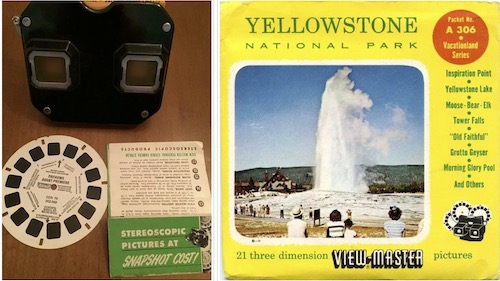
One of the most intriguing things I played with as a kid was a View-Master. For those unfamiliar, a precursor to 3-D glasses the View-Master was a popular stereoscopic toy that allowed me to view images in a three-dimensional format. It consisted of a handheld plastic viewer and a series of circular cardboard “reels,” each containing a set of paired images (see below).
We had a series of reels ranging from Hopalong Cassidy to a variety of national parks. My favorite was Yellowstone National Park. For a dairy farm kid for which a “vacation” consisted of a day trip to Taylors Falls or Duluth squeezed between milkings, the View-Master gave me the opportunity to experience the majesty of our parks – in 3-D!
The “Old Faithful” geyser was particularly captivating. The View-Master reel had a series of time-lapse photos showing the faithful geyser in various stages of eruption. All in 3-D! I studied each of the slides. I couldn’t get enough!
In the previous post, we discussed faith, a word that occurs over 250 times in the New Testament. It derives from the Greek word pistis and can easily be translated as trust (see I Gotta Have Faith). What about faithful – how are faith and faithful related and/or different?
For starters, faith is a noun and faithful is an adjective. Faith refers to the belief or trust in something, particularly God, while faithful describes a person characterized by loyalty, devotion, and reliability. Faith is the foundation or conviction, while faithful reflects the actions and qualities associated with steadfastness and trustworthiness.
Faithful is a translation of the Greek word pistos, which, as you can see, is a derivation of pistis (faith) and pisteoū (believe). These are Greek words found in the New Testament. Looking into the word pistos, what piques my interest are the English words that describe faithful – loyalty, devotion, reliability, steadfastness, trustworthiness, etc. These smack of the Old Testament characterization of God’s covenant loyalty and reliability, hesed and emet (see Hesed and Emet and Veritas).
In a similar fashion to our quantification of faith, I suspect we view being faithful as some form of perfection, success, or “getting it right.” Loyalty and perfection are not the same. I am loyal to my wife but far from perfect and don’t get it right all the time (as she would likely agree 😬). Though she might like it if I got it right more often, I know that loyalty is far more important to her. I suspect God is more interested in our pistos than our successes, our getting-it-rightness.
I am reminded of a story about Mother Theresa. When orphans were starving in India at a greater rate than her little orphanage could possibly serve, Mother Theresa was asked by a reporter how she could feel any sense of success. Her response? God does not require that we be successful, only that we be faithful. In Western thought, we have equated success and faithfulness. God wants our pistos, our loyalty and our devotion.
We must also remember that loyalty is covenantal. While I am faithful to my wife, she is also faithful to me – she makes it easy to be loyal to her. The Old Testament narrative is a story about God’s covenant loyalty. With Jesus, God provided forgiveness of sin making loyalty a possibility. God’s loyalty makes us want to be loyal/faithful in return. The Apostle Paul summed it up for his friend and apprentice Timothy like this (2 Timothy 2:11-13):
Here is a trustworthy (pistos) saying:
If we died with him,
we will also live with him;
if we endure,
we will also reign with him.
If we disown him,
he will also disown us;
if we are faithless,
he remains faithful (pistos),
for he cannot disown himself.
God’s pistos trumps our pistoslessness
Addendum 7/23/2023. Reading 1 Thessalonians 5 this morning, I came across this: The one who calls you is faithful, and he will do it (5:24). Greek for “The one who calls you is faithful” – Pistos ho kalon,
 Practical Theology Today