Let’s Celebrate!

We love a good celebration. What happens after our sports team wins the big one? Or when a World War ends? Or when we get a promotion? Or when the shepherd finds the lost sheep? We celebrate!

The word celebrate comes from Latin roots, and its etymology reveals some rich and festive meaning. The word comes from the Latin verb celebrare, which means “to honor, to go to in great numbers, to solemnize, to observe a festival.” So at its root, “celebrate” is about gathering people together to honor, remember, and/or observe something significant – often in a joyful or meaningful way.

Humans are wired for celebration and remembrance – to stop, look back, and reflect on momentous occasions. From birthday parties and national holidays to family traditions and cultural festivals, we instinctively celebrate that which matters to us. It’s in our God-given nature.

Celebrations aren’t just about fun; they help anchor us in time, in memory, and in meaning. They remind us who we are, where we’ve come from, and what we value most. Whether sacred or ordinary, these moments shape identity and draw us into community.
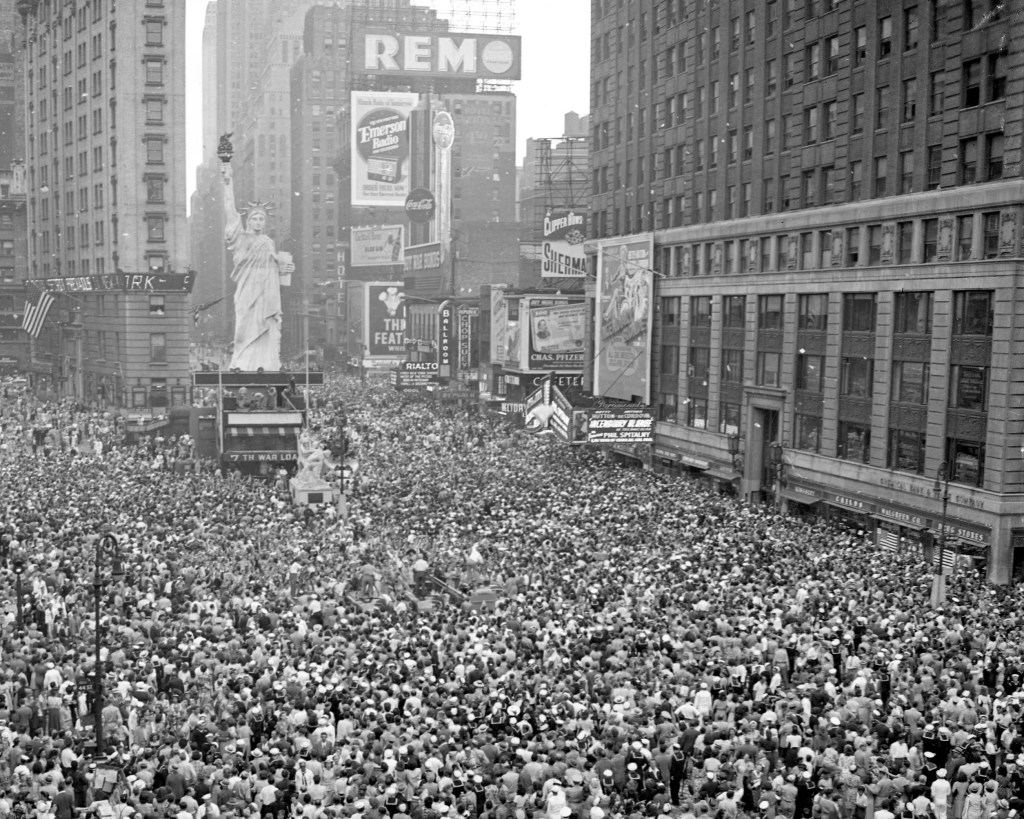
Times Square, VE Day 1945

Over the centuries, monarchial leaders have grasped the understanding of our need to celebrate by instituting kingdom-wide festivals. These kingdom parties were usually all-inclusive – from courtiers to the peasant ranks, all participated. Queen Victoria, who reigned over the British Empire from 1837 to 1901, instituted such a national celebration.

Queen Victoria’s Golden Jubilee marked the 50th anniversary of her reign and was celebrated across the British Empire on June 20, 1887. Central events took place in London and included a grand thanksgiving service at Westminster Abbey, attended by royalty, dignitaries, and representatives from around the world. Throughout the Empire, communities held street parties, fireworks displays, and public festivities. The Jubilee served as both a celebration of national unity and a display of the vast reach of the British monarchy.

We see a pattern of celebration deeply woven into Scripture. The benevolent King Yahweh didn’t just permit celebration, He commanded it.

After giving the people the Ten Commandments, Yahweh provided an additional set of commands related to the treatment of others – fellow servants, property protection, and social responsibility focused on justice and mercy. The deliverance of His commands was followed by the institution of three annual festivals that the people were to celebrate – the Festival of Unleavened Bread (Passover), the Festival of Harvest, and the Festival of Ingathering (See Exodus 23).

Reflecting on these three annual festivals we see God’s heart to draw His people into regular rhythms of remembrance, worship, and gratitude. These were not just events on a calendar; they were sacred invitations to remember who He was and what He had done. They reminded Israel that their story began with deliverance, was sustained by provision, and moved toward a future shaped by His faithful presence.

In our fast-paced, “always-on” world, such rhythms still matter, maybe even more so. Celebration slows us down. Celebration is woven into the fabric of God’s kingdom. Remembrance calls us back. When we intentionally create space to remember God’s goodness – through personal moments, family traditions, or gathered worship – we step into something deeply human and profoundly holy. These practices point us to a God who transcends time and is faithful across generations, filling us with gratitude, worship, and wonder. Sometimes a child-like wonder.

Something to reflect on as we approach the annual celebration of our risen King.

The First Last Supper

A couple of Sundays ago, we celebrated communion (often referred to as the Last or Lord’s supper) during worship at our church. My wife and I were privileged to serve others in our congregation. After the service, I reflected on an email conversation I had earlier in the week with a friend regarding the first Last Supper that Jesus celebrated with his followers.

The timing of Jesus’ Last Supper was the annual Passover celebration meal. As Jesus’ followers settled in for the all-night celebration, it became apparent that this one wouldn’t be a typical Passover meal. What made it untypical? Jesus!

A little context as a reminder of the significance of the Passover celebration and meal for the first-century Israelites (i.e., all of Jesus’ followers), which had been celebrated every year for about 13 centuries. The back story…

The Israelites had moved from Canaan to Egypt during a drought (cf. Joseph and his Amazing Technicolor Dreamcoat). In time, they outnumbered the Egyptians, were conscripted and enslaved, and moved off their land and into ghettos. They were enslaved for 430ish years.

How long are 430 years? Some American context: 430 years ago, around 1600, England had just begun to colonize North America. Think about what has changed in our world since then.  430 years is a long time.

God, through Moses, demanded the release of his people with the familiar “Let my people go” command. The Egyptian ruler, Pharaoh, refused. God sent a number of plagues to encourage Pharaoh to rethink his stance. Instead of softening, after each plague Pharaoh dug his heels in and treated God’s people more unjustly.

Finally, God sent an Angel of Death.  As payment for Pharaoh’s relentlessness, this angel of justice would fatally visit Egypt, resulting in the death of the firstborn of every household in the land – Egyptian and Israelite. God provided a means of protection for his people. They were to slay a lamb, spreading the blood on the doorframes of their homes.  If they obeyed, this angel of death would pass over the house, saving the firstborn. Finally, Pharaoh relented and let the Israelites go.

This is what the Israelites celebrated every year. Each of Jesus’ followers likely made an annual 80-90 mile trek from Galilee to Jerusalem to celebrate Passover. This particular celebration was no exception. Throughout the Gospels, we can read the story associated with the trek to Jerusalem for what turned out to be their last Passover celebration (cf. Matthew 19-26, Mark 10-14, Luke 17-21, John 11-13).

So, in the first-century Jewish culture, Passover was a BIG deal. Like Christmas or Easter.

The Passover meal kicked off the week-long celebration. Meal preparation began early afternoon with the slaying of a lamb at the temple whose blood was sacrificially sprinkled on the altar. The lamb was then roasted to be served at the Passover meal. The Jewish historian Josephus recorded that 255,600 lambs were slaughtered in the temple in 66 AD, the year the temple was completed. From that, Josephus calculated that approximately 2 1/2 million people were present in Jerusalem that year (assuming one lamb to about 10 people).

The Meal was more than just a meal. It was a well-scripted (think liturgy) religious celebration in which the host helped the participants remember the Exodus story, that event 430 years prior in which God rescued them from the Egyptian slave-holders. That’s not a short story to tell. I recently listened to Flavious Josephus’ rendition of the Exodus story in his Antiquities of the Jews, a rendition that took over two hours to narrate. Not a short story!

There were four distinct parts to the six-hour meal, each followed by a cup of wine. First, the host (presumably Jesus, in this case) offered the first cup of wine and a scripted prayer of blessing, something like this: “Blessed art thou, O Lord, our God, King of the world.” Then someone (usually a child) asked, “Why is this night different from other nights?” and the host retells the WHOLE story.

Thirdly, was the meal itself. Finally! The host blessed the food and the people began to partake. The meal consisted of unleavened bread, herbs, greens, stewed fruit, and roasted lamb. The evening was concluded with the singing of the Hallel (i.e. halleluiah) Psalms (Psalms 113-118).

The evening was so scripted that any variance would not go unnoticed. Kind of like reading to a child their favorite book and getting a sentence wrong. They would know and let you know of any discrepancies.

Jesus varied from the script that night in discrepant ways.

First, he announced that one of the Twelve would betray Him. The evening started with a mic drop of colossal proportions. When it was time to eat, Jesus took the bread and gave thanks, presumably saying the scripted prayer, “Blessed art thou, O Lord, our God, King of the world, who brings forth bread from the earth.” Then he deviated with “Take it; this is my body.” (Mark 14:22). I can envision his disciples, well aware of the deviation, looking at each other in wonderment. “What could he mean?” Another mic drop of sorts.

As if that wasn’t enough, Jesus deviated from the script one more time. He took one of the cups of wine*, gave thanks, and passed it to his followers to drink. As they were drinking the wine, he deviated greatly from the script with “This is my blood of the [new] covenant, which is poured out for many” (Mark 14:24). This deviation was completely outside first-century Jewish thought. Touching blood resulted in ceremonial uncleanliness, which is presumably why the priest and Levite went around the beaten man in the good Samaritan parable. Drinking of blood? Totally forbidden.

Jesus had, in one evening, reshaped the entire belief system of his little band of followers.

Which turned out to be a very good thing as we look back on history. Jesus, in deviating from the expected script, turned his followers’ heads toward a different and more complete understanding of God, his kingdom, and their role in his kingdom. The scripts they were familiar with were part of the story, but not the whole story. Jesus crashed through the comfortable and familiar to give them a new, more complete perspective of God and their calling.

May we always be willing to let Jesus disrupt the comfortable and familiar certainties of our faith with broader perspectives.

* It is believed that it was the Cup of Redemption that Jesus instructed the disciples to partake of in the last supper since both accounts in Matthew and Luke describe the cup being taken after the meal.