Our journey toward a better understanding of the kingdom of God gave us a glimpse of the benevolence of our Divine King, Yahweh. We discovered in his benevolence Yahweh gifted the long-enslaved Israelites with much-needed rest, which we know as Sabbath. It was clearly a gift from God that was later formalized as one of the Ten Commandments. Because it was one of the “Ten Words” (as the commandments are known in Judaism), I wondered…
Do we tend to view the sabbath as a command only and miss the gift?
A story from experience. An “expectation” of the organization I have been part of for 50 years is that staff take one day a month of sabbath for rejuvenation. More than once, as a trainer of new staff, the question of what that day could/should look like would surface. I would usually suggest they poll several seasoned staff people to see how they utilized the day-a-month sabbath. Invariably, the new staff folks reported back that they could not find staff veterans who sabbathed with any regularity.
So I interviewed several people in corporate mid-management, asking, “If your company provided you with the opportunity to schedule a day a month to do nothing, would you take it?” The resounding response was, Yes!” One person even said they’d schedule the full year immediately.
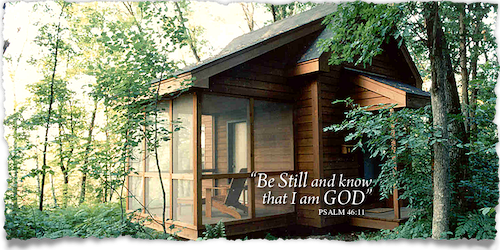
If Sabbath is a gift, then why do we have such a hard time being with the Giver? Maybe that’s part of the issue – we don’t know how to be with the Giver. Before my quasi-retirement, I did a 48-hour silent retreat twice a year at Pacem in Terris, a retreat center near me. The retreat center’s instructions were to bring only my Bible and journal. I recall with fondness 20 years of such retreats. What I don’t recall are specific ways I heard from God. I just enjoyed not working,* reading scripture, and talking with God as I read or went for walks in the woods.
But mostly, I just rested.
The pastor who put me onto Pacem in Terris recommended a 48-hour, two-night retreat. He told me there was a good chance I might sleep a chunk of the first day (which sometimes was true). As I began to understand sabbath, I began to realize that it is simply regular rest from work. Remember that sabbath was a gift of rest to the Israelites, who had likely slaved seven days a week their entire working lives.

So, I wonder, why don’t we see sabbath rest as a gift? Some thoughts…
I suspect one reason is the way we read the fourth commandment: Remember the Sabbath day and keep it holy… and the way it has been taught to us. Our eyes go to two words – capital “S” Sabbath, giving it weight and importance. True as that is, we mustn’t forget (“remember?”) that sabbath, at its core, means rest. God, our creator, knows us and knows us well. We need regular rest.
I also suspect the word holy leads to some confusion. For many of us, holy has some super-spiritual connotation. Thus, we view sabbath rest as something deeply spiritual that is beyond us, so we don’t sabbath. Holy simply means to set apart. In twenty-first-century thinking, it means setting aside days of rest and honoring them. To the young people that I mentor, I tell them to calendar their days of rest/solitude a year out and protect those dates. (I’m fully aware that adjustments might need to take place, but adjust ≠ cancel.)
“I don’t know what to do” is one of the big reasons I hear why people don’t set aside and keep days of sabbath. “Doing” – the great Achille’s heal for Western Christians! About 30 years ago, I began to realize that I’m a human being, not a human doing. Rest means not doing. When we block out times of solitude, we just want to rest and be with God. It’s a hard shift to make, but a shift that can only happen if we protect times of sabbath. What do we usually need rest from? Doing!
We are human beings not human doings
Recently, a young man I mentor who ministers as a profession asked me a great question: “What do you know now that you wished you would have known 30 years ago.” My immediate response: “I wished I would have known that it’s not about me.” One of the main reasons given to me for not taking sabbath rest is one of time. “I’m too busy and don’t have time. I’ll sabbath when I get all caught up.” Or, “There’s too much good work to be done, taking days away from God’s calling feels unproductive.” Or, I often hear a sense of guilt, that sabbath rest feels selfish.
In my estimation, if we get our worth from what we do, then sabbath rest will be difficult for us. If we get our worth from what we do, then we will tend to overestimate our importance in God’s kingdom and it becomes about us. God is good at what he does – being the King of the universe and all. I don’t think sabbath rest is just a command; it’s a statement that our Divine King knows what we need better than we do.
We must remember that Sabbath is a gift from the King to his subjects. Jesus reminded the religious leaders of that…
The Sabbath was made for man, not man for the Sabbath (Mark 2:27)
* One of the things I learned during my times at Pacem in Terris: I bring a small pad with me to jot down things that I need to do once I get back. That way, I have them captured on paper and can ignore them throughout my time of solitude, knowing I can address them when I get home. Interestingly, I rarely ever look at the pad when I get home!
 Practical Theology Today