Mary’s Poem

I absolutely love poetry – when I hear it read. I remember attending a Cursillo weekend event in the mid-1980s where one of the spiritual directors read poems from his favorite author. The words leaped off the page and drew me in, so much so that I went out and bought the book for myself. To my disappointment, as I read from the book, the poems did nothing for me. I think we engineering-types struggle to read poetic literature. I know I do. To my dismay, the richness of so much poetry just never seems to leave the pages.

I’ve heard many people say they struggle reading Hebrew poetry, like the Psalms, as did I for about the first 45 years of my life. Then something changed. I took a seminary course in Psalms through the Reformed Theological Seminary in the mid-1990s. I remember asking the professor which English translation of the Bible gives us the best sense of the meter and intent of these great Hebrew poems and songs. He suggested reading from the New American Standard Bible. Thus began a new appreciation of Hebrew poetry.

Mary’s Magnificat (Luke 1:46-55) is certainly in the genre of Hebrew poetry. It reads like many of the Psalms, laced with thanksgiving and admiration of God along with declarations of his redemptive and loyal characteristics. We should keep in mind that Mary would have been quite familiar with Hebrew poetry, especially the Psalms. She might likely have sung some of the Psalms during her week-long journey to visit her cousin, Elizabeth.

It was at Elizabeth’s home that Mary mouthed the Magnificat. Magnificat is the title attributed to her poem/song of praise which was a response to Elizabeth’s reception and words of blessing of Mary and her unborn baby, Jesus. The term Magnificat comes from the opening line of the poem in the Latin Vulgate Bible – Magnificat anima mea Dominum, “My soul magnifies the Lord.” 

Though Mary’s poem appears to have been spontaneous, one could/should assume the contents could have resulted from things she would have been pondering since the visit from the angel, Gabriel, and most likely during her long trip to visit Elizabeth. I think of a couple different times in the Gospels that speak of Mary’s treasuring and pondering of events unfolding in her life:  Mary treasured up all these things and pondered them in her heart (Luke 2:19, after the visit from the shepherds the night of Jesus’ birth) and his [Jesus’] mother treasured up all these things in her heart (Luke 2:51, after the young lad went missing and was found discussing theology with the teachers in the Temple). 

And certainly, a visit from an angel declaring that she would birth the Messiah would be cause for much pondering!

If you recall, when Mary reached Elizabeth’s home and greeted her, Elizabeth’s baby John leaped in her womb. And Elizabeth was filled with the Holy Spirit, and she exclaimed with a loud cry, “Blessed are you among women, and blessed is the fruit of your womb! And why is this granted to me that the mother of my Lord should come to me? For behold, when the sound of your greeting came to my ears, the baby in my womb leaped for joy. And blessed is she who believed that there would be a fulfillment of what was spoken to her from the Lord” (Luke 1:39-45). Elizabeth commended Mary for her faith and confirmed the angel Gabriel’s proclamation that she would indeed carry the Messiah in her womb. No wonder Mary broke into song (though scripture doesn’t indicate that she sang) and said…

“My soul magnifies the Lord,
47     and my spirit rejoices in God my Savior,
48 for he has looked on the humble estate of his servant.
    For behold, from now on all generations will call me blessed;
49 for he who is mighty has done great things for me,
    and holy is his name.
50 And his mercy* is for those who fear him
    from generation to generation.
51 He has shown strength with his arm;
    he has scattered the proud in the thoughts of their hearts;
52 he has brought down the mighty from their thrones
    and exalted those of humble estate;
53 he has filled the hungry with good things,
    and the rich he has sent away empty.
54 He has helped his servant Israel,
    in remembrance of his mercy,
55 as he spoke to our fathers,
    to Abraham and to his offspring forever.” (ESV)

Read the Magnificat again and you will see the gospel, the good news that accompanies the arrival of a king.  This King will be different than all other kings of the earth. Most kings, upon arrival, exalt those with wealth, position, and power. Most kings, upon arrival, throw celebrations and feasts for those of wealth, position, and power – celebrations and feasts catered by servants of humble estate.  This King arrived through a servant of humble estate.  This King would reverse the order, exalting the humble and humbling the exalted. 

No wonder the late pastor and author, Eugene Peterson, referred to this good news as the great reversal. No wonder Dietrich Bonhoeffer, the German pastor and theologian who was executed by the Nazis, called the Magnificat “the most passionate, the wildest, one might even say the most revolutionary hymn ever sung.”

* Mercy is that rich Hebrew word, hesed, that we have previously discussed.

The Road to Emmaus

One of my favorite Easter stories is the one often entitled The Road to Emmaus. If you have never read this story or haven’t recently read it, you might want to.  It can be found in Luke 24:13-35.  I’ve read or heard it a number of times over the past few months.  It’s a most fascinating story – I’m glad that Luke felt God’s tug to include it in his gospel.

It’s the story about two of Jesus’ followers (not part of the Twelve) as they travel from Jerusalem to Emmaus on “that very day” – the day Jesus was resurrected.  As they walked the seven-mile trek, they had all kinds of time to talk through the events of the past three days, so they did. 

As they walked, Jesus showed up, appearing unbeknownst. Jesus had once said, “Where two or three gather in my name, there am I with them” (Matt. 18:20). That’s literally what he did, though the two disciples didn’t recognize him. As he came alongside them he asked a simple, yet profound question: “So, what were you guys talking about.”  They stood there looking sad.

One of them asked Jesus if he was the only person that hadn’t heard what took place in Jerusalem these last few days.  Jesus then asked a simpler and even more profound question: “What things?”  Love it.  Jesus, who experienced it all, asked, “What things?”

It was just like Jesus – not missing a teaching moment, always asking great questions.  (I suppose he could have been just messing with them – I certainly would have!)  I think as a teacher, Jesus asked questions for a couple reasons: (1) He wanted to discover what they understood, thought, believed, and perceived, and, more importantly, (2) He wanted them to discover what they understood, thought, believed, and perceived.

Mostly, I think he wanted people to pause, think, and ponder.

Think about some of the questions he asked – Do you want to get well?  What do you think about John the Baptist?  Which of the three was the neighbor to the victim? What do you think (he asked this often)? What do you want me to do for you?  Why do you call me ‘Lord, Lord’ and don’t do what I say?  Who do you say that I am?  What are you looking for? He seemed to always be asking questions that caused the hearer to pause and maybe ponder for a second or two. Or more.

I remember talking with a High School girl during a grief group session I was facilitating several years ago.  She was struggling with how God could have taken her loved one.  I asked her the question, “Take or allow?”  She was doodling on her folder, paused, looked at me, and said, “I’ve never had anyone ask me that before.  I’ll have to think about it.”  Ponder.  This young gal, with a pretty new faith, came back the next week and said that she was rethinking how she viewed God’s role in her loved one’s death.

Several years ago at a local coffee shop, a stranger, noticing me writing in my journal, asked me how keeping a journal has helped me grow in my faith.  (No one had ever asked me that before or, at least, not that point blank.)  I thought about it for a second and said, “It makes me ponder.”

It really does.  As I spend time alone with God in solitude, I find it’s in the moments that I ponder what I’m reading (and the subsequent questions that seem to arise) that things begin to connect for me.  I get to discover what I understand, think, believe, and perceive about things.  It’s almost like Jesus is sitting with me asking the questions that make me pause and think – pondering in solitude. 

I refer to it as times of pondertude.

What Might it Take?

If you have never read the book of Nehemiah in the Old Testament, you should. If you have read it, you might want to read it again, because it is a most amazing story. The books of Ezra and Nehemiah are paired together, following the historical books of Kings and Chronicles.  In the Hebrew Bible, Ezra and Nehemiah are one book entitled Ezra-Nehemiah, but the Christian canon separates them into two different books.

In the fifth century B.C., the Israelites continued to emerge from their exile in the Persian Empire. They were invaded and conquered by the Babylonians in 586 B.C., with Jerusalem and its temple destroyed in the process. God’s chosen people found themselves scattered throughout the Babylonian Empire and eventually witnessed Babylonian’s own fall to Persia.

With the Persian overthrow of Babylon, the Israelites found themselves living under a regime that was more accepting of God’s people and willing to let them return home to rebuild their nation. God raised up a series of leaders to take charge of that homegoing. Two of these were Ezra, the priest, and Nehemiah who became the governor of Judah. 

The Book of Nehemiah is basically a memoir, written by Nehemiah himself and preserved and edited by later Jewish scribes. His story picks up around 445 B.C. when he was the cup-bearer and presumably trusted advisor to the Persian king, Artaxerxes I. Though the entire memoir of Nehemiah is a worthy read, I want to focus our attention on the beginning of the story…

In the month of Kislev (Autumn), Nehemiah learned that his countrymen were in trouble and that Jerusalem’s walls and gates were still in ruins. Nehemiah’s response? In his words:

As soon as I heard these words I sat down and wept and mourned for days, and I continued fasting and praying before the God of heaven. (Nehemiah 1:4, ESV)

His prayer, captured in verses 5-11, reads like any number of Psalms. Starting by appealing to God’s covenant loyalty (see Hesed and Emet), Nehemiah called on him to “let your ear be attentive and your eyes open, to hear the prayer of your servant that I now pray before you day and night for the people of Israel your servants” (verse 6). Continuing in a typical psalmist motif, he confesses the sins of the Israelites, employing the inclusive “we.” He closed his prayer with a specific request that, as the cup-bearer, God would grant him favor with the king.

In Chapter 2, the story picks up in the month of Nisan (March-Aprilish), 4-5 months after Nehemiah received and prayed about Jerusalem’s condition. God granted Nehemiah favor with the king, possibly surpassing his own hopes. (I think of the Apostle Paul’s prayer “to him who is able to do immeasurably more than all we ask or imagine…” [Ephesians 3:20]). The story in a nutshell…

The king noticed Nehemiah’s melancholy countenance and asked what was troubling him. In fear, he shared with the king his lamentation over the fact that Jerusalem lay in rubble. The king asked, “What are you requesting?” Nehemiah’s response to this most favorable question:

So I prayed to the God of heaven.  And I said to the king, “If it pleases the king, and if your servant has found favor in your sight, that you send me to Judah, to the city of my fathers’ graves, that I may rebuild it. (Nehemiah 2:4-5, ESV)

Nehemiah then proceeded to lay out a time frame as well as a plan to rebuild the city, starting with the walls and gates. He audaciously asked Artaxerxes that the provincial governors ensure his safe travel. He also asked for kingdom resources, like timbers for beams to rebuild the gates. The king granted Nehemiah’s requests and topped it off with an army escort back to Jerusalem.

So I prayed…and I said

This is where I want to park for a bit. I have heard many a sermon suggest that Nehemiah prayed and God, in that moment, gave him the exact words to say along with the plans. There is certainly something to that, but I fear it’s too simplistic and doesn’t do justice to the God/human relationship we see throughout the biblical narrative.

Consider this: Nehemiah had 4+ months to ponder the situation back in Jerusalem. I can imagine him repeatedly asking the question, “What might it take?” as he pondered his God-inspired vision to repair the walls and reinvigorate the city. I think Dallas Willard’s description of prayer (“Talking with God about what we are doing together”) is apropos. Though rhetorical in nature, “What might it take?” could have been the ongoing prayer as Nehemiah talked with God about his vision.

I suspect Nehemiah’s response to the king’s question “What are you requesting?” was a natural outcome of months of pondering, talking with God, and asking “What might it take?”

I actually experience something similar 25 years ago. We had moved to a community with the task of reviving its 30-year-old Young Life ministry that was in disarray (rubble?) – to the point that major stakeholders questioned its continued viability. Six weeks into my tenure, I visited the monthly meeting of the community’s youth ministers. After introductions, I was asked to tell a bit of my story – my youth ministry background, what led to my taking the Young Life position, etc.

One of the youth ministers asked a question I did not anticipate: “How might we, as youth ministers, help Young Life get back on track in our community?” I suddenly realized how Nehemiah might have felt! So I prayed and I said, “Send your best kids to Young Life – those who need to be in mission; those who need a neutral place to invite their friends. Young Life can be that place for them.”

I had pondered for years (talking with God!) about how I might work alongside a ministry like Young Life, should I ever join a church staff as the youth minister. I didn’t know exactly what it might look like, but I did know that I would want to make sure my best kids were aware that such a great neutral option was available to them, so they could minister to friends.

And the result? The initial responses were looks of surprise, maybe even shock. But two of the ten youth ministers took me up on the offer. We saw weekly attendance immediately increase from a few to about 100, continuing for the duration of my tenure. I suspect the impact of the question has had a far-reaching impact – far more than the asker dreamed or imagined.

The Most Fascinating Person in the Universe

When I was serving as the Director of Youth Ministries at Central Lutheran Church in Elk River, MN, we developed some core values – we called them “non-negotiables.” We agreed that we would focus on Jesus, the most fascinating person in the universe. A couple concurrent values: (1) every kid has the right to know the most fascinating person in the universe and (2) it’s a sin to bore a kid with the most fascinating person in the universe.

Recently I was checking in on my pastor friend, Matt Woodley. He is the Cathedral Vicar of the Church of the Resurrection in Wheaton, IL. Like most churches, their website is designed with typical drop-down header menus, like “About Us,” “Connect,” “Next Steps,” “Sermons,” “Give,” etc. The Church of the Ressurection’s website has a curious menu option – Jesus. After clicking on “Jesus” and reading the content, written by Matt Woodley, I immediately wanted to share it in a blog post. So here it is – enjoy!

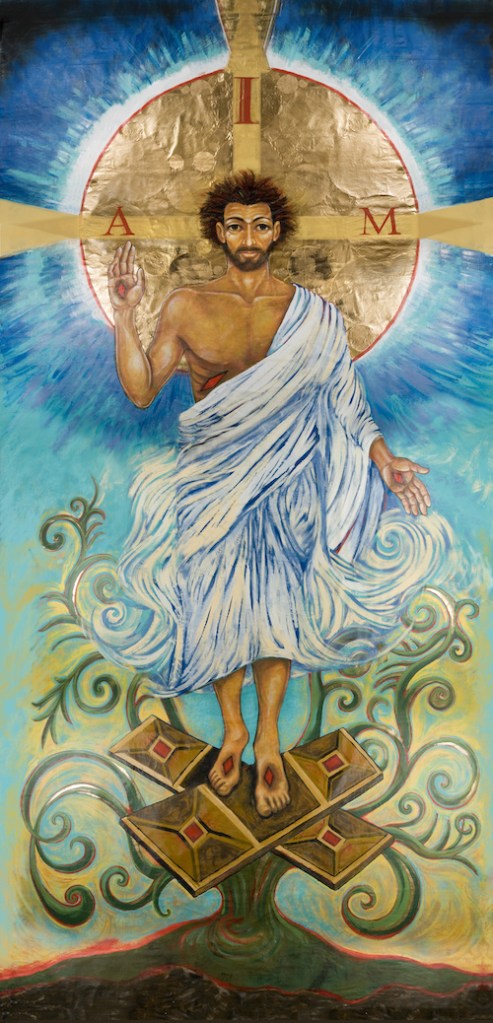
Christ Banner by longtime Resurrection artist Ray Wu

The British mystery writer and playwright Dorothy Sayers noted there’s one thing we cannot say about Jesus Christ—that he was a bore. “On the contrary,” Sayers once wrote, the people who opposed Jesus, “thought him too dynamic to be safe.”  

When I first started reading the historical accounts of Jesus, I was captivated by Jesus’ life and teaching. After spending most of his life as a refugee and then a blue-collar craftsman, he started announcing a dynamic new message. The Kingdom of God is here, he said, so turn your whole life around to get ready for it. He claimed his message was the best good news the world has ever seen. 

He made outlandish (unless they were true) claims about himself—like “I am the way, the truth, and the life” or “I have authority on earth to forgive sins.” He railed against the religious leaders of his day, calling them hypocrites and “white-washed tombs.” 

And yet he often displayed remarkable tenderness to normal or even “bad” people—like the owners of a small family fishing business, low-level government officials mired in corruption, a terrorized woman caught in the act of adultery, or a father and mother grieving the death of their twelve-year-old daughter. Through these simple, tender encounters, Jesus offered a new vision for dignifying and redeeming a broken but yearning humanity. 

Jesus is utterly un-boring, fresh, and fascinating.

Yes, Jesus is utterly un-boring, fresh, and fascinating. The award-winning essayist John Jeremiah Sullivan once joked about the “Jesus phase” that he and many of his friends passed through in high school. But after snubbing the faith of his childhood, Sullivan said he often has doubts about his doubts. He admits that he still can’t get over the Jesus of his “Jesus phase.” “My problem isn’t… that I feel a sucker for having bought it all,” Sullivan laments. “It’s that I [still] love Jesus Christ.”  Jesus Christ—his life and teaching and also his death and resurrection—are at the center of everything we believe and do at the Church of the Resurrection. To us he’s not only a fascinating historical figure; he’s also the world’s deepest hope and only savior. (Matt Woodley, Cathedral Vicar, Church of the Resurrection)


Addendum, February 11, 2023. William Willimon (retired Duke Divinity School and Methodist Bishop): “Why Jesus? Because he’s the most fascinating person in the world.” *

* Willimon, W. H. (2010). Why Jesus? Abingdon Press, ix (intro)

Kyrie Eleison

I am presently in the midst of a chronological read of the Bible. Many years ago, I came across a plan that allows a person to read through the Bible in a year, reading the stories fairly chronologically – reading concurrent Old Testament stories from Kings, the Chronicles, the Psalms, and/or the prophets. Or gospel stories from the writings of all four evangelists (Matthew, Mark, Luke, or John).

If you know me, you may not be surprised that I’m not a big fan of read-through-the-Bible-in-a-year programs. I have nothing against them per se – but they can be a setup for failure. I’ve watched far too many people start the year-long process in January and peter out by mid-February. (In the same vein, I’ve witnessed far too many people start January fitness plans with similar shelf lives.)

So why am I engaged in such a plan? For the chronology, not the associated time frame. I started this particular read-through in June 2020. Following the laid-out chronology, I’m slowly working my way through scripture using two (and sometimes three) translations. My go-to translations are The Voice and the NIV supplemented by listening on Audible. I might be going slow but I am, in fact, successfully reading through the Bible chronologically, which was my original intent. (If you’ve ever read The Story, you understand the value of chronological scripture reading.)

I am presently reading through the four Gospels, following Jesus’ final journey up to Jerusalem for the Passover and his ultimate execution. The typical route from Galilee required traveling through Jericho, about 20 miles East of Jerusalem. During this particular trip through Jerichico Jesus encountered Zacchaeus, inviting himself to dinner, and spending the afternoon with the tax collector (Luke 19). Inviting oneself to dinner was an honor in first-century Jewish culture. It was a transformative afternoon for Zacchaeus and I assume for the townspeople. And I’m sure for his disciples as well (though three years into their journey with Jesus, they were maybe starting to get used to his radical and revolutionary behavior).

As Jesus and his entourage headed out of town, they were confronted by two blind men sitting by the roadside (Matthew 20). When they heard that Jesus was passing by, they shouted…

Lord, Son of David, have mercy on us!

Lord have mercy! These guys knew their scripture. Their scripture, the Hebrew Law, Prophets, and Psalms, were laced with “Lord have mercy” language. Following the traditional understanding of the covenant relationship between the one true God (Yahweh) and His people, they called out to Jesus for mercy.

The Greek word for mercy is eleison. The corresponding Hebrew word for eleison is hesed, which we have discussed a number of times in this blog (see Hesed and Emet, Persistence, Veritas). Hesed is a rich and robust term that surpasses our understanding of mercy. It describes covenant loyalty and relational fidelity. It is freely given, often unexpectedly, without requiring anything in return. (I think of Barrington Bunny.)

When the blind men called out to Jesus, they were making assumptions about his connection to Yahweh (Son of David reference) and the associated covenant loyalty. Based on rumors they probably heard about this Jesus, they called out to him, “Lord have mercy!” They preceived that Jesus might be willing and able to heal them, so they called out for mercy. Moved by compassion, Jesus touched their eyes, giving them sight. And they followed him.

Central to following Jesus is the concept of trust. “Lord have mercy!” It seems the two blind men trusted Jesus before there was any hope of receiving their sight. In fact, the crowd rebuked them but they persisted in their appeal to his eleison. “Lord have mercy!” is a prayer model worthy of our attention.

I discovered eleison in this story by employing a Greek Interlinear New Testament. In the process, I discovered the Greek for “Lord have mercy” to be kyrie eleison. Kyrie eleison may be familiar to you. It certainly is in Eastern Orthodox traditions, embedded in their worship liturgy as Kýrie, eléison; Christé, eléison; Kýrie, eléison (“Lord, have mercy; Christ, have mercy; Lord, have mercy”). It is traditionally known as “The Jesus Prayer.” Not a bad prayer to pray.

Kýrie, eléison; Christé, eléison; Kýrie, eléison.

A side note: If you are of an age that remembers 80s music, you may recall the Mister Mister song, Kyrie Eleison. I always found the beginning of the chorus intriguing: “Kyrie eleison down the road that I must travel…”

ADDENDUM 1/31/2023: Annie F. Downs has created a podcast that will help listeners experience all four Gospels twelve times during the year 2023. It’s called Let’s Read the Gospels. Enjoy!

Enamored

I had an interesting conversation with my friend Kevin a couple of weeks ago that keeps ruminating in my mind. I first met Kevin four years ago when he left a 25-year career of church planting and pastoring to join our local Young Life region to help develop ministries in new communities. As a church planter, it was a natural fit for him.

During our conversation, Kevin was reflecting on his past years of ministry. He said he’s begun to realize, in recent years, that something seemed “off” in his previous years of ministry leadership. He felt like he had been “selling Christianity as a package, with Jesus as one part of the entire product line.” Through his continual engagement with Young Life, he said he’s become increasingly amazed and enamored with Jesus. For him, Jesus has become the whole package that he gets to offer to others.

Enamored. Not a word I use often, but for some reason, it resonated with me. The dictionary definition would point one toward something romantic – affected by strong feelings of love, admiration, or fascination (Merriam-Webster). A synonym that further enhances an understanding of enamored is captivate. Captivate suggests being influenced or dominated by something irresistible.

As you may be aware when discipling or mentoring (mostly younger) people, I have them read the Gospels repeatedly – for all kinds of reasons, but mostly to “hang out” with Jesus, knowing its transformative value.* The Jewish understanding of becoming a disciple of a rabbi was to become like the rabbi and join him in his mission. They become captivated and fascinated with the rabbi and pattern their life accordingly. I think becoming enamored with Jesus is the exact right outcome of one spending continuous time reading the Gospels.

I think of Jim Rayburn (Young Life’s founder) always saying that Jesus is the most fascinating person in the universe. What a great starting point for becoming enamored with Jesus. I suspect that our western Christian cultural approach is not to be enamored with the most fascinating person in the universe. Rather, we are enamored with what the most fascinating person in the universe can do for us (i.e., pave a way for us to go to heaven). Does that mean we are more enamored with heaven than with Jesus? Wouldn’t that be a form of idolatry? (NT Wright always reminds his readers/hearers that heaven is big deal, but it’s not the end of the world.)

What does it mean to be enamored with Jesus? Here’s a great question to ponder: What did Jesus’ disciples see in him that caused them to walk away from their work to follow him? I have always suspected that Jesus didn’t “cold call” people when inviting them to follow him – especially when we think of those first ones – fishermen Peter, James, John, and their local tax collector, Levi. I have to believe that Jesus had spent time with these guys, taking an interest in their work and engaging in their world. I suspect these guys were fascinated and captivated by this different kind of rabbi – they were enamored. Enamored enough to drop what they were doing to discover more. Jesus was irresistible!

How does one become enamored with Jesus?

I don’t think it’s something we can make happen. I think it’s a natural (organic) outcome of focusing on Jesus, the most fascinating person in the universe. Focusing on who he is – his character, mission, interactions – not just on what he can do for us. It’s hanging out with him, becoming more and more fascinated and captivated by him. Like Kevin, it changes our perspective on everything else.

One of my favorite books is Jim Collin’s Good to Great. His team researched companies that experienced a transformation of growth that outpaced the stock market trends of the time. He studied the companies in an attempt to discover the cause of the growth. Most fascinating to me was the chapter recaps describing “unexpected findings.” I suspect an “unexpected finding” for Kevin was becoming enamored with Jesus!

I think that periodically it’s healthy for us to ask the question, “What are we enamored with? What fascinates and captivates us?” The answer to the question will shape the “package” we have to offer the world around us.

* ADDENDUM 1/31/2023: Annie F. Downs has created a podcast that will help listeners experience all four Gospels twelve times during the year 2023. It’s called Let’s Read the Gospels. Enjoy!

Circular Thinking

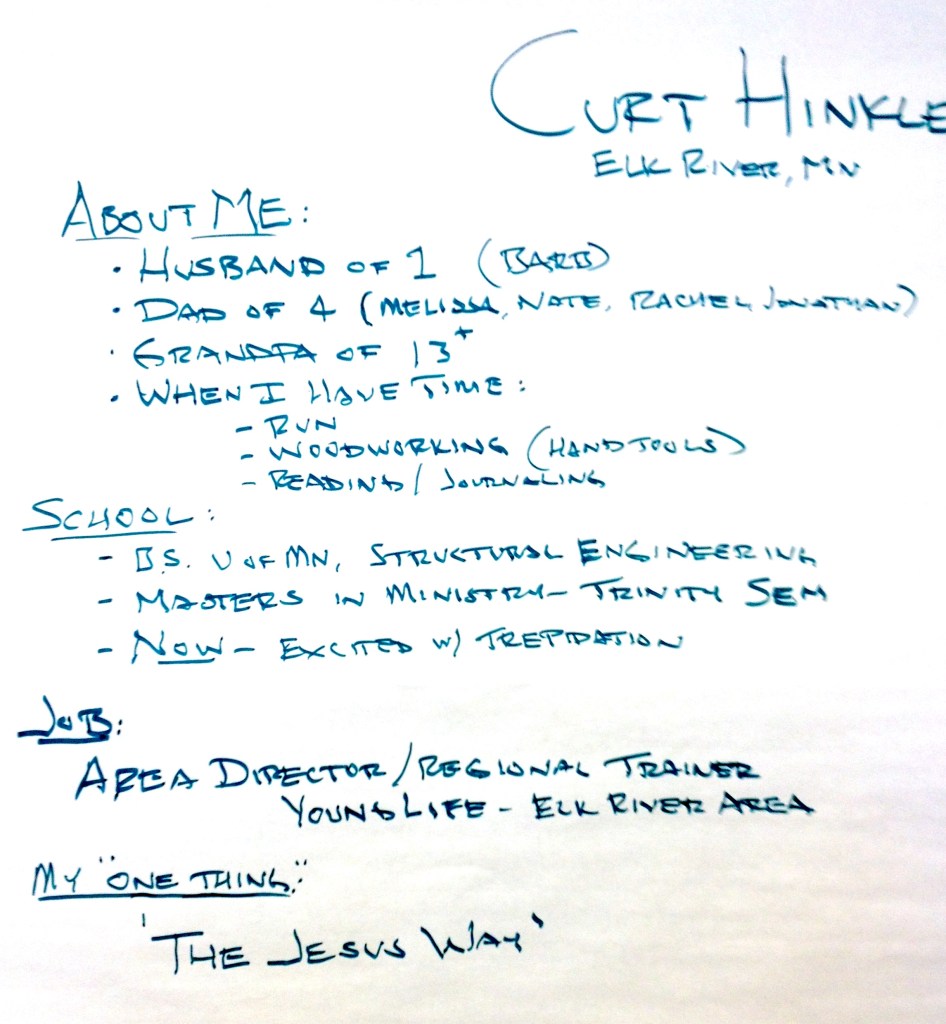
The first day of the Summer Residency for my Doctorate in Higher Educational Leadership program started with a “get to know each other” exercise. We were each given a sheet of paper from a flip-chart and some colored markers. We were instructed to spread out and create a sheet that described who we are with the understanding that we would share our creation with the cohort. A great and fun idea. Who doesn’t want to get to share who they are? So, I wandered out of the classroom to find a quiet place to create my sheet.

When I came back into the room I discovered how linear my thinking was, as you can see below. Next to mine is a photo of my friend Amy Bronson’s creation. As I shared my sheet with the class, I simply worked down the list, discussing each of the bullet points – quite linear. As Amy discussed her story, she took us on a journey around her sheet – almost in a circular manner.

There is a significant different between Eastern and Western thought. One of those differences is our actual thinking process. Western thinking is quite linear – steps 1,2,3, leading to a final outcome. Eastern thinking is more process-oriented and “circular.” The focus isn’t about getting to the final outcome but the pilgrimage. Its more about the journey than the outcome.

We need to remember that Hebrew thinking was Eastern, which means the Hebrew scriptures were written by Eastern thinkers. Notice how the Hebrew Bible, the Old Testament, is written in story and journey form. It doesn’t give us exacting formulas to land on, but principles to follow (the Proverbs are a great example of this). In our Western thinking, we tend to presume that the New Testament follows the Old Testament linearly. We must also remember that Jesus was trained and grew up in an Eastern culture, learning the Hebrew scriptures. (This would be true of the Apostle Paul and most, if not all, of the other New Testament writers who constantly circled back to the Hebrew scriptures as they developed their own understanding of Jesus and his anointing as King)

I want to circle back to a previous blog post, The Great Omission. In it we looked at what is often referred to as Jesus’ Two Great Commandments:

Love the Lord your God with all your heart and with all your soul and with all your mind.” This is the first and greatest commandment. And the second is like it: “Love your neighbor as yourself.” All the Law and the Prophets hang on these two commandments. (Matthew 22:36-40)

I have always suspected the two commandments were more circular in their intent (i.e., Hebrew thought). I suspect we get bogged with Western linear thought (i.e., once I learn to love God well, then I can begin to love others). Since we can never quite get that figured out (how to love God well) then we subconsciously (or consciously) allow ourselves off the hook regarding the loving our neighbors.

Looking at the two commandments in a circular manner might look like this: We love God the best we can, as best as we know him, and start loving others because he asked us to.  In the process, we see and know God better (and maybe differently), so we can love him all the more, allowing us to love others better, etc., etc.  

My friend Chuck Jamison pointed me to something that New Testament scholar M. Robert Mulholland suggested regarding the two commandments. The text, he says, could be translated “Love the Lord your God with all your heart, soul, and mind. Another way to say this is to love your neighbor as yourself.”

Chuck Jamison: “Love your neighbor” is just another way of saying “Love God.” To actually love God would be to love my neighbor… whomever is standing in front of me at the present moment. That’s a powerful thought. Imagine the transformative power in that – for me and the world around me!

North(ish)

I was asked to write a blog post this week for the Zoë Website. The topic is the concept of Northish which has been a driving force in the development of the Zoë platform. So, I thought I’d share it here. (Full disclosure: my friend Pete Paulson gets credit for coining the term Northish – it came out of a conversation we had several years ago.) The Zoë blog posting…

As an adult that has worked with high school and college-aged young people for several decades, I have to wonder if we haven’t done them a disservice as they think about their futures.  I have witnessed a lot of angst as they try to figure out what direction to head or as they struggle searching for their niche in the world.  We really see the prevalence of angst in recent years, given the steadily increasing costs of post-secondary education.

I wonder if the angst comes from the culture we live in, especially in our western culture.  We are results-driven people.  We tend to focus on outcomes and miss the value of the journey and learning along the way toward realizing those outcomes.  Our young emerging adults especially feel this.  Since the adults around them live with outcome-based definitions of success, it gets transferred onto our young people (unintentionally or maybe intentionally).  We talk about winning, scoring well on tests, “getting it right,” etc., looking for “due-North.” 

Emerging adults learn well from us – wanting to “get it right.”  Thus the angst!

In more recent years, I’ve been talking with young people about a perspective that I like to call “Northish.”  What is Northish, you might ask?  Well, it’s not “due north,” that’s for sure.  Northish is more about setting a general direction.  Northish is more like asking the question, “Do I want to go to Canada or to Mexico?”  If I want to go to Canada, I wouldn’t get on a freeway heading south.  I would take roads that generally head toward Canada – NorthishNorthish isn’t about “getting it right.”  It’s about getting the general direction figured out.  The concept of Northish starts one on a journey that leads toward self-discovery.  The journey is as important as (I would argue more important than) the outcome.  Northish is freeing, giving one the freedom to adjust and tweak along the way.

We would do our emerging adults a great service if we help them toward discovering their Northish; if we help them learn the general direction they might want to head; if we help them find a sense of purpose.  Enter Zoë!  What I like about Zoë is that it’s a platform that helps people find their Northish.  Zoë reinforces a message that it is all about the user’s journey toward finding their purpose in the world.  It helps the user discover who they are and what they value, pointing them toward a life of purpose and meaning.  Purpose isn’t a destination; it’s a direction.  Northish!   

The above posting is obviously about young emerging adults. But aren’t we all still emerging – especially when related to our faith? Studies show that only one in three adults know their purpose, can describe their Northish. Pay close attention to what Jesus said and did. I would argue that he encouraged people to find Northish. In a world that often focuses on “getting it right,” may God help you find your Northish.

Jesus – “I have come that they might have life (zoe) and have it to the full.”

(John 10:10)

Scripture for a Pandemic

Over the years, God seems to provide us followers with scripture passages that carry us through various seasons of life – anchors we can cling to. For my 18th birthday, toward the end of my senior year in high school, I was given a little Hallmark book entitled Consider the Lilies: Great Inspirational Verses From the Bible. It actually served as my bible for the next year or so (sad as that seems today). It pointed me to a few scriptures that served as anchors through my first couple years after high school. The scripture that resonated the most with me can be found in Matthew 6, part of Jesus’ sermon on the mount. Especially helpful were verses 25-34…

25 “Therefore I say to you, do not worry about your life, what you will eat or what you will drink; nor about your body, what you will put on. Is not life more than food and the body more than clothing? 26 Look at the birds of the air, for they neither sow nor reap nor gather into barns; yet your heavenly Father feeds them. Are you not of more value than they? 27 Which of you by worrying can add one cubit to his stature?

28 “So why do you worry about clothing? Consider the lilies of the field, how they grow: they neither toil nor spin; 29 and yet I say to you that even Solomon in all his glory was not arrayed like one of these. 30 Now if God so clothes the grass of the field, which today is, and tomorrow is thrown into the oven, will He not much more clothe you, O you of little faith?

31 “Therefore do not worry, saying, ‘What shall we eat?’ or ‘What shall we drink?’ or ‘What shall we wear?’ 32 For after all these things the Gentiles seek. For your heavenly Father knows that you need all these things. 33 But seek first the kingdom of God and His righteousness, and all these things shall be added to you. 34 Therefore do not worry about tomorrow, for tomorrow will worry about its own things. Sufficient for the day is its own trouble. (NKJV)

Looking for a go-to scripture on which to focus as you figure out how to navigate a pandemic such as this? You might want to think about this passage from Jesus’ teaching to his first century followers. He was preparing them to live in a pandemic of sorts. He was preparing them to be kingdom people in a time of uncertainly – a season laced with anxiety, hardship, and persecution. He was telling them clearly that God is bigger than anxieties, hardships, and persecution. And he’s bigger than pandemics, I suspect.

Consider the lilies of the field, how they grow: they neither toil nor spin, yet they thrive during a pandemic. Lord, help us to not simply survive this pandemic, but maybe even thrive a bit. Help us to surthrive, as my friend Mick would say.

If I keep on doing what I’ve always done…

There’s an old saying that goes like this: If I keep on doing what I’ve always done, I keep on getting what I’ve always gotten.  Albert Einstein is attributed to having said something similar, coming at it from a different angle: Insanity is doing the same thing over and over again and expecting different results.

This is great advise and not necessarily rocket science (no disrespect to Mr. Einstein).  Then how come behavioral change is so doggone difficult, especially when sin rears its ugly head?  How often have we been determined to change our behavior, to change what we do so we could realize a different outcome?  And the outcome?  So often the same old results.

The Apostle Paul spoke to this in Romans 7:18-19…I have the desire to do what is good, but I cannot carry it out.  For I do not do the good I want to do, but the evil I do not want to do—this I keep on doing. Paul reminds us that this is the frustration we live with while we are in the process of being transformed into the likeness of Jesus.  Paul also reminds us of God’s grace and deliverance: Who will rescue me from this body of death?  Thanks be to God, who delivers me through Jesus Christ our Lord! (Vs. 24-25)

Paul never suggested that we concede to living this life of frustration.  Nor did Jesus. Jesus said he came that we may have life, and have it to the full (John 10:10). The answer, however, isn’t to simply change what we do. It doesn’t seem to get us there. Consider the following trustworthy saying:

If I keep on thinking what I’ve always thought,
then I’ll keep on perceiving what I’ve always perceived.
If I keep on perceiving what I’ve always perceived,
then I’ll keep on seeing what I’ve always seen.
If I keep on seeing what I’ve always seen,
then I’ll keep on doing what I’ve always done.
If I keep on doing what I’ve always done,
then I’ll keep on getting what I’ve always gotten.

I became aware with this saying half a life-time ago in a Fuller Seminary class.  It changed my life!  I was under the assumption that if I simply changed my behavior – what I was doing – then all might be well.  But all wasn’t well and I knew it.  And, just like Paul, trying simply to change what I did left me frustrated.

This saying reminds us that change in behavior comes from a change, first in our thinking, not just addressing the behavior.  Granted, we can change our habits for a while, but if our thinking and perceiving is the same, we will revert back.

Jesus reminded the Pharisees (with strong language) of the danger of trying to address the behavior without changing our thinker/perceiver: What miserable frauds you are, you scribes and Pharisees! You clean the outside of the cup and the dish, while the inside is full of greed and self-indulgence.* Can’t you see, Pharisee? First wash the inside of a cup, and then you can clean the outside. (Matt. 23:25-26)

Jesus continued his critique of the Pharisees by calling them whitewashed tombs.  (I don’t think I would ever want to hear Jesus call me a whitewashed tomb!) 

We do want to change don’t we?  (I’m assuming a response in the affirmative, but I could be wrong). But change doesn’t happen by merely changing what we do.  This is probably what Paul was addressing when he suggested we are transformed by the renewing of our mind – our chooser/thinker/perceiver (Rom 12:2). Change comes from the inside. Change comes with the transformation of how we think and why we think the way we do. The good news: God does the heavy lifting. Our job is to show up. But show up we must!

* The Kingdom New Testament translation suggests “moral flabbiness” in place of self-indulgence.