I loved playing hide and seek when our kids were toddlers. They didn’t totally understand the concept, though. I would send them off to hide as I counted. With their inability for stealthiness, I always knew exactly where they were hiding. Pretending that I couldn’t find them, I would say out loud, “I wonder where (name) could be?” Unable to contain their excitement, they would jump out and exclaim, “Here I am, Daddy!”
I recently spent time reading and pondering Acts 9 – the “conversion” of Saul (later known as Paul). I say “conversion” because he wasn’t actually converted as we tend to use the term. We usually associate conversion from non-belief to belief in something. Saul was not an unbeliever. In fact, he was a zealous believer, learner, and adherent of the Mosaic law.
As you might remember, Saul had received permission (along with appropriate documentation) from the Jewish high priest to travel from Jerusalem to Damascus to arrest followers of the Way for trial before the ruling council, the Sanhedrin, back in Jerusalem. As Saul and his entourage set out for Damascus (a 3-4 day journey by mule or horseback), it would be fair to assume that some believers in Jerusalem high-tailed it to Damascus to warn the believers of Saul’s impending arrival and intent.
What if you lived in Damascus and belonged to the Way?
What would you do? Would you leave the city until the threat was over? Not everyone had the means or ability to do so. Would you go into hiding? Who could you trust? I have read various World War II accounts of the reactions of the Jewish people in cities soon to be overrun by the Nazis. The Wehrmacht’s reputation along with the authority to mistreat Jews bred fear as people escaped the city or went into hiding. I assume a similar fear spread through the young Christian community.
As we know, Jesus intercepted Saul, spoke to him directly (“Saul, Saul! Why are you persecuting me?”), blinded him with the brightness of his presence, and sent him into the city to await further instructions. In a great reversal, Saul found himself hiding in the city. Picking up the story from Acts 9…
In Damascus, there was a disciple named Ananias. The Lord spoke to him in a vision. “Ananias!” he said. “Here I am, Lord,” he replied. (Acts 9:10, NTFE)
“Here I am, Lord.” Where have we heard this before? We find Isaiah speaking similar words in Isaiah 6. In a vision, Isaiah saw the Lord in full glory and responded, “Woe to me! I am ruined!” Then the Lord spoke directly: “Whom shall I send? Who will go for us?” Isaiah’s well-known response…
“Here I am. Send me.”
The same Lord spoke to Ananias in a vision. Visions tend to happen when someone is in intimate communion with God. We can assume that Ananias might have been praying when the Lord spoke to him. What was he praying about? We have no idea, but I suspect protection from Saul and his cohort might have been part of the conversation. In the vision, God gave Ananias the address where Saul was hiding and instructed him to go lay hands on Saul so he could see again.
Saul was anticipating Ananias’ arrival – he had received a vision, too. So, Saul was praying? I suspect so. He had just had a visit from the resurrected Jesus. I suspect he prayed a lot! He probably had a lot of questions to which he needed clarification. For three days he fasted and prayed. And probably meditated as well. The meditation practices of the Pharisees in the first century were deeply rooted in the Hebrew Bible and Jewish tradition. I imagine Saul pondered his memorized scriptures, wondering how Jesus fit into what he thought he understood.
Naturally, Ananias objected to God’s directive. The word was out of Saul’s reputation, his arrival in Damascus, and that he came with the authority of the chief priests to arrest Christians. “Just go,” replied the Lord. “He is a chosen vessel for me [like Isaiah?], to carry my Name before the nations and kings – and the children Israel, too.”
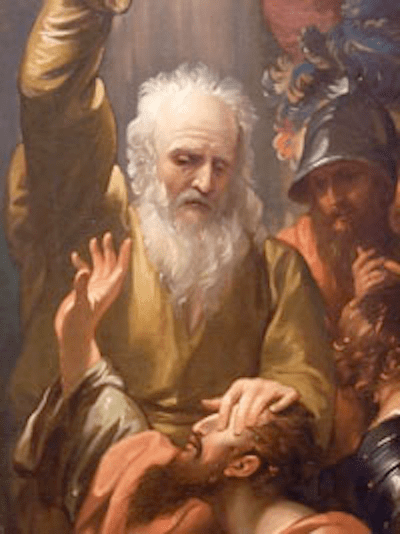
17 So Ananias set off, went into the house, and laid his hands on him. “Brother Saul,” he said, “the Lord has sent me—yes, Jesus, who appeared to you on the road as you were coming here—so that you may be able to see again, and receive the Holy Spirit.” 18 At once something like scales fell off his eyes, and he was able to see. He got up and was baptized.
Saul subsequently went on to become a most significant person of the new movement, starting churches across the Roman Empire. He also provided deep theological thought connecting the Hebrew Scriptures* with the life and work of the resurrected Jesus. Nearly half of the books in the New Testament are attributed to his later writings. And what of Ananias? We know no more than this short encounter. What we do know is that he was available. And obedient. May we always be postured to be able to say…
Here I am, Lord.
* From NT Wright regarding Saul’s discoveries: It confirmed everything Saul had been taught; it overturned everything he had been taught. The law and the prophets had come true; the law and the prophets had been torn to pieces and put back together in a totally new way.1
1 Wright, N. T.. Acts for Everyone, Part One: Chapters 1-12 (The New Testament for Everyone) (pp. 140-141). Presbyterian Publishing Corporation. Kindle Edition.
 Practical Theology Today