Old Faithful

Time spent with our grandkids causes me to reflect back to “when I was their age,” reminiscing what life was like for me decades ago. Much has changed, but kids are kids and the kinds of things that intrigued me intrigue them as well. I love watching them with their nose in books or as they learn to draw. I loved to read and draw. What I read was different (Hardy Boys mysteries versus Harry Potter). I drew horses and tractors. Our grandkids draw Pokémon figures.

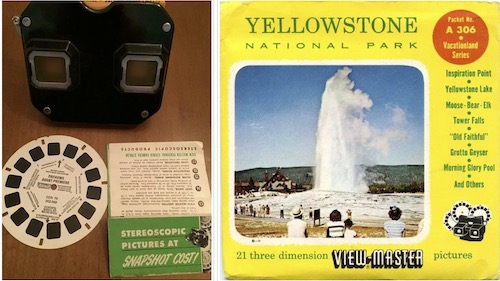
One of the most intriguing things I played with as a kid was a View-Master. For those unfamiliar, a precursor to 3-D glasses the View-Master was a popular stereoscopic toy that allowed me to view images in a three-dimensional format. It consisted of a handheld plastic viewer and a series of circular cardboard “reels,” each containing a set of paired images (see below).

We had a series of reels ranging from Hopalong Cassidy to a variety of national parks. My favorite was Yellowstone National Park. For a dairy farm kid for which a “vacation” consisted of a day trip to Taylors Falls or Duluth squeezed between milkings, the View-Master gave me the opportunity to experience the majesty of our parks – in 3-D!

The “Old Faithful” geyser was particularly captivating. The View-Master reel had a series of time-lapse photos showing the faithful geyser in various stages of eruption. All in 3-D! I studied each of the slides. I couldn’t get enough!
In the previous post, we discussed faith, a word that occurs over 250 times in the New Testament. It derives from the Greek word pistis and can easily be translated as trust (see I Gotta Have Faith). What about faithful – how are faith and faithful related and/or different?

For starters, faith is a noun and faithful is an adjective. Faith refers to the belief or trust in something, particularly God, while faithful describes a person characterized by loyalty, devotion, and reliability. Faith is the foundation or conviction, while faithful reflects the actions and qualities associated with steadfastness and trustworthiness.

Faithful is a translation of the Greek word pistos, which, as you can see, is a derivation of pistis (faith) and pisteoū (believe). These are Greek words found in the New Testament. Looking into the word pistos, what piques my interest are the English words that describe faithful – loyalty, devotion, reliability, steadfastness, trustworthiness, etc. These smack of the Old Testament characterization of God’s covenant loyalty and reliability, hesed and emet (see Hesed and Emet and Veritas).

In a similar fashion to our quantification of faith, I suspect we view being faithful as some form of perfection, success, or “getting it right.” Loyalty and perfection are not the same. I am loyal to my wife but far from perfect and don’t get it right all the time (as she would likely agree 😬). Though she might like it if I got it right more often, I know that loyalty is far more important to her. I suspect God is more interested in our pistos than our successes, our getting-it-rightness.

I am reminded of a story about Mother Theresa. When orphans were starving in India at a greater rate than her little orphanage could possibly serve, Mother Theresa was asked by a reporter how she could feel any sense of success. Her response?  God does not require that we be successful, only that we be faithful. In Western thought, we have equated success and faithfulness. God wants our pistos, our loyalty and our devotion.

We must also remember that loyalty is covenantal. While I am faithful to my wife, she is also faithful to me – she makes it easy to be loyal to her. The Old Testament narrative is a story about God’s covenant loyalty. With Jesus, God provided forgiveness of sin making loyalty a possibility. God’s loyalty makes us want to be loyal/faithful in return. The Apostle Paul summed it up for his friend and apprentice Timothy like this (2 Timothy 2:11-13):

Here is a trustworthy (pistos) saying: 

If we died with him,
    we will also live with him;
if we endure,
    we will also reign with him.
If we disown him,
    he will also disown us;
if we are faithless,
    he remains faithful (pistos),
    for he cannot disown himself.

God’s pistos trumps our pistoslessness

Addendum 7/23/2023. Reading 1 Thessalonians 5 this morning, I came across this: The one who calls you is faithful, and he will do it (5:24). Greek for “The one who calls you is faithful” – Pistos ho kalon,

I Gotta Have Faith*

My daughter and I were recently talking about faith, trust, belief, faithfulness, etc. Faith is one of those religious terms that we assume to understand, but deeper consideration might suggest otherwise. Consider this oft-heard statement: “If you just have (or had) enough faith, then _____ (fill in the blank).” There is a sense of a threshold of faith that once reached, God will grant us our desires. And if those desires aren’t fulfilled, then we assume we are at fault – we didn’t have enough faith, didn’t reach that elusive threshold. (And unfortunately, there are a number of people that are willing to remind us of our lack of faith.)

I suspect we tend to quantify faith, thus “enough” and “threshold” thinking. Personally, I realized that when I quantify faith, then I become the focus, not God. My faith makes the difference. My faith results in _____ (again, fill in the blank). The focus is on me and my ability. I’m pretty sure that if I am the focal point, then surely something must be amiss.

In addition, a quantified approach to faith not only focuses on me but also on the outcome. If the desired outcome happens, then we say “They had enough faith,” But what if the desired outcome doesn’t happen, then what?

Consider the many times Jesus commended and affirmed people’s faith. I think of his response to the faith of the centurion: “Truly I tell you, I have not found anyone in Israel with such great faith.” (Matt. 8:10). Or the faith of the paralyzed man’s friends: “When Jesus saw their faith, he said, ‘Friend, your sins are forgiven.'” (Luke 5:20).

As I look at the many occurrences of Jesus commending people for their faith, I see a theme that I hadn’t really noticed before. Most of those lauded didn’t qualify as people with any sort of faith at all, according to the religious traditions.

Many, if not most, were in need of healing. The religious culture labeled, oppressed, and ostracized people with diseases and physical infirmities – they lacked a measurable amount of faith, I suspect. Some were members of the wrong tribe, like the Roman centurion (above) or the Syrophoenician / Canaanite woman who came to Jesus despite the tribal distinctions (see Matt. 15:21-28 and Mark 7:24-30).

In the passages describing Jesus’ commendation of people’s faith, the Greek word translated as faith is pistis. As we typically find to be true with translations from Greek, a single English word is often not sufficient. In their use of pistis, Plato and other Greek philosophers referred to the conviction of the truth of anything, of belief. (Pistis is related to pisteoū, often translated as “belief.”)

The new testament writers used pistis to describe our relationship to God and to Christ. When it relates to God, pistis is “the conviction that God exists and is the creator and ruler of all things.” In reference to Christ, it denotes “a strong and welcome conviction or belief that Jesus is the Messiah, through whom we obtain eternal salvation in the kingdom of God” (Thayer’s Lexicon). The predominant idea is one of trust (or confidence) in the one true God and/or that Jesus is the Christ (Messiah).

Central to faith is the object of one’s faith.

So what was this faith that outsiders possessed and Jesus lauded? They simply trusted Him. He was the object of their faith. When we think in terms of quantified faith, we become the object. When we think of faith in terms of trust, God becomes the focus. Can he be trusted? Is he reliable? Does he have my best interests in mind? Regardless of the outcome?

A couple of great stories…

From Esther. Esther needed to speak to the king on behalf of the Israelites but it was unlawful for her to approach the king without being summoned – the law said she should be put to death. But she knew that she was the one that needed to speak on behalf of the people. She did not say “I have faith that God will protect me.” Her words? “I will go to the king, even though it is against the law. And if I perish, I perish.” TRUST.

From Daniel (esp. chapter 3). Shadrach, Meshach, and Abednego refused to worship the king’s idols and were promised that they’d be tossed in a furnace if they didn’t. They did not say “We have enough faith and we know God will protect us.” Their reply? “O Nebuchadnezzar…if we are thrown into the blazing furnace, the God we serve is able to save us from it… But even if he does not, we want you to know, O king, that we will not serve your gods or worship the image of gold you have set up.” TRUST.

Faith: Just plain trust. Not quantified. Not outcome dependent. Just plain TRUST!!!

* “Apologies” for the unashamed use of lyrics from the 1980s George Michael song, Faith.