Here I Am!

I loved playing hide and seek when our kids were toddlers. They didn’t totally understand the concept, though. I would send them off to hide as I counted. With their inability for stealthiness, I always knew exactly where they were hiding. Pretending that I couldn’t find them, I would say out loud, “I wonder where (name) could be?” Unable to contain their excitement, they would jump out and exclaim, “Here I am, Daddy!”

I recently spent time reading and pondering Acts 9 – the “conversion” of Saul (later known as Paul). I say “conversion” because he wasn’t actually converted as we tend to use the term. We usually associate conversion from non-belief to belief in something. Saul was not an unbeliever. In fact, he was a zealous believer, learner, and adherent of the Mosaic law.

As you might remember, Saul had received permission (along with appropriate documentation) from the Jewish high priest to travel from Jerusalem to Damascus to arrest followers of the Way for trial before the ruling council, the Sanhedrin, back in Jerusalem. As Saul and his entourage set out for Damascus (a 3-4 day journey by mule or horseback), it would be fair to assume that some believers in Jerusalem high-tailed it to Damascus to warn the believers of Saul’s impending arrival and intent.

What if you lived in Damascus and belonged to the Way?

What would you do? Would you leave the city until the threat was over? Not everyone had the means or ability to do so. Would you go into hiding? Who could you trust? I have read various World War II accounts of the reactions of the Jewish people in cities soon to be overrun by the Nazis. The Wehrmacht’s reputation along with the authority to mistreat Jews bred fear as people escaped the city or went into hiding. I assume a similar fear spread through the young Christian community.

As we know, Jesus intercepted Saul, spoke to him directly (“Saul, Saul! Why are you persecuting me?”), blinded him with the brightness of his presence, and sent him into the city to await further instructions. In a great reversal, Saul found himself hiding in the city. Picking up the story from Acts 9…

In Damascus, there was a disciple named Ananias. The Lord spoke to him in a vision. “Ananias!” he said. “Here I am, Lord,” he replied. (Acts 9:10, NTFE)

“Here I am, Lord.” Where have we heard this before? We find Isaiah speaking similar words in Isaiah 6. In a vision, Isaiah saw the Lord in full glory and responded, “Woe to me! I am ruined!” Then the Lord spoke directly: “Whom shall I send? Who will go for us?” Isaiah’s well-known response…

“Here I am. Send me.”

The same Lord spoke to Ananias in a vision. Visions tend to happen when someone is in intimate communion with God. We can assume that Ananias might have been praying when the Lord spoke to him. What was he praying about? We have no idea, but I suspect protection from Saul and his cohort might have been part of the conversation. In the vision, God gave Ananias the address where Saul was hiding and instructed him to go lay hands on Saul so he could see again.

Saul was anticipating Ananias’ arrival – he had received a vision, too. So, Saul was praying? I suspect so. He had just had a visit from the resurrected Jesus. I suspect he prayed a lot! He probably had a lot of questions to which he needed clarification. For three days he fasted and prayed. And probably meditated as well. The meditation practices of the Pharisees in the first century were deeply rooted in the Hebrew Bible and Jewish tradition. I imagine Saul pondered his memorized scriptures, wondering how Jesus fit into what he thought he understood.

Naturally, Ananias objected to God’s directive. The word was out of Saul’s reputation, his arrival in Damascus, and that he came with the authority of the chief priests to arrest Christians. “Just go,” replied the Lord. “He is a chosen vessel for me [like Isaiah?], to carry my Name before the nations and kings – and the children Israel, too.”
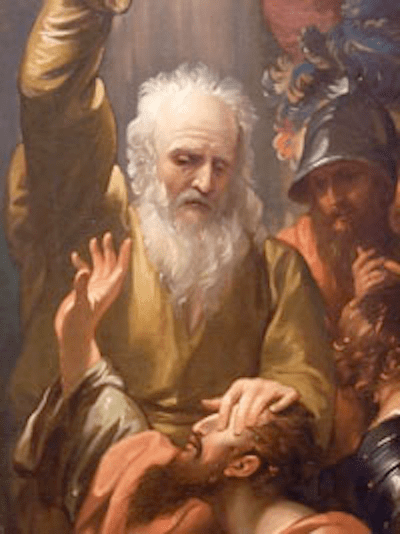
Conversion of St. Paul. Benjamin West, ca 1786

17 So Ananias set off, went into the house, and laid his hands on him. “Brother Saul,” he said, “the Lord has sent me—yes, Jesus, who appeared to you on the road as you were coming here—so that you may be able to see again, and receive the Holy Spirit.” 18 At once something like scales fell off his eyes, and he was able to see. He got up and was baptized.

Saul subsequently went on to become a most significant person of the new movement, starting churches across the Roman Empire. He also provided deep theological thought connecting the Hebrew Scriptures* with the life and work of the resurrected Jesus. Nearly half of the books in the New Testament are attributed to his later writings. And what of Ananias? We know no more than this short encounter. What we do know is that he was available. And obedient. May we always be postured to be able to say…

Here I am, Lord.

* From NT Wright regarding Saul’s discoveries: It confirmed everything Saul had been taught; it overturned everything he had been taught. The law and the prophets had come true; the law and the prophets had been torn to pieces and put back together in a totally new way.1

1 Wright, N. T.. Acts for Everyone, Part One: Chapters 1-12 (The New Testament for Everyone) (pp. 140-141). Presbyterian Publishing Corporation. Kindle Edition.


The Songs of Jesus

Ten years ago Timothy and Kathy Keller wrote the book, The Songs of Jesus: A Year of Daily Devotions in the Psalms. We tend to forget that the Psalms written in antiquity were part of the Hebrew Scripture which Jewish worshipers would have known well. They were the contemporary music of Jesus’ first-century world. Just as we have songs connected to the Christian holiday seasons today (e.g., Advent, Lent, Easter, etc.), so did they.

What immediately comes to mind are the Psalms of Accent (Psalms 120-134). These are Psalms that the people sang as they ascended up into Jerusalem to annually attend the three mandated festivals (Passover, Pentecost [or Weeks], Booths [or Tabernacles]). Jesus and his fellow Israelites would have known many (if not all) 150 Psalms by heart as they were incorporated into regular times of worship. Keller’s book was designed to draw us to the same songs Jesus sang.

As I have mentioned elsewhere, I have been in the habit of reading and praying the Psalms for close to 30 years – sometimes one per day or one per week. Or, as with the past couple of years, I park on a Psalm for a time, gleaning what I can, then moving on to the next one. I just spent a week in Psalm 82, a relatively unknown but significant song.

As you may know, the 150 Psalms are really a collection of five books as follows:

  1. Book 1 (Psalms 1-41). Primarily attributed to David, these psalms focus on covenantal faithfulness.
  2. Book 2 (Psalms 42-72). The psalms of Book 2 focus primarily on a hope for a Messianic kingdom.
  3. Book 3 (Psalms 73-89). Attributed to Aspah, the psalms in this section of songs are a mix of communal lament and post-exilic Messianic hope.
  4. Book 4 (Psalms 90-106). The focus? Yahweh, the God of Israel, is the true King of all creation, who can thus bring healing justice to his rule, his Kingdom.
  5. Book 5 (Psalms 107-150). This final book includes psalms of thanksgiving, praise, and celebration. It concludes with a series of Hallelujah psalms (146–150), each beginning and ending with “Praise the Lord” (Hallelujah).

Interestingly, each book ends with a doxological prayer, blessing the God of Israel, the everlasting Lord. Example: Praise be to the Lord God, the God of Israel, who alone does marvelous deeds. Praise be to his glorious name forever; may the whole earth be filled with his glory. Amen and Amen. (Psalm 72:18-19). See also, Psalm 41:13; 89:52; 106:48; and Psalm 150)

Psalm 82 is in the middle of Book 3. Amid psalms of lament related to exile and pleas for God to come to the aid of his people, we find this seemingly free-standing song. The psalm contains concepts that have perplexed theologians for centuries. But the main thrust of the psalm seems to be absolutely clear: Yahweh is the God of all “gods” and he expects nations and societies to operate justly. And if they don’t, they will have him to contend with…

2 “How long will you [plural] defend the unjust
    and show partiality to the wicked?
Defend the weak and the fatherless;
    uphold the cause of the poor and the oppressed.
Rescue the weak and the needy;
    deliver them from the hand of the wicked.

In the world of the ancients (Mesopotamia, Palestine, Egypt, etc.), deities and nations were entwined. Other nations knew that the national god of Babylon was Marduk; Egypt was Ra; and, of course, Israel was Yahweh, the one true God. The people of the exile lamented because, to the watching nations, it appeared that Marduk was more powerful than Yahweh. Yet, we don’t hear much of the Babylonians these days. Nor their God, Marduk. Why? Because…

5 “The ‘gods’ know nothing, they understand nothing. They walk about in darkness; all the foundations of the earth are shaken… But you will die like mere mortals; you will fall like every other ruler.”

The gods were tried and found wanting. The criteria for Yahweh’s judgment of the gods was justice. The national gods supported imperialistic domination and cruelty imposed on the conquered people. Weak, fatherless, poor, and oppressed people are a natural outcome of national domination. “Psalm 82 tells us how we are to be judged by God but also how God wants to be judged by us. Everything else that God says or does in the Bible should be judged by that job description.”1 Social justice that is basic to Yahweh, the God of the Bible can be seen in Jesus, God in the flesh. Luke 4 immediately comes to mind…

18 “The Spirit of the Lord is on me,
    because he has anointed me
    to proclaim good news to the poor.
He has sent me to proclaim freedom for the prisoners
    and recovery of sight for the blind,
to set the oppressed free,
19 to proclaim the year of the Lord’s favor.”

20 Then he rolled up the scroll, gave it back to the attendant and sat down. The eyes of everyone in the synagogue were fastened on him. 21 He began by saying to them, “Today this scripture is fulfilled in your hearing.”

“Everything else that God says or does in the Bible should be judged by [this] job description.”

1 Crossan, J. D. (1998). The birth of Christianity: discovering what happened in the years immediately after the execution of Jesus (1st ed). HarperSanFrancisco.

Read the Introduction

I discovered that no one reads introductions to books. A few years ago, my son sent me a photo of a footnote in a work-related book he was reading. The footnote concluded with something like, “This information should have been included in the introduction, but since no one reads introductions…”

I did not habitually read introductions until after reading the Celebration of Discipline, by Richard Foster, some 45 years ago. It was a blockbuster that all serious Christ-followers would/should want to read. A wanna-be serious Christ-follower, I bought it and dove in. Celebration of Discipline explores the “classic disciplines,” or central spiritual practices of the Christian faith – the inward disciplines of meditation, prayer, fasting, and study; the outward disciplines of simplicity, solitude, submission, and service; and the corporate disciplines of confession, worship, guidance, and celebration.

Reading this well-acclaimed book was to have resulted in a rich spiritual life infused with joy, peace, and a deeper understanding of God. That did not happen. The opposite happened as you can read in a previous post, Circa 1981…I Quit! The twelve disciplines overwhelmed me to the point of giving up. I could never juggle all twelve, so why try? A few years later as I shared my frustration with the book to a friend, he asked if I had read the introduction. Of course not! I wanted to jump into the meat of the book.

Wondering if I might have missed something, I read the introduction, where Foster laid out the purpose of the disciplines. They were not disciplines as we tend to think (i.e.,, “She’s really disciplined in how she lives her life.”). The disciplines weren’t things to do or accomplish. They weren’t a means of self-transformation as I mistakingly thought. The disciplines had one purpose and one purpose only – to position us before God so that he could transform us into his image. Information that would have been good to know before reading the book! After that experience, I have not failed to first read a book’s introduction!

I recently began a read-through/study of the Gospel of John. Though I’ve read this gospel many times over the years, I realized that the first 18 verses of chapter one are John’s introduction to the rest of the story. The New Living Translation refers to the section as Prologue: Christ, the Eternal Word. John’s introduction/prologue sets a powerful stage for the remainder and essence of his gospel. How powerful? Some examples…

1In the beginning was the Word, and the Word was with God, and the Word was God. He was with God in the beginning. Through him all things were made; without him nothing was made that has been made.

Composed about 60 years after Jesus’ resurrection, John wrote his gospel in Greek and chose logos (think logo) which is translated as “Word” in English. First-century readers would have been familiar with the use of logos from Greek philosophy. Heraclitus was one of the earliest philosophers to use the term logos extensively. For him, logos represented the underlying order and reason in the universe, stating that all things came into being according to this logos. John personified and deified logos, a significant introductory statement that would play out through his narrative.

In him was life, and that life was the light of all mankind.

John employed the word zoe, another word not lost to Greek philosophy. Zoe describes an absolute fullness of life, both essential and ethical – a real and genuine life, a life active, vigorous, and blessed. The Logos was the source of zoe for humanity. Think John 10:10, “I have come that they may have life (zoe), and have it to the full.” John, as did some of the Greek philosophers, connected zoe to logos. Again, no insignificant move. Zoe appears over 30 times in John’s gospel.

12 To all who did receive him, to those who believed in his name, he gave the right to become children of God…

Believe is such a varied word in the English language. It is context-dependent, ranging from degrees of hope (e.g., “I believe the Timberwolves will make the NBA finals”) to degrees of certainly (e.g., “I believe this chair will support me when I sit on it”). The Greek word that John uses here is pisteuo and is very specific. Believe is not an adequate translation of pisteuo. A more accurate translation would include the phrases, “rely on, trust in, adhere to.”

Think about this: I like to ask people what percent of people that they go to school or work with would say they believe in God. The response is usually a large percentage – upwards of 50%. A second question: What percent would say they rely on, trust in, and adhere to God. A much smaller estimation. English “believe” does not do pisteuo justice. Why is this important? John utilizes pisteuo close to 100 times in his gospel so it’s important that we grasp its full meaning. (Here’s a suggestion: When reading the New Testament scriptures, translate “believe” to a form of “trust” and see what that does to your understanding.)

14a The Word became flesh and made his dwelling among us.

Literally, “the Logos became flesh and tabernacled among us.” In his introduction, John made it clear that the Nazarene Jesus was, in fact, the Logos, God in the flesh. Equally important was his use of the term tabernacle. All first-century Hebrew readers knew the significance of the Tabernacle – it’s where God resided with his people. Their final tabernacle was the recently destroyed, idolized Temple of Jerusalem. In this introductory statement, John made clear that God took up residence among his people as a human being. This informs the rest of his gospel.

14bWe have seen his glory, the glory of the one and only Son, who came from the Father, full of grace and truth.

Full of grace and truth! I have previously written about hesed and emet (see The Two Biggies). Grace and truth are the Greek equivalents of hesed and emet. John has attributed these two strong attributes of God to Jesus, the Word that had become flesh. People often ask about the God of the Old Testament versus the God of the New Testament. In these introductory statements, John was clearly saying there is no difference.

This is merely a primer of what John has packed into these introductory verses (of course, his gospel did not contain chapters or verses). Encapsulating the essence of John’s epilogue, I suspect entire books could be (probably have been) written regarding this prologue. Hopefully, this is useful for you – it was for me. And going forward…

Read introductions first!

They Paved Paradise…

…and put up a parking lot (Joni Mitchell, Big Yellow Taxi, 1970).

My wife Barb and I recently returned from two weeks of travel in Greece, following the footsteps of the Apostle Paul led by David Sparks of Footsteps Ministries. Starting in Thessaloniki we made excursions to Veria (Berea) visiting the traditional rostrum in a synagogue, likely in the same location where Paul delivered his message about the resurrected Jesus a couple thousand years ago! We also saw the remnants of the old Jewish Quarter recently being rebuilt/renovated. Sadly no Jewish people have lived in Berea since all were deported to Auschwitz during World War II.

While in Northern Greece, we also visited ancient Philippi and the stream where Lydia and the first Philippian converts were baptized. At the ancient ruins, we walked on the same road Paul and Silas would have walked on, and stood in the forum where they were stripped and beaten before being thrown in jail. And we peered into the likely location of their jail cell.

Our journey took us to Athens and Mars Hill (Areopagus) where Paul, at the base of the Acropolis, defended his belief in one true God in marked contrast to Greek mythology and polytheism. We visited ancient Corinth, standing in the forum where Paul was brought before Gallio, the Roman proconsul, by Jews not wanting to hear about a dead and resurrected messiah. Leaving Athens by cruise ship, we visited ancient Ephesus in Turkey as well as some islands of the Aegean Sea (Rhodes, Mykonos, and Crete).

As you can imagine, we were deep in Greek Orthodox territory. While traveling from city to city we saw Greek churches scattered throughout. We visited several eastern churches including the 1400-year-old church of St. Demetrius, dedicated to the Roman military officer who was martyred for his faith in Christ by Emperor Galerius. Some churches were converted mosques following the fall of the Ottoman Empire. Although the exteriors of the churches varied significantly, their interior had many things in common.

Five years ago I briefly visited a Greek Orthodox Church in Korçë, Albania. It was newer as it was built after Albania gained religious freedom following the fall of the Soviet Union in 1990. In ignorance, I deemed the Church to be filled with what seemed like meaningless, ritualistic icons. I discovered otherwise during this trip. Some icons, yes but more importantly were the detailed paintings and frescos.

But they weren’t just paintings. They told the Gospel story. Illiterate people over the centuries could sit in worship services and observe the gospel narrative in moving and living colors! We could spend hours discussing the detailed purposeful art. But I want to move on to something I observed about Greek Orthodoxy that wasn’t part of our teaching tour.

Cathedral of St. Titus (Also known as Agios Titos), Heraklion, Crete

The photo above is of the Cathedral of St. Titus (Also known as Agios Titos) in the city of Heraklion, Crete. Titus is not mentioned in the Acts of the Apostles, but it is understood that he was the first overseer of the Christian community that Paul helped found on the island of Crete. The original Church on this site was built in the mid-14th century. It was converted into a mosque when Heraklion (then Candia) fell to the Ottoman Turks in 1669.

Destroyed completely by an earthquake in 1856, the building in the photo was a replacement mosque built in 1869. When Greece gained its independence from the Ottoman Empire in 1925, the mosque was converted to the present church.

Like so many of the Greek Orthodox churches the cathedral, as you can see, is located in the center of the city with a plaza in front and a school playground adjacent on the left. We could hear the children playing outside during our teaching time in the church. To the right is a coffee shop. On the plaza were banks and stores of commerce. What was missing? A parking lot!

We were in and around the Church for a couple hours mid-morning on a weekday. There was a constant coming and going of people. Ladies, with groceries in hand, would come into the Church, say a prayer, light a candle and be about their day. Others appeared to stop in on their way to work. One young couple came in for a blessing from the clergy. In general, the Church seemed like the center of activity for people as they went about their days. This was my takeaway:

The Church was a part of the fabric of the community.

And that’s a big deal. Being part of the fabric of a community is proximate to the life of Jesus. He wasn’t just a rabbi. He was a rabbi that became part of the fabric of his community – Capernaum. It’s where a majority of his early followers resided.

Proximate. As I typed the word it occurred to me that I don’t think I have ever used or typed proximate in a sentence. On the fear that I might be misusing the word I, as I am wont to do, looked it up…

Proximate : closest in relationship; immediate, very or relatively close or near. Etymologically, proximate derives from Latin proximatus ‘drawn near.’ Drawn near! What immediately comes to mind is Jesus’ proclamation of the gospel, the good news of God: “The time has come. The kingdom of God has come near” (Mark 1:15).

Proximate, proximity – it’s how we become part of the fabric of our communities. In urban cultures, it seems that proximity and fabric can be naturally woven together. I suspect it’s more difficult for western suburban churches where we build facilities and put up parking lots.

Everything’s a Surprise…

Throughout my ministry career, I have always used the philosophical “Modus operandi” that everything’s a surprise at _______ (fill in the blank). This was certainly the MO of Young Life over the years. Heck, my introduction to the ministry came from taking ten kids to a Young Life camp in Colorado – and everything was truly a surprise. We did mystery road trips where kids had no idea what to expect. We told them what they should pack and the rest was a surprise.

That philosophy translated when serving in Church youth ministry opportunities as well. I wanted the leaders (and the kids) to understand that “everything’s a surprise” is theologically solid.

We read a book to our own kids as they were growing up – Theirs is the Kingdom. It is a wonderfully written story of Jesus. It is not a children’s Bible, per se. It is more of an aggregate narrative of all the gospel writings. The title of one of the sections of the book particularly captured my attention: The Surprise of the Kingdom. I remember thinking the title was apropos of God’s character displayed through the centuries and especially through Jesus. Everything Jesus did and said was a complete surprise to all witnesses.

Living the Christian life is not a well-laid-out journey. We really don’t know what each hour/day/week/years(s) might hold. It’s a journey full of surprises. If we want otherwise, we might want to pick a different religion!

Why don’t we like surprises? I’m guessing because then things are out of our control and that’s pretty uncomfortable. We prefer comfort and control. But in our preference for comfort and control, Jesus has to be pushed to the wings. They aren’t congruent.

Think of Jesus calling people to follow him, especially the fishermen. Come follow me and I’ll make you fishers of people. That’s all he told them, The rest was… wait for it, a surprise. We have no indication that other disciples had even that much definition as to what lay ahead when he invited them to follow. They didn’t know what was going on half the time, but they followed anyway because Jesus’ words had the ring of eternal life (John 6:68-69, JB Phillips).

What I think might relate to Christ-followers in the 21st century is Jesus’ discourse with the Pharisee Nicodemus. It was a bit of a primer of the life in the Spirit. As Jesus spoke with Nicodemus, he metaphorically related the Spirit of God with the wind that blows where it pleases…

The wind [or spirit] blows all around us as if it has a will of its own; we feel and hear it, but we do not understand where it has come from or where it will end up. Life in the Spirit is as if it were the wind of God (John 3:8, The Voice).

The wind of God, carrying us along where He wants to take us. In following Jesus, God’s Spirit, the Holy Spirit, takes us places we don’t expect or anticipate. Following Jesus, being led by the Holy Spirit, is the penultimate mystery road trip, full of surprises. Read the book of Acts and pay close attention to how the Holy Spirit directed the lives of the first followers. Nothing was as they thought it would/should be.

Everything was a surprise for the early followers

At Pentecost they spoke about Jesus in languages they never learned. Peter never thought he would eat non-kosher food. Surprise, he did. Especially follow the life of the Apostle Paul. Jesus surprised him while on a literal road trip to Damascus to arrest Christians and bring them back to Jerusalem for trial. On that trip the wind started to blow in a different direction for him. That same wind, the Holy Spirit, directed the remainder of his life taking him to places he never anticipated.

Think about it. Paul had his life all figured out at a young age. He was a graduate theology student under the tutelage of Gamaliel, one of the greatest first-century rabbis. Paul’s credentials according to the Jewish objective rubric of righteousness:

 Circumcised? On the eighth day. Race? Israelite. Tribe? Benjamin. Descent? Hebrew through and through. Torah-observance? A Pharisee. Zealous? I persecuted the church! Official status under the law? Blameless. (Philippians 3:5-6, New Testament for Everyone).

Paul had comfort and control. He knew the Torah and its implications. He knew and banked on God’s promises. Cause and effect. A statement David Hubbard made in the introduction of his commentary on Proverbs comes to mind…

“We cannot use Proverbs like subway tokens to open the turnstile every time.  They are guidelines, not mechanical formulas.  They are procedures to follow, not promises we claim.  We heed them the best we can, try to gain the wisdom that experience can teach, and then leave large amounts of room for God to surprise us with outcomes different from what our plans prescribe.1 (My emphasis)

God surprised Paul with outcomes different than his plans and objective approach to faith prescribed. God introduced him to the Holy Spirit and to a subjective experience.2 The rest is, as we say, history. The Holy Spirit took Paul on a mystery road trip that was substantially different than he probably anticipated. Some of the surprises of that road trip…

24 Five times I received the forty lashes minus one from the Jews. 25 Three times I was beaten with rods. Once I received a stoning. Three times I was shipwrecked. I have spent a night and a day in the open sea. 26 On frequent journeys, I faced dangers from rivers, dangers from robbers, dangers from my own people, dangers from Gentiles, dangers in the city, dangers in the wilderness, dangers at sea, and dangers among false brothers; 27 toil and hardship, many sleepless nights, hunger and thirst, often without food, cold, and without clothing. 28 Not to mention[a] other things, there is the daily pressure on me: my concern for all the churches (2 Corinthians 11:24-28, CSB).

Though God surprised him with outcomes different than his plans prescribed, Paul had no regrets…

“Whatever former things were gains to me [as I thought then], these things [once regarded as advancements in merit] I have come to consider as loss [absolutely worthless] for the sake of Christ [and the purpose which He has given my life]” (Philippians 3:7, Amplified Bible

May we, like Paul, allow God to surprise us with outcomes different than our plans prescribed. Experience suggests we will have no regrets.

1Hubbard, D. A. (1989). The communicator’s commentary. Proverbs. Word Books.

2In his book, Galatians for You, Timothy Keller suggests, “The Spirit brings us a radically subjective experience” (p. 99). I think I will want to dig into this idea more!

If only…

As I may have indicated previously, my wife Barb and I weekly host a young adult Bible study group. Since September, we have been working our way through The Chosen. Our rhythm is to watch an episode followed by a fairly robust and varied discussion. It has been a transformative experience thus far. The group is primarily made up of grandkids, their friends, and other Young Life leaders.

At present, we are mid-way through the third season. This past week we watched the episode depicting the healing of the hemorrhaging woman who dared to touch the hem of Jesus’ robe. Barb, not knowing the focus of the episode, sent a text earlier that day to the grandkids and friends about the same story. It was a devotional she had written several years ago and posted on FaceBook for the women’s ministry Never So Broken. It had “popped up” on her Facebook page which prompted her to share it. I love God “coincidences.”

Here’s the devotional that she shared…

For she thought, “If I just touch His clothing, I will get well.”

Do you ever find yourself thinking if only…

If only you could get away, if only you had a little extra time, or money. We have a yearning deep inside of us…something is missing.

In Mark 5, we encounter a woman who has been bleeding internally for 12 years. She has suffered greatly and used all her resources trying to get well. She is at the end of her rope, her hope is gone, she feels life for her is over and then she hears of Jesus and thinks, if only…

Jesus had become quite popular because He was significantly different than any other religious figure in their world and the crowds pressed in on all sides, just to be near Him.

Weak from her loss of blood, she isn’t sure she will find the strength to push to the center of the crowd. But, she has put all her hope in getting to Jesus. So determined, she thinks, if only…

Finally she makes it in to the center of the crowd and touches His robe. Jesus stops immediately and says “who touched Me?” The disciples, His closest friends, think what a ridiculous question. How can You ask who touched You when people are pressed in on all sides? But Jesus knows. And so He asks, “who touched Me?”

There is a lot of sadness in our world yet often we don’t think of reaching out to Jesus. Instead, we rely on our own abilities, other people, status, institutions, religion – everything but Jesus. We put our hope in trust-worthy and not so trust-worthy options. And yet, everyone, everything, fails us at some point. Even those who love us the most, because they are not infallible.

The woman in the story is healed and Jesus calls her daughter. Can you imagine? She has lost all hope, but He heals her and calls her daughter! He tells her it was her trust and confidence in Him that made her well. Her financial situation has not changed, she used it all up trying to find healing but she has something so much more valuable – she has peace. She has a future. She has hope!

There is only One who is constant, never changing, always there for us. One who will recognize if we “touch” Him. He knows when we reach out for Him and He responds. If only we reach out for Him…

Easter Eve

Mary Magdalene and Mary the mother of Joses saw where he was laid. (Mark 15:47)

Today is Easter Eve which we also call Holy (and sometimes Black) Saturday. On this day, Walter Wangerin suggested this message to Mary Magdalene as she struggled to make sense of the events of the previous couple of days. I want to share it with you all…

Even in your despair, observe the rituals. It is the Sabbath; then let it be the Sabbath after all. Pray your prayers. However hollow and unsatisfying they may feel, God can fill them. God is God, who made the world from nothing—and God as God can still astonish you. He can make of your mouthings a prayer—and of your groanings a hymn. Observe the ritual. Prepare your spices. Return on Sunday, even to this scene of your sorrow, expecting nothing but a corpse, planning nothing but to sigh once more and to pay respects. 

One story is done indeed, my Magdalene. You’re right. You’ve entered the dark night of the soul. 

But another story—one you cannot conceive of (it’s God who conceives it!)—starts at sunrise. And the empty time between, while sadly you prepare the spices, is in fact preparing you! Soon you will change. Soon you will become that holy conundrum which must baffle and antagonize the world: a saint. Saint Mary Magdalene. “As dying, and behold we live; as punished, and yet not killed; as sorrowful, yet always rejoicing; as poor, yet making many rich; as having nothing, and yet possessing all things”—that host of contradictions, the beauty of Spirit, the puzzle of all who know him not, the character of the saints! 

Come again on Sunday, Mary, and see how it is that God makes saints. Come, follow.

Wangerin Jr., Walter (1992). Reliving the Passion: Meditations on the Suffering, Death, and the Resurrection of Jesus as Recorded in Mark. (p. 152). Zondervan. Kindle Edition.

Joseph, the Maverick

We tend to love movies with mavericks as main characters. We think of Top Gun and certainly Top Gun Maverick. I remember the television show Maverick, starring James Garner, a maverick’s maverick. As a youngster, I loved watching Garner’s character operate outside accepted cultural norms. I secretly wanted to emulate Maverick, but as a first-born farm kid (with my dad in the room as we watched), I knew that imitating Maverick was out of the question.

Maverick – an unorthodox or independent-minded person

Unbeknownst to most of us, the etymology of maverick is fairly recent, derived from the name of Samuel A. Maverick (1803–70), a mid-19th-century Texas rancher who did not brand his cattle. Thus a secondary definition used mostly in North America: an unbranded calf or yearling.

I wonder if the attraction to mavericks is an opportunity to live vicariously through them. I wonder if deep down we’d all like to be a bit of a maverick now and then, but propriety and societal norms deter us from doing so.

Joseph of Arimathea was no maverick. He was a wealthy, first-century member of the Sanhedrin, the ruling Council of the Jewish people. As the ruling council, the Sanhedrin was comprised of the wealthy and elite. At the time of Jesus’ arrest and crucifixion, the Council had religious, economic, and political power. The common people feared them.

Joseph wasn’t only a member, but likely a member in good standing given that he was considered a “good and upright man” (Luke 23) and a “prominent member” (Mark 15). His reputation was solid. His theology was apparently solid as well as he was waiting for the kingdom of God. He must have had “ears to hear” since he became a disciple of Jesus, though in secret because he feared the other leaders. Not wanting to risk his standing or reputation, Joseph of Arimathea was no maverick.

We also know that he did not consent to the decision and actions of the Council (Luke 23) to be rid of Jesus, though there is no evidence that he spoke out against the rest of the leadership during the “trial.” Then something happened to Joseph. Somehow, sometime between the trial and Jesus’ death, he got a backbone and became a maverick. He was different. He was not the same.

He went to Pontius Pilate, the Roman governor, with an audacious request. He asked for the body of Jesus so he could honor Him with a proper, pre-sabbath burial. In his newfound maverick-ness, Joesph’s request was audacious beyond imagination.

First, he went against the Council. They likely didn’t care about Jesus enough to follow Jewish tradition regarding burial before sundown, before the beginning of the sabbath of the Passover week. They had relinquished all kosher propriety when they tried Jesus illegally, then partnered with the Romans to silence him. “Let him hang there – we are done with him!”

Secondly, Jesus was executed for high treason. Romans didn’t allow the bodies of treasonous persons to be removed from crosses.  They got as much leverage as possible from each crucifixion.  Bodies hung for days as a reminder to those in eyesight not to ‘cross’ the Empire.  And if a body hung there over the Sabbath?  What did they care?  Caesar was their deity, not some Jewish god.

Pilate was probably in a pretty bad mood when Joseph, the maverick, made his request.  He hadn’t listened to his wife regarding Jesus.  He tried to appease and please everyone politically and it backfired.  He sent an innocent man to his death and he knew it.  The Sanhedrin had manipulated him.  They won and he lost.  Roman governors weren’t fond of being one-upped by their subjects.  What was Rome going to say about this when they found out (and they would)?

Joseph boldly went to Pilate and asked for Jesus’ body so he could bury it in his own tomb (personal tombs were for family, not criminals).  Only the wealthy and elite had their own tombs. When he, a member of the Sanhedrin, went to Pilate, he risked it all.  He risked his life – Pilate could have jailed him or even killed him.  And he risked his reputation. What would be his fate when the rest of the Council found out what he did.  What of his status?  His wealth?

But Joseph was changing.  Somewhere along his journey, he encountered Jesus.  And he began to act like a maverick – a very bold maverick.  He walked away from the identity, power, position, and comfort of being a member of the Council.  The kingdom-seeker found the kingdom at hand – Jesus.  

Encounters with Jesus change us. Always. We will never be the same. We might even become mavericks.

Maundy Thursday

In Western tradition, today, March 28, 2024, is Maundy Thursday. A day of solemnity, Maundy Thursday (also called Holy Thursday) is observed worldwide as part of the Christian Holy or Passion week. We know it to commemorate the last Passover meal that Jesus celebrated with his followers which we call the Last Supper. It’s also the night he was betrayed and arrested.

The word “Maundy” originates from the Latin word mandatum, which means “commandment” (think mandate). Therefore Mandatum, Maundy, is connected to Jesus’ commandment to his disciples on that night to love one another…

A new command I give you: Love one another. As I have loved you, so you must love one another.  By this everyone will know that you are my disciples, if you love one another. (John 13:34-35)

It’s also the night Jesus washed his disciples’ feet. Thus many Christian groups imitate this action by holding a foot-washing rite on Maundy Thursday.

This year I have been traveling through Lent using Walter Wangerin’s Reliving the Passion, an amazing ‘crawl into the story’ treatise of the passion week as recorded in the Gospel of Mark. I have used it off and on over the past 25 years, experiencing new thoughts and emotions each year of its use. This year I was reminded of how Jesus lived out the Lord’s Prayer as he prayed in the Garden of Gethsemane on that night in which he was betrayed. 

Wangerin reminds his readers that Jesus often taught the same thing twice – first with words and then reinforced with actions and deeds.  On the same night in which he was betrayed, as we watch Jesus praying alone in the garden, we get a glimpse of the Lord’s Prayer actually lived out. With a deep and desperate desire, Jesus pleaded with his Father, his Abba, to be saved (rescued) and to be spared of what he knew was coming. He was living out, in raw honesty, the sixth petition of the Prayer…

Lead us not into temptation – Save us from this time of trial.

Jesus pleaded not once, not twice, but three times, Remove this cup from me, embodying the plea of the seventh petition of the Prayer…

Deliver us (me!) from evil, from the evil one. 

As Jesus pleaded with his Father, he displayed a posture and attitude of faithful and complete obedience saying, Yet not what I will, but what you will. Jesus, living out before our eyes, the third petition, “which prepares us properly for any answer God may give to all [our] other petitions” (Wangerin)…

Thy will be done on earth as it is in heaven.

Wangerin continued: “Implicit, hereafter, in his entering into ‘the hour’ of trial after all is his personal conviction that ‘the time is fulfilled, and the kingdom of God is at hand.’ Jesus, now more than ever in his ministry, is the living embodiment of the second petition, Thy kingdom come. Right now, his acceptance of the Father’s will is the coming of that kingdom here!”

Thy kingdom come.

Jesus began both prayers addressing God as Father, with the garden prayer showing a deep intimacy – Abba, Father. It’s the expression a child has when her father comes home from work – Daddy! 

On this Maundy Thursday, we find ourselves in the midst of ongoing wars, heightened turmoil in the Middle East, global economic uncertainty, doubts about American leadership, and increased political polarization. We struggle for words to articulate our deep, raw, and maybe even desperate feelings. May the Lord’s Prayer(s) be of comfort – especially in light of Jesus’ deep, raw, and desperate prayers in the garden. Maybe during this Holy Week we, too, can learn to live the Prayer. That would be a good thing! 

Our Father, who art in heaven,
hallowed be thy name;
thy kingdom come;
thy will be done;
on earth as it is in heaven.
Give us this day our daily bread.
And forgive us our trespasses,
as we forgive those who trespass against us.
And lead us not into temptation;
but deliver us from the evil one.
For thine is the kingdom,
the power and the glory,
for ever and ever. Amen.