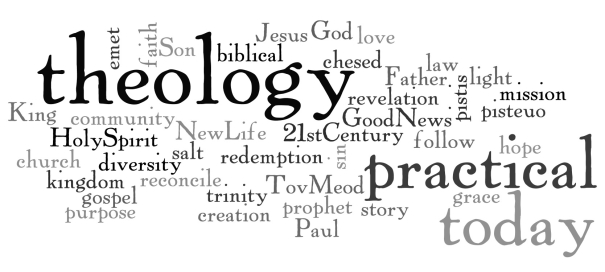
Practical Theology…

So, what makes theology practical? What makes anything practical? By definition, something practical is focused on the actual doing or use of something rather than theory and ideas. I like theories and ideas. I love theories and ideas. But I am aware that theories and ideas that don’t translate into action can lead to omphaloskepsis (navel contemplation). I remember my dad once saying about a pastor, “He’s so heavenly minded that he’s no earthly good.” My dad was suggesting practicality might have been missing in the pastor’s approach to ministry and life.

Boston University’s Center for Practical Theology suggests that “practical theology” describes the mutually strengthening relationship between the theological learning and the actual experience and needs of Christian communities. There we have it – theology that is practical translates into actual experiences needed to live the Christian life. As mentioned in the first post, a ‘practical’ definition of theology is the attempt to understand God, what he is up to, and then joining him in his work. Practical theology translates into individual and corporate participation in God’s kingdom work – all easier said than done.

So, how do we get a handle on who God is, what he is up to and then, how we participate in his kingdom work? The intent of this blog is the exploration of some answers to these practical questions. We will approach this in bite-sized chunks in a manner that might transform the way we do life – with God and with those around us. The exploration will focus on Jesus. He is, after all, “the visible expression of the invisible God” (JB Phillips Translation). In my thinking, a practical way to begin to understand God and what he is up to comes through paying attention to Jesus’ words and deeds when he took on human form and walked among humanity.

In my thinking, a practical way to accomplish this is relatively simple and easy – by READING THE GOSPELS.* Matthew, Mark, Luke, and John in the New Testament. Not once, not twice, but ongoing. I try to read through them several times a year. I know a pastor that reads one of the Gospels each week prior to beginning his sermon prep. Frequency isn’t as important as consistency. Sustained and consistent time in the Gospels is a transformative experience – ask anyone that has adopted the practice.

Enjoy the Journey

* ADDENDUM 1/31/2023: Annie F. Downs has created a podcast that will help the listener experience all four Gospels twelve times during the year 2023. It’s called Let’s Read the Gospels.

Practical Lent…

Lent starts this week on Ash Wednesday. Lent (literally springtime) was popularized in the fourth century and had a different and more practical purpose than we might think seventeen centuries later. If we were to poll people this week as to the purpose of Lent, we would likely hear something about what we should give up during the 6+ weeks leading up to Easter. We might likely have a similar view. If so, we find ourselves entering into this springtime with a negative perspective. I live in Minnesota. With another 8-9″ of snow predicted for this weekend, I am not hearing many people dread the coming of spring. Who would want to approach spring sullenly? What about Lent?

The editors of Bread and Wine: Readings for Lent and Easter suggest that “Lent should never be morose – an annual ordeal during which we begrudgingly forgo a handful of pleasures. Instead, we ought to approach Lent as an opportunity, not a requirement.” After all, the main purpose of fasting (the forging of a pleasure) is to provide more opportunity to discover and enjoy God. There is an old liturgy that refers to the Lent and Easter season as “this joyful season.” How might we approach Lent this year in a manner that brings joy? I will toss out a few suggestions, trusting readers to weigh in with other suggestions…

  • Read one of the Gospels. This is always my go-to. You plan your reading so that you finish at Easter, providing you with the backstory leading up to Jesus’ death and resurrection.
  • Read Walter Wangerin’s classic Reliving the Passion (based on the Gospel of Mark). It has been transformative for me over the years. (It’s available for Kindle… or Amazon can get it to you in a couple days.)
  • Read Bread and Wine.
  • Find a weekly Lenten service with the express purpose of discovering and enjoying God in new ways.
  • Since we are talking about the hope of springtime, N.T. Wright’s book Surprised by Hope would be a good read (though it might take you past Easter to finish).

Whatever you choose to do during this season, God will meet you, further revealing himself to you (I speak from experience!). Blessings!

Click here if you would like to receive notifications of future postings.

I’m Back…

After a hiatus of several years, I’ve decided to re-enter the world of blogging. Fifteen years ago I created a blog with the original intent of staying connected with young people I knew through church youth ministry or Young Life. In time the audience grew to a diverse mix of people with whom I had a relationship – young and older. Looking back, blogging was a healthy way for me to process what I was discovering as a Christ-follower. However, that blog came to a grinding halt four years ago as coursework ramped up in the Doctorate in Educational Leadership (Higher Ed.) program which I participated. I’m finding that I miss the opportunity to write and ponder. So, reentering the blogging sphere is for my benefit more than anyone. Feel free to join me in this journey.

Practical theology. What do I mean by that? Actually, I am figuring it out as I wander into this process. I have always described myself as a practical theologian, using the term theologian loosely. In my thinking, a theology that doesn’t play out in one’s everyday life is impractical, or of no real use. A ‘practical’ definition of theology is the attempt to understand God, what he is up to, and then joining him in his work. This blog will focus on how we join God in his work – both globally and in that part of the world where he has landed us. So, join me as we work together to figure this out. I do not intend to make this about theological stances. If that is what you are looking for, you will be disappointed. I do intend to help us see God and the life to which he has called us from new perspectives. And different perspectives are always healthy as this old saying reminds us…

If I keep on choosing what I've always chosen,
then I'll keep on wanting what I've always wanted.

If I keep on wanting what I've always wanted,
then I'll keep on thinking what I've always thought.

If I keep on thinking what I've always thought,
then I'll keep on perceiving what I've always perceived.

If I keep on perceiving what I've always perceived,
then I'll keep on seeing what I've always seen.

If I keep on seeing what I've always seen,
then I'll keep on doing what I've always done.

If I keep on doing what I've always done,
then I'll keep on getting what I've always gotten.

Subscribe to Practical Theology Today Email List