An interesting concept…

One of my favorite ministry experiences over the years has been conversations with collegeish-aged young adults. For several years we had a dozen or so young folks in our living room where we wrestled with scripture, our theologies, and the implications for daily life. After a hiatus of about six years, that opportunity has resurfaced for us.

One of the reasons I love hanging out with this age of young people is to watch them become critical thinkers – willing to wrestle with and ask questions people my age are less inclined to address. I remember several years ago a young woman asked a most compelling question to consider. I don’t entirely remember the context, but the question went something like this: “Do we love Jesus or do we love the concept of Jesus?”  

As I’ve periodically pondered this thought over the past several years, it seems the question can be restated in another way.  Are we truly interested in being Christ-followers or are we more enamored with the concept of being a Christ-follower?

I fell in love with my wife, Barb, 48 years ago.  We couldn’t wait to be married (and those that know us, know that story!).  To be honest, I was probably as much captivated by the concept of being married to her as I was in love with her.  As with any newlyweds, the first year was filled with its share of ups and downs.  That first year I learned this was the real deal; that I needed to figure out how to love and be loved.  A concept of being married wasn’t going to get me very far.

By definition, concept suggests an abstract idea or a general notion.

Hmmm…a general notion wouldn’t have gotten me very far unless I put some wheels to it.  A general notion of marriage wouldn’t have sufficed.  It has taken intentionality and determination to learn how to love and care for Barb well.

I’m reminded of the Israelites as they wandered the desert for 40 years with the concept of the Promised Land on the horizon.  When push came to shove and it was time to cross the Jordan River to take the land, God spoke these words to Joshua, their leader: Be strong and courageous, because you will lead these people to inherit the land I swore to their ancestors to give them. (Joshua 1:6).  God told Joshua several times to be strong and courageous.  Poking around in the Hebrew, I discovered that this phrase is laced with intentionality and determination.  God knew the concept of a Promised Land alone wasn’t going to get them across the river.

I watch Band of Brothers at least once a year.  The D-Day invasion was one of the most remarkable events in modern history.  The invasion concept was a couple of years in the making. On June 6, 1944, Allied troops numbering 156,000 had to set their concept of the invasion aside and put the wheels in motion.  They needed to be strong and courageous, invading enemy territory with intentionality and determination.  Something that always amazes me as I watch movies or read books about the D-Day Invasion is the numerous mishaps that occurred throughout the operation. The concept actually failed the troops in many ways, yet through intentionality and determination, the operation was a success, though at great cost.

Reading through the Gospel of Matthew recently, I saw glimpses of what we are talking about.  An example:

Then a teacher of the law came to him and said, “Teacher, I will follow you wherever you go.”  Jesus replied, “Foxes have dens and birds have nests, but the Son of Man has no place to lay his head.”  Another disciple said to him, “Lord, first let me go and bury my father.”  But Jesus told him, “Follow me, and let the dead bury their own dead.”  (Matthew 8:19-22)

Jesus wasn’t being rude.  I suspect the teachers of the law were more interested in the concept of the law than its demands (i.e., love your neighbor, love your enemy, don’t retaliate, etc.).  Jesus, the fulfillment of the law, was “saying let’s go do it.”  

Few chose to follow.  They might have been more enamored with the concept of following than actually doing it. In his book, The Divine Conspiracy, Dallas Willard suggests that we have made discipleship/following Jesus optional:

“A disciple is a person who has decided that the most important thing in their life is to learn how to do what Jesus said to do.”

More than a concept. Discipleship and follower-ship only happen with intentionality and determination. Or as the Apostle Paul told the Philippian Christians regarding his own follower-ship…

[For my determined purpose is] that I may know Him [that I may progressively become more deeply and intimately acquainted with Him, perceiving and recognizing and understanding the wonders of His Person more strongly and more clearly]... (Philippians 3:10, AMPC)

This was Paul’s determined purpose as he wrote from captivity in Rome, approaching 60 years of age and likely aware that he was nearing the end of his life.

More than a concept!

The Two Biggies (Hesed & Emet)

In the early days of this blog, I published a post about two Hebrew words that I discovered through an Old Testament survey class in the 1980s. It became evident these words were two of the Old Testament biggies that describe God and his relationship with his people – hesed and emet. Apparently, they must be biggies for others as well. On average, my most “popular” blog posts have received about 300 views since their posting. The post, Hesed and Emet, is approaching 4000 views. So I thought it might be worth revisiting, combing that post and the subsequent Veritas into a single read.

Hesed

The Hebrew word hesed (sometimes transliterated as chesed) is translated into English using a variety of different words/terms depending on the translation. Looking at Psalm 85:10, we see the treatment of hesed in various translations:

  • Love and faithfulness meet together; righteousness and peace kiss each other. (NIV)
  • Steadfast love and faithfulness meet; righteousness and peace kiss each other. (ESV)
  • Lovingkindness and truth have met together; Righteousness and peace have kissed each other. (NASB)
  • Mercy and truth have met together; Righteousness and peace have kissed. (NKJV)

Hesed is difficult to translate because it stands for a cluster of ideas—love, mercy, grace, kindness. It wraps up in itself all the positive attributes of God.  Hesed is one of Yahweh’s most treasured characteristics. This is a rich and robust term for which no single English word (or two words, in the case of “steadfast love”) is sufficient.  Beyond a sense of love and mercy, embedded in heseds meaning is covenant loyalty and relational fidelity.

Hesed is freely given, often unexpectedly, without requiring anything in return. Though stemming from covenant (contract) loyalty, there is a sense that such loyalty surpasses the letter of the law. In Hosea, God said that he desires mercy (hesed), not sacrifice (law), which Jesus reiterated (Matthew 9:13). Jesus further reinforced this thought when addressing the Roman law that forced locals to carry soldiers’ packs for a mile; Jesus suggested going an extra mile (Matthew 5:41). 

Hesed, you can see, describes the rich and robust depth of God’s character. 

In the Old Testament, the Hebrew scriptures, ‘hesed’ is predominantly used to illustrate God’s benevolence toward His people. There is also a sense that it was to be practiced ethically in the way people treated each other, be it relatives, friends, or foreigners. Hesed is a quality that moves someone to act for the benefit of someone else without considering “what’s in it for me?”

Boaz recognized hesed (kindness) in Ruth’s character (Ruth 3:10). One also thinks of God’s desire that his people not seek vengeance, but show love toward their neighbor (Leviticus 19:18) which Jesus reinforced, as part of “Great Commandments” (Mark 12:30-31). Mark’s gospel used the Greek term agape (love), the Greek equivalent of hesed. Again, think “go the extra mile.”

Hesed is used 248 times in the Old Testament, 50% of its usage is in the Psalms, so it isn’t difficult to spot. As you read, be looking for it. Pay attention to the context in which it is used. I find myself translating the English back to Hebrew, knowing the richness and robustness of the word.

Emet

I learned a new word a couple of years ago – verity. Verity, I discovered, is derived from veritas, the Latin word for truth. We began this post by looking into the word hesed. As we saw in Psalm 85, hesed and emet are often found together, increasing the richness and robustness of the description of God’s character – “Steadfast love and faithfulness meet; righteousness and peace kiss each other” (Psalm 85:10, ESV). The word faithfulness in this passage is emet, another rich and robust Hebrew word describing God’s character, so we have “Hesed and emet meet; righteousness and peace kiss each other.”

The Theological Workbook of the Old Testament suggests that emet can be translated into English as faithfulness or verity (truth).  As with the example above, when coupled with hesed, it creates a synergism of two of God’s strongest attributes. (Keep in mind the definition of synergy – the combined effect is greater than the sum of the individual attributes.) 

So emet carries an underlying sense of certainty & dependability, reliability & trustworthiness; this is over and against our culture-war use of truth, which focuses on absolute accuracy. I suspect the Pharisees and religious leaders of Jesus’ day hijacked emet in favor of telling others how they should live rightly.

Remember that Jesus is the visible expression of the invisible God (Colossians 1:15), the God of hesed and emet. Maybe John had hesed and emet in mind when he said that Jesus became flesh and dwelt among us,  full of grace and truth (John 1:14).

Ponder all this for a while. It gives me the chills when I ponder it. You?

Addendum March 2025. Psalm 117, the shortest psalm in the Psalter, is all about hesed and emet

Praise the Lord, all you nations;
    extol him, all you peoples.
For great is his love [hesed] toward us,
    and the faithfulness [emet] of the Lord endures forever.

Addendum July 2025. The correct term for the linking of hesed and emet is hendiadys: the expression of a single idea by two words connected with “and,” e.g., nice and warm, when one could be used to modify the other, as in nicely warm.

Obed-Edom

A couple of weeks ago our pastor introduced us to Obed-Edom. Obed who? Obed-Edom. I was vaguely familiar with the story about him but didn’t know his name. This is what I was familiar with…

The Ark of the Covenant (also known as the Ark of the Lord) was central to the Israelites’ relationship with God. The Ark contained items specific to the covenant relationship between Yahweh and the people: a gold jar of manna, Aaron’s staff that had budded, and the stone tablets of the covenant, according to the author of Hebrews (see Hebrews 9:3-4). It was more than just a fancy box. It was called the Name, the name of the Lord (Yahweh) Almighty (cf. 2 Samuel 6:2, 1 Chronicles 13:6). The Ark was a visible representation of God’s presence with His people. Think, Christ is the visible expression of the invisible God (Colossians 1:15, Phillips). The Ark was a big deal.

You may recall that the Philistines were the arch-enemy of the Israelites. At one point, they decided that it would be wise to carry the Ark into battle, hoping it would ensure victory. It did not. In fact, aware of the presence of the Ark, the Philistines doubled down, defeated the Israelites, and captured the Ark. They placed the Ark in the temple of their god, Dagon. But Dagon’s statue kept falling over in the presence of the Ark. So, after a few months, the Philistines sent the Ark back to Israel. It ended up at Abinadab’s house where it remained for 21 years, during the entire reign of King Saul, possibly unbeknownst (1 Samuel 5-7).

When David became king of Israel, he assembled an entourage to go get the Ark from Abinadab’s house. Not understanding the significance and holiness of the Ark, the people mishandled it, resulting in loss of life. Fear seized the people and David, so they dropped the Ark off at Obed-Edom’s house where it remained for three months, during which the Lord blessed his household (1 Chronicles 13).

David did not do due diligence before his first attempt to bring the Ark back to Jerusalem. The second time he did better. With thought and foresight, he returned to Obed-Edom’s house to retrieve the Ark, adhering to directives outlined in the Hebrew Law. This attempt proved to be successful.

This is the part of Obed-Edon’s story that was less familiar to me…

After living three months with the Ark (the representation of the Lord’s presence) in his home, Obed-Edom was all-in. He and his family relocated to Jerusalem to continue to be in the presence of the Ark, of God. We don’t know what his pre-Jerusalem occupation was, but he became a gatekeeper in Jerusalem, ultimately ministering before the ark as a worship musician and a doorkeeper for the ark (1 Chronicles 15-16). Obed-Edom’s legacy was primarily as a gatekeeper/doorkeeper for the sanctuary of the Lord. To us, not what we might consider a legacy, but as a follower of Yahweh, he left a legacy worthy of record in the Hebrew scriptures (see 1 Chronicles 26:1-8).

As I discovered this secondary story about Obed-Edom, I immediately thought of the poem Sam Shoemaker wrote as an apologia for his life, I Stand by the Door. His legacy…

I stand by the door.

I neither go too far in, nor stay too far out.

The door is the most important door in the world—

It is the door through which men walk when they find God.

There’s no use my going way inside, and staying there,

When so many are still outside and they, as much as I,

Crave to know where the door is.

And all that so many ever find

Is only the wall where a door ought to be.

They creep along the wall like blind men,

With outstretched, groping hands.

Feeling for a door, knowing there must be a door,

Yet they never find it . . .

So I stand by the door.

The most tremendous thing in the world

Is for men to find that door—the door to God.

The most important thing any man can do

Is to take hold of one of those blind, groping hands,

And put it on the latch—the latch that only clicks

And opens to the man’s own touch.

Men die outside that door, as starving beggars die

On cold nights in cruel cities in the dead of winter—

Die for want of what is within their grasp.

They live, on the other side of it—

live because they have not found it.

Nothing else matters compared to helping them find it,

And open it, and walk in, and find Him . . .

So I stand by the door.

Go in, great saints, go all the way in—

Go way down into the cavernous cellars,

And way up into the spacious attics—

It is a vast, roomy house, this house where God is.

Go into the deepest of hidden casements,

Of withdrawal, of silence, of sainthood.

Some must inhabit those inner rooms,

And know the depths and heights of God,

And call outside to the rest of us how wonderful it is.

Sometimes I take a deeper look in,

Sometimes venture in a little farther;

But my place seems closer to the opening . . .

So I stand by the door.

There is another reason why I stand there.

Some people get part way in and become afraid

Lest God and the zeal of His house devour them;

For God is so very great, and asks all of us.

And these people feel a cosmic claustrophobia,

And want to get out. “Let me out!” they cry.

And the people way inside only terrify them more.

Somebody must be by the door to tell them that they are 

Spoiled for the old life, they have seen too much:

Once taste God, and nothing but God will do any more.

Somebody must be watching for the frightened

Who seek to sneak out just where they came in,

To tell them how much better it is inside.

The people too far in do not see how near these are

To leaving—preoccupied with the wonder of it all.

Somebody must watch for those who have entered the door, 

But would like to run away.  So for them, too,

I stand by the door.

I admire the people who go way in.

But I wish they would not forget how it was

Before they got in.  Then they would be able to help

The people who have not yet even found the door,

Or the people who want to run away again from God.

You can go into deeply, and stay in too long,

And forget the people outside the door.

As for me, I shall take my old accustomed place,

Near enough to God to hear Him, and know He is there, 

But no so far from men as not to hear them,

And remember they are there, too.

Where?  Outside the door—

Thousands of them, millions of them.

But—more important for me—

One of them, two of them, ten of them,

Whose hands I am intended to put on the latch.

So I shall stand by the door and wait

For those who seek it.

“I had rather be a door-keeper . . .”

So I stand by the door.

A Life of Purpose

About 20 years ago, Rick Warren, founding pastor of Saddle Back Church in Lake Forest, CA, rolled out his best-selling book, The Purpose Driven Life: What on Earth Am I Here For?  It quickly rose to the top of the New York Times Best Seller list – an indicator that the topic met a felt need.

Churches responded to the popularity of the book offering book studies to help parishioners process the 40 short chapters.  Chapters were designed for daily reading with the goal of helping readers reflect on their lives, values, and beliefs.  I remember two distinct responses to the book/studies.  For some, it was a transformative, even a watershed experience (see Watershed Moments).  

There was another segment of readers that came away disappointed – they were hoping that God would reveal to them a very specific purpose, maybe even a change in direction, career, etc. – “what does God want me to do?” stuff.  That didn’t happen for them, nor was it the “purpose” of the book.  I think Rick Warren’s hope was to help people live a life of purpose, not necessarily find their purpose.  There is a significant difference.  It’s Why versus What and How stuff.  Why precedes What and How.  Always. (Simon Sinek reminds us of this in his TED Talk, How Great Leaders Inspire Action.)  If we don’t know the Why we might find ourselves just pounding sand.

The Hon. Al Quie passed away recently (8/18/2023) at the age of 99.  As a fellow Minnesotan, I followed with interest his life of political service, with service being the operative word.  He served as a state senator, congressman, as well as the Governor of Minnesota.

Al Quie knew his Why  

I’m not aware that Al Quie had a written “life purpose statement.” But his unwritten purpose statement was evident from his life. It was one of serving and ministering to those in his sphere of influence, which was pretty significant, by the way.  A couple of examples:

One example took place in the mid-1970s as Chuck Colson of Watergate “fame” was serving out a prison sentence for his role in the Watergate scandal.  While awaiting trial, Colson became a Christ-follower through the ministering of Quie and others.  Influenced by his new-found faith, Colson decided to own his role in the scandal, pleading guilty accordingly.  The judge rewarded him with a 1–3-year sentence.

About a half year into serving his sentence, it soon became evident that Colson’s family was suffering immensely from his incarceration.  His teenage son was particularly struggling.  Quie, knowing that Colson’s family’s well-being was in jeopardy, made a stunning offer:   

“Chuck, I have been thinking,” Quie said to Colson.  “There’s an old statute someone told me about.  I’m going to ask the President if I can serve the rest of your term for you… Your family needs you, and I can’t sleep while you’re in prison; I think I’d be a lot happier being inside myself.” 1

Al Quie knew his Why

I don’t remember all the details, but within a few days of the offer, the sentencing judge released Colson after serving seven months of his sentence “because of family problems.”  I suspect that somehow Quie’s offer was instrumental.

I got to meet Al Quie a few times through my friend Mick.  For twenty years, Mick, Al, and a couple of other guys have met on Thursday mornings for prayer and fellowship, more recently at the memory care center where Quie finished his life.  Mick explained that though Al’s sphere of influence was reduced to a small room and the hallway outside his door, his purpose remained steadfast – ministering to those around him.  

Apparently, Quie would work on jigsaw puzzles in the hall outside his room.  Al shared with Mick, that as he worked on a puzzle when a resident happened to look blue and melancholy, he would help them place some pieces to the puzzle.  This simple gesture consistently led to a spark of joy in their eyes and the re-emergence of their smiles.

Al Quie knew his Why!!

1 Colson, C. W. (1997). Born again. Spire.

Watershed Moments

I was talking recently with a younger friend (most of my friends seem to be younger than me 😬). We both have a tendency to be doers, which gets in the way of being. He asked me if I ever had a watershed moment where I began to move away from being a doer, moving toward a healthier balance of doing and being. I did experience such a watershed moment, which I will talk about in a bit. But first, let me describe the difference between doing and being as I understand them.

Doing is about engaging in actions, tasks, and activities in the external world. It’s related to productivity, accomplishments, and the tangible results of our efforts. It’s easy to get our worth from doing because of its quantitative tangibility.

Being, on the other hand, is about existing in, even embracing the present moment, and connecting with the world around us (i.e., people, nature, etc.) It’s about experiencing life beyond external achievements and roles. For doers, we didn’t get much worth from being.

But, as a psychologist friend once reminded me, we are human beings, not human doings

My watershed moment: About 25 years ago I was attending a monthly Young Life staff gathering. My friend Brad opened our time with some scripture to ponder. The scripture was Joshua 5:13-14…

13 Now when Joshua was near Jericho, he looked up and saw a man standing in front of him with a drawn sword in his hand. Joshua went up to him and asked, “Are you for us or for our enemies?” 14 “Neither,” he replied, “but as commander of the army of the Lord I have now come.” Then Joshua fell facedown to the ground in reverence, and asked him, “What message does my Lord have for his servant?”

As Brad read the passage, when he got to “What message does my Lord have for his servant?” I was anticipating something entirely different. I was expecting to hear Joshua ask, “What does my Lord want me to do?” Do?! I was shocked and chagrined that my mind went right to “do.” The staff time ended and I headed back to my town, 40 miles away, in a heavy snowstorm. Six inches (15 cm) already had fallen and another six were predicted. As I navigated the snow-covered roads in my little 2-wheel drive Mazda pickup, I could not get the Joshua incident out of my mind.

I had kept a journal for several decades. I bought inexpensive spiral-bound 6×9 notebooks to capture my thoughts and activities. As a doer, my journals were more populated with my activities than my thoughts. That day I decided that I wanted to start moving toward a more balanced life. I wanted to be as much as I did.

So, in the middle of the snowstorm, about 10 miles (16 km) into the trip home, I turned around and drove back to Barnes and Noble to purchase a $20 leather journal. My thinking? If I paid $20 for a journal, I wasn’t as likely to fill it up with what I did.

My watershed moment!

Watershed. Makes me think of the Civil Engineering Hydrology course I took at the University of MN in the 1970s. A major project for the course revolved around the Root River watershed in southern Minnesota. We were to estimate the effect on the river level of a 3″ rainfall. By definition, a watershed is a geographical area of land defined by the natural topography where all precipitation drains into a common point, in this case, the Root River.

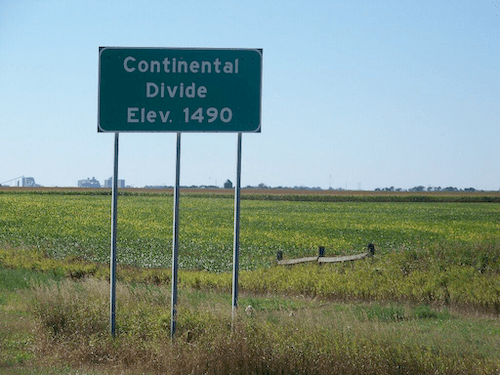
We just returned from a road trip to the Glacier National Park area in western Montana. While traveling, we crossed several continental divides – continental versions of watersheds. Most continental divides are at higher altitudes, upwards of 6000 feet (1830 meters). One of the divides we crossed was in eastern North Dakota at an elevation of 1490 feet (454 meters). As you can see by the photo below there was nothing very dividing or even “continental” about this one. The rains and snow melt east of the North Dakota divide drain toward the Red River of the North, ultimately making its way to the Hudson Bay in Canada. Western precipitation flowed toward the Missouri River, ultimately draining into the Mississippi and the Gulf of Mexico.

Continental Divide sign on I-94 between Valley City and Jamestown, ND

Crossing the North Dakota divide was literally a “watershed moment.” But not much seemed to be different after we passed the sign. The topography seemed the same. But as we traveled for a few more hours, we saw it – the Missouri River. Even though we didn’t notice any major topographical differences, change was, in fact, occurring.

Watershed moments can be dramatic, like crossing a 10,000-foot (3050-meter) continental divide. I suspect that more often than not, spiritual watershed moments look more like the North Dakota divide. But a divide nevertheless. Looking back 25 years to my watershed moment during that Minnesota snowstorm, I can see that a shift toward a doing-being balance has been taking place. Five years into the post-watershed journey, not so much.

When I poke around in a Greek-English interlinear New Testament, I find a lot of what in Greek grammar is referred to as the present continuous tense – terms like be-believing, be-becoming, be-following, etc. Though my watershed moment was 25 years ago, balancing being and doing has been an ongoing journey, a present continuous experience. I think that’s the significance of watershed moments. They are points in our life from which we don’t look back. As we continue walking with Jesus, transformation is slowly taking place even when the outcomes aren’t immediately visible.

Be-becoming!

Fear of the Lord

One of my favorite family-gathering memories: It was a holiday dinner at my in-laws’. With six girls and a boy in the family, such dinner gatherings were loud and festive. And, as was often the case in the 20th century, the men sat in the living room adjacent to the kitchen as our spouses prepped the meal. We were, of course, discussing important things like football.

At this particular gathering, all of us brothers-in-law were gathered in the living room when one of them said with much boldness, “I fear no man!” quickly followed by a quieter comment about his wife, “But that little woman in the next room scares the snot out of me.” As I said, one of my favorite family-gathering memories. And we bring it up annually.

The concept of fearing God is among the most challenging biblical ideas, particularly in the context of the Old Testament, the Hebrew scriptures. We are likely familiar with, The fear of the Lord is the beginning of wisdom… (Proverbs 9:10a). It’s one of those Proverbs that sounds profound and correct but we don’t know why. If asked to describe or explain “fear of the Lord,” we might be a bit at a loss. What does it really mean?

When I first encountered the phrase in personal readings 50+ years ago, it caused me to pause. Growing up going to church and Sunday School I probably heard it a lot. But when I read it myself it seemed like a new term for me. A cursory exploration in my compact Bible Dictionary revealed that “fear of the Lord” could be translated or redefined as reverence or respect.

That seemed to satisfy me for a little while, but there was a lingering sense that it was larger and more robust than that. My pastor’s title was Reverend. I respected him, but I didn’t fear him nor did I suspect he was on the same par as God. There had to be more. So I did some digging and discovered some stuff…

Yirah (יִרְאָה) is the most common Hebrew word used for “fear” in the context of fearing God. It conveys a sense of awe, reverence, and respect. Yirah is often associated with a profound recognition of God’s greatness and holiness, leading to an attitude of humility and obedience. It is frequently used in the context of seeking wisdom and understanding from God (thus the Proverbs 9:10 passage). The Psalms are laced with “fear of God” language, for example, Psalm 86:11 (AMP):

Teach me Your way, O Lord [Yahweh],
I will walk 
and live in Your truth;
Direct my heart to fear Your name [with awe-inspired reverence and submissive wonder].

The fear of Yahweh represents an attitude of recognizing our complete reliance on Him for mercy, forgiveness, and even our very existence.

Fearing God is having a clear understanding of who God is and how my own sinful nature places me in conflict with his nature, and it is knowing that my only hope is divine grace and mercy. A healthy understanding of “fear of the Lord” is dependent on my view of God. If I know the God of scripture, “fear of the Lord” will look different than if I view Him as a god that smites, a celestial tyrant.  This is why I repeatedly advise people to maintain a consistent practice of spending time immersed in the Gospels developing a deeper understanding of Jesus, the visible expression of the invisible God (Colossians 1:15).

N.T. Wright in addressing “fear of the Lord.” Human beings were made to know, worship, love, and serve the creator God. That always was and always will be the way to healthy and fruitful human living. It demands, of course, a certain kind of humility: a willingness to let God be God, to celebrate and honour him as such, and acknowledge his power in and over the world. *

The placing of our lives in the hands of God is the attitude of submission that the Old Testament refers to as “the fear of the Lord.” Bottom line…

Submission to the Lord is the beginning of wisdom. And life!

* Wright, N. T.. Paul for Everyone: Romans, Part One (The New Testament for Everyone) (p. 13). Presbyterian Publishing Corporation.

Old Faithful

Time spent with our grandkids causes me to reflect back to “when I was their age,” reminiscing what life was like for me decades ago. Much has changed, but kids are kids and the kinds of things that intrigued me intrigue them as well. I love watching them with their nose in books or as they learn to draw. I loved to read and draw. What I read was different (Hardy Boys mysteries versus Harry Potter). I drew horses and tractors. Our grandkids draw Pokémon figures.

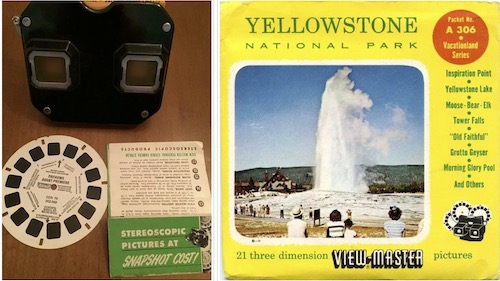
One of the most intriguing things I played with as a kid was a View-Master. For those unfamiliar, a precursor to 3-D glasses the View-Master was a popular stereoscopic toy that allowed me to view images in a three-dimensional format. It consisted of a handheld plastic viewer and a series of circular cardboard “reels,” each containing a set of paired images (see below).

We had a series of reels ranging from Hopalong Cassidy to a variety of national parks. My favorite was Yellowstone National Park. For a dairy farm kid for which a “vacation” consisted of a day trip to Taylors Falls or Duluth squeezed between milkings, the View-Master gave me the opportunity to experience the majesty of our parks – in 3-D!

The “Old Faithful” geyser was particularly captivating. The View-Master reel had a series of time-lapse photos showing the faithful geyser in various stages of eruption. All in 3-D! I studied each of the slides. I couldn’t get enough!

In the previous post, we discussed faith, a word that occurs over 250 times in the New Testament. It derives from the Greek word pistis and can easily be translated as trust (see I Gotta Have Faith). What about faithful – how are faith and faithful related and/or different?

For starters, faith is a noun and faithful is an adjective. Faith refers to the belief or trust in something, particularly God, while faithful describes a person characterized by loyalty, devotion, and reliability. Faith is the foundation or conviction, while faithful reflects the actions and qualities associated with steadfastness and trustworthiness.

Faithful is a translation of the Greek word pistos, which, as you can see, is a derivation of pistis (faith) and pisteoū (believe). These are Greek words found in the New Testament. Looking into the word pistos, what piques my interest are the English words that describe faithful – loyalty, devotion, reliability, steadfastness, trustworthiness, etc. These smack of the Old Testament characterization of God’s covenant loyalty and reliability, hesed and emet (see Hesed and Emet and Veritas).

In a similar fashion to our quantification of faith, I suspect we view being faithful as some form of perfection, success, or “getting it right.” Loyalty and perfection are not the same. I am loyal to my wife but far from perfect and don’t get it right all the time (as she would likely agree 😬). Though she might like it if I got it right more often, I know that loyalty is far more important to her. I suspect God is more interested in our pistos than our successes, our getting-it-rightness.

I am reminded of a story about Mother Theresa. When orphans were starving in India at a greater rate than her little orphanage could possibly serve, Mother Theresa was asked by a reporter how she could feel any sense of success. Her response?  God does not require that we be successful, only that we be faithful. In Western thought, we have equated success and faithfulness. God wants our pistos, our loyalty and our devotion.

We must also remember that loyalty is covenantal. While I am faithful to my wife, she is also faithful to me – she makes it easy to be loyal to her. The Old Testament narrative is a story about God’s covenant loyalty. With Jesus, God provided forgiveness of sin making loyalty a possibility. God’s loyalty makes us want to be loyal/faithful in return. The Apostle Paul summed it up for his friend and apprentice Timothy like this (2 Timothy 2:11-13):

Here is a trustworthy (pistos) saying: 

If we died with him,
    we will also live with him;
if we endure,
    we will also reign with him.
If we disown him,
    he will also disown us;
if we are faithless,
    he remains faithful (pistos),
    for he cannot disown himself.

God’s pistos trumps our pistoslessness

Addendum 7/23/2023. Reading 1 Thessalonians 5 this morning, I came across this: The one who calls you is faithful, and he will do it (5:24). Greek for “The one who calls you is faithful” – Pistos ho kalon,

I Gotta Have Faith*

My daughter and I were recently talking about faith, trust, belief, faithfulness, etc. Faith is one of those religious terms that we assume to understand, but deeper consideration might suggest otherwise. Consider this oft-heard statement: “If you just have (or had) enough faith, then _____ (fill in the blank).” There is a sense of a threshold of faith that once reached, God will grant us our desires. And if those desires aren’t fulfilled, then we assume we are at fault – we didn’t have enough faith, didn’t reach that elusive threshold. (And unfortunately, there are a number of people that are willing to remind us of our lack of faith.)

I suspect we tend to quantify faith, thus “enough” and “threshold” thinking. Personally, I realized that when I quantify faith, then I become the focus, not God. My faith makes the difference. My faith results in _____ (again, fill in the blank). The focus is on me and my ability. I’m pretty sure that if I am the focal point, then surely something must be amiss.

In addition, a quantified approach to faith not only focuses on me but also on the outcome. If the desired outcome happens, then we say “They had enough faith,” But what if the desired outcome doesn’t happen, then what?

Consider the many times Jesus commended and affirmed people’s faith. I think of his response to the faith of the centurion: “Truly I tell you, I have not found anyone in Israel with such great faith.” (Matt. 8:10). Or the faith of the paralyzed man’s friends: “When Jesus saw their faith, he said, ‘Friend, your sins are forgiven.'” (Luke 5:20).

As I look at the many occurrences of Jesus commending people for their faith, I see a theme that I hadn’t really noticed before. Most of those lauded didn’t qualify as people with any sort of faith at all, according to the religious traditions.

Many, if not most, were in need of healing. The religious culture labeled, oppressed, and ostracized people with diseases and physical infirmities – they lacked a measurable amount of faith, I suspect. Some were members of the wrong tribe, like the Roman centurion (above) or the Syrophoenician / Canaanite woman who came to Jesus despite the tribal distinctions (see Matt. 15:21-28 and Mark 7:24-30).

In the passages describing Jesus’ commendation of people’s faith, the Greek word translated as faith is pistis. As we typically find to be true with translations from Greek, a single English word is often not sufficient. In their use of pistis, Plato and other Greek philosophers referred to the conviction of the truth of anything, of belief. (Pistis is related to pisteoū, often translated as “belief.”)

The new testament writers used pistis to describe our relationship to God and to Christ. When it relates to God, pistis is “the conviction that God exists and is the creator and ruler of all things.” In reference to Christ, it denotes “a strong and welcome conviction or belief that Jesus is the Messiah, through whom we obtain eternal salvation in the kingdom of God” (Thayer’s Lexicon). The predominant idea is one of trust (or confidence) in the one true God and/or that Jesus is the Christ (Messiah).

Central to faith is the object of one’s faith.

So what was this faith that outsiders possessed and Jesus lauded? They simply trusted Him. He was the object of their faith. When we think in terms of quantified faith, we become the object. When we think of faith in terms of trust, God becomes the focus. Can he be trusted? Is he reliable? Does he have my best interests in mind? Regardless of the outcome?

A couple of great stories…

From Esther. Esther needed to speak to the king on behalf of the Israelites but it was unlawful for her to approach the king without being summoned – the law said she should be put to death. But she knew that she was the one that needed to speak on behalf of the people. She did not say “I have faith that God will protect me.” Her words? “I will go to the king, even though it is against the law. And if I perish, I perish.” TRUST.

From Daniel (esp. chapter 3). Shadrach, Meshach, and Abednego refused to worship the king’s idols and were promised that they’d be tossed in a furnace if they didn’t. They did not say “We have enough faith and we know God will protect us.” Their reply? “O Nebuchadnezzar…if we are thrown into the blazing furnace, the God we serve is able to save us from it… But even if he does not, we want you to know, O king, that we will not serve your gods or worship the image of gold you have set up.” TRUST.

Faith: Just plain trust. Not quantified. Not outcome dependent. Just plain TRUST!!!

* “Apologies” for the unashamed use of lyrics from the 1980s George Michael song, Faith.

Tim Keller, Author

One more post dedicated to the life and ministry of Timothy Keller – a trilogy of sorts, which is appropriate given Keller’s love of J.R.R. Tolkien’s Lord of the Rings and C.S. Lewis’s Space trilogies. Keller was a prolific writer – something that didn’t happen for him until the sixth decade of his life. I tend to pay more attention to people that write later in their faith journey when they possess a more fully developed theology. In the same manner, I like reading the epistles that the Apostle Paul wrote later in his ministry (e.g., Philippians, Colossians, Ephesians).

Keller’s numerous books (and sermons) reflect a culturally thoughtful and intellectually rigorous approach to theology. I recently discovered that I have read a fair number of his books. I thought it might be interesting to capture of few great quotes from his books I’ve read – for my benefit if nothing else! You may also enjoy…

Tweet by The Gospel Coalition, May 26, 2023

“The gospel is this: We are more sinful and flawed in ourselves than we ever dared believe, yet at the very same time we are more loved and accepted in Jesus Christ than we ever dared hope.”  (The Reason for God: Belief in an Age of Skepticism, 2008)

“A faith without some doubts is like a human body without any antibodies in it. People who blithely go through life too busy or indifferent to ask hard questions about why they believe as they do will find themselves defenseless against either the experience of tragedy or the probing questions of a smart skeptic.”  (The Reason for God)

“Doubt is not the opposite of faith; it is an element of faith” and “Believers should acknowledge and wrestle with doubts… It is no longer sufficient to hold beliefs just because you inherited them.” (The Reason for God)

“Our need for worth is so powerful that whatever we base our identity and value on we essentially ‘deify.'” (The Reason for God)

“The only person who dares wake up a king at 3 am for a glass of water is a child. We have that kind of access.”  (Twitter)

“Justice without grace is only harshness. Grace without justice is only sentimentality.” (The Reason for God)

“God never said that the journey would be easy, but He did say that the arrival would be worthwhile.” (The Reason for God)

“Both brothers were lost, but only one knew it.” (The Prodigal God: Recovering the Heart of the Christian Faith, 2008)

“The gospel is distinct from mere morality. Morality is about good and bad, but the gospel is about lost and found.” (The Prodigal God)

“The younger son repents because of his circumstances; the elder son does not repent despite his circumstances. The first is sorry for what he has done; the second is angry that God does not seem to have blessed him enough for his goodness. The younger son repents with his whole heart; the elder son, with only half a heart.” (The Prodigal God)

“Both the irreligious and the religious are spiritually lost, but they are lost in different ways. Religious people are lost because they don’t think they’re lost. Irreligious people are lost because they don’t know they’re lost.” (The Prodigal God)

“The gospel is not religion. Religion operates on the principle of ‘I obey, therefore I’m accepted.’ The gospel operates on the principle of ‘I’m accepted, therefore I obey.'” (The Prodigal God)

“Jesus’s teaching consistently attracted the irreligious while offending the Bible-believing, religious people of His day. However, in the main, our churches today do not have this effect. The kind of outsiders Jesus attracted are not attracted to contemporary churches, even our most avant-garde ones. We tend to draw conservative, buttoned-down, moralistic people. The licentious and liberated or the broken and marginal avoid church. That can only mean one thing. If the preaching of our ministers and the practice of our parishioners do not have the same effect on people that Jesus had, then we must not be declaring the same message that Jesus did.” (The Prodigal God)

“Jesus doesn’t just give us advice; He gives us Himself… Jesus doesn’t just show us the way; He is the way… Jesus doesn’t just point us to truth; He is the truth… Jesus didn’t come to make bad people good; He came to make dead people alive… Jesus doesn’t offer temporary relief from life’s struggles; He offers eternal hope in the midst of them.” (Encounters with Jesus: Unexpected Answers to Life’s Biggest Questions, 2013)

“Jesus did not come to earth simply to teach; He came to be the King… Jesus doesn’t just claim to be a king; He is the King of all kings… Jesus didn’t just talk about the kingdom of God; He brought the kingdom of God to earth… Jesus didn’t come to establish an earthly empire; He came to bring about a revolution of the heart… Understanding Jesus as King means recognizing His authority over every aspect of our lives.” (Jesus the King: Understanding the Life and Death of the Son of God, 2011)

“The desire for justice and the longing for a better world point to something beyond ourselves. They hint at the existence of a moral lawgiver.” (Making Sense of God: An Invitation to the Skeptical, 2016)

“Christianity is not merely a set of beliefs; it is a story that makes sense of the world. It offers a comprehensive framework for understanding life, purpose, and the human condition.” (Making Sense of God)

“The gospel is not a transaction; it is a transformation. It is not about earning salvation through good works, but receiving God’s grace and allowing it to change us from the inside out.” (Making Sense of God)

That was fun! My pastor put me onto this book: Timothy Keller: His Spiritual and Intellectual Formation, by Collin Hansen, which just came out in February. If you are a Timothy Keller fan, I highly recommend it. I listened to it on Audible, which contains some bonus talks and sermons of Keller’s, including the message he preached the Sunday after 9/11/2001.

Tim Keller, Intellect

Though largely known for his cultural engagement that led to a successful mega-Church plant (though not in his plans when he moved to Manhattan – see Timothy Keller), Timothy Keller’s real asset to Christianity was his intellect. Those who are not part of the Christian faith commonly hold the belief that Christians have “checked their intellect at the door.” This prevailing perception is rooted in the fact that many Christians have indeed demonstrated this behavior and, at times, even exhibited a sense of arrogance regarding their stance.

I think of people like Mark Driscoll who bragged about his lack of education when he planted a church at 25 years of age (cf. Rise and Fall of Mars Hill). Wise people like Keller and Dallas Willard would suggest we think otherwise. Willard reminded his readers of Romans 12:2: Don’t be conformed to the patterns of this world, but be transformed by the renewing of your minds so that you can figure out what God’s will is—what is good and pleasing and mature (CEB).*

We tend to focus on the beginning of the first sentence of the passage, trying hard not to conform to the patterns of this world (which is simply moralism, by the way). As a result, we end up conforming to something else. Twenty years ago we lived in a smaller fairly churched community with a plethora of churches possessing a variety of worship styles. I have often quipped that when at an ecumenical gathering in that community, I could tell where they attended based on the way they prayed. *

We conform to something, which I posit can be a result of checking our intellect at the door. Mars Hill’s intent was that people come to know Jesus. After salvation, people’s intellects weren’t a necessity – Mark Driscoll provided them with what they needed. His messages pushed back against the culture of the world (do not conform to the patterns of this world) and gave them a different set of patterns to conform to. And they did – 15,000 thousand attendees and staff. Then Mars Hill collapsed.

Shifting our attention from conformity, let’s direct our focus towards the latter portion of Paul’s statement: but be transformed by the renewing of your minds so that you can figure out what God’s will is—what is good and pleasing and mature. I’ve talked about the word transformation before (see Metamorfoo). How does transformation happen? Not through conformity, but by feeding the intellect.

Renewing our minds cannot happen if we are “mindless” and rely only on others to tell us what to do and believe. Paul’s letters were full of intelligent thought and I assume he expected the groups to whom they were written to ponder together and discuss together. Jesus told stories and asked questions that drove his hearers (especially his followers) to become critical thinkers. Keep in mind that for first-century Israelites conformity trumped mind renewal. Former conformers were part of Paul’s audience when he wrote his letter to the Romans.

What does renewing the mind look like? In pointing Christ-followers to the second part of the passage, Dallas Willard stressed the need for intentional spiritual practices and intellectual cultivation of a Christ-centered worldview that might lead to a genuine transformation in every aspect of life. He appealed to biblical discipleship – be with, learn from, become like, and join Jesus in his mission. He appealed to the intellect. Willard often said that Jesus is the most intelligent person in the universe – learning from Him can/will lead to authentic and comprehensive transformation in one’s life.

Timothy Keller’s emergence as a prominent figure for engaging with culture within the evangelical community can be directly attributed to his intellectual agility and the development of his critical thinking skills, which he began cultivating during his college years. He grappled with the prevailing evangelical ambivalence towards racism and apartheid, perceiving them to be incongruent with the life and teachings of Jesus. He also wrestled with the more liberal theology that showed concern for “the other,” yet omitted Jesus from the equation. It compelled him to turn to Jesus, seeking a critical understanding of his teachings rather than conforming to the expectations of others.

Keller became a well-respected pastor, theologian, and author known for his intellectual approach to Christianity. He became widely recognized for his ability to engage with philosophical, cultural, and intellectual challenges to the Christian faith in a post-Christian age. His numerous books and sermons reflect a culturally thoughtful and intellectually rigorous approach to theology.

Keller emphasized the importance of engaging the mind in matters of faith and encouraged believers to explore and wrestle with difficult questions. He sought to bridge the gap between faith and reason and presented Christianity as intellectually compelling. Blaise Pascal (the brilliant 17th-century mathematician and physicist, who, after a profound conversion redirected his intellectual pursuits towards Christian philosophy), provided Keller with a quote that described his philosophy of ministry:

Men despise religion. They hate it and are afraid it may be true. The cure for this is first to show that religion is not contrary to reason, but worthy of reverence and respect. Next, make it attractive, make good men wish it were true, and then show that it is.

What we get to intelligently do: Make Christianity attractive, make people wish it were true, and then show them that it is.

* We want to keep in mind that Jesus always appealed to the intellect – asking questions and telling stories to help people “rethink their thinking.” Remember that repentance begins with a shift in one’s thinking. It’s important to consider Jesus’ enhancement to the Shema’s (Deut. 6:4-5) meaning and significance by replacing the word “strength” with “mind,” thus expanding its richness and depth: Love the Lord your God with all your heart and with all your soul and with all your mind (Matt. 22:37). In Mark 12:30, we observe that Jesus retained the term “strength” and added “mind.”

* Addendum 7/17/2023. I stumbled onto this quote by Henri Nouwen: “Often we hear the remark that we have to live in the world without being of the world. But it may be more difficult to be in the Church without being of the Church.” [Nouwen, H. J. M. (1997). Bread for the journey : a daybook of wisdom and faith 91st edition). Harper SanFrancisco.]