I was reminiscing recently about the day I took the Professional Engineering (PE) exam over 40 years ago (or it could have been a nightmare! 😬). It was a brutal, 8-hour test. The four-hour morning session consisted of about 40 “short,” multiple-choice problems. Simple math says that “short” equates to six minutes per question so time management was of the essence. This is an example of a typical short problem…
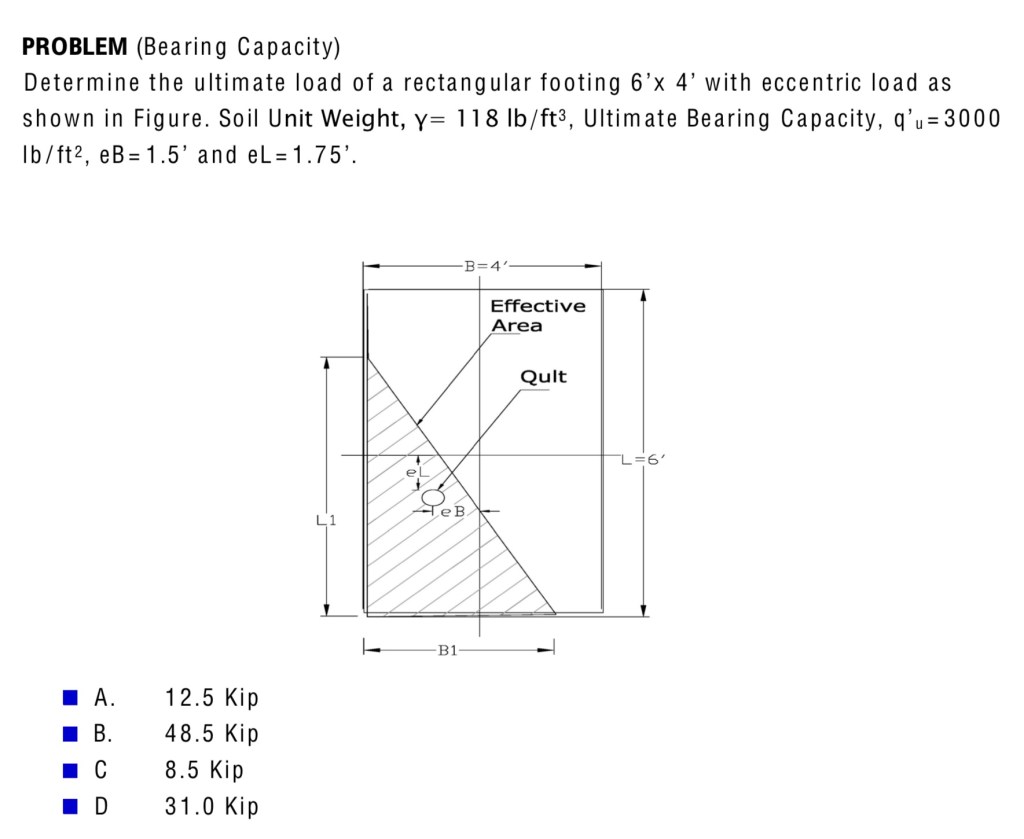
Looking at this problem makes my head hurt! The afternoon session was even more grueling: the completion of four significant “show your work” problems (selecting from a menu of 12). For some reason, designing foundations was a bit second nature to me (the above example is a foundation problem). I was thrilled to discover that two of the twelve afternoon problems were the design of foundations.
The definition of a foundation, as used in engineering, describes the lowest load-bearing part of a building or structure – an underlying base of support. Similarly, foundation can also be used to describe an underlying basis (such as a tenet, principle, or axiom) upon which something stands or is supported. We refer to such tenets or principles as “foundational.”
Reading Psalm 89 recently, I came across this foundational statement:
14 Righteousness and justice are the foundation of your throne;
love and faithfulness go before you.
Psalm 89 is considered a royal psalm (thus “throne”) written lamentably after the exile and demise of the royal line of King David. Though a Davidic king no longer ruled over Israel, God was still King. To the psalmist, Yahweh’s rule and character are unquestionable.
Psalm 89:14 contains what we might call “the big four” words that describe God’s character: righteousness, justice, love, and faithfulness. We cannot read scripture without seeing these four characteristics described and/or demonstrated. They permeate all of scripture because God permeates all of scripture.
Almost inseparable, righteousness (Hebrew, tsedeq) and justice (Hebrew, mishpat) go hand-in-hand. Righteousness and justice are intrinsic attributes of God’s character, deeply interconnected and foundational to understanding how God relates to the world. In scripture righteousness and justice are often mentioned together, illustrating their deep connectivity. They tell us something about God. (Similarly love (hesed) and faithfulness (emet) are interconnected – see The Two Biggies).
Righteousness means that God acts in ways that are perfectly just, fair, and consistent with His own holiness. God’s righteousness is His commitment to do what is right, which includes His faithful and fair treatment of all His creation. Righteousness refers to a standard or quality of relationships, while justice is the action taken to maintain or restore those relationships when they are broken. We think of covenantal loyalty.
Justice is a central theme in the Bible, woven into the fabric of God’s character as well as His expectations for humanity. Usually, justice is described as the action taken to uphold what is right, which includes both punishing wrongdoers and caring for those who are marginalized, oppressed, or in need. It’s about giving people their due—whether protection, care, or punishment.
For God, being righteous means that He always acts justly; His righteousness leads to justice. In his book Generous Justice, Timothy Keller points out that these attributes of God are not just abstract qualities but are demonstrated through His actions—particularly in His care and concern for the vulnerable – a foundational concern. Keller points out that scripture consistently draws attention to what he calls the “vulnerable quartet” – those who especially need protection and justice…
The Poor. The Orphan. The Widow. The Foreigner.
As mentioned above “the big four” foundational characteristics of God (righteousness, justice, love, and faithfulness) permeate all of scripture. In the Gospels, we see Jesus, the Davidic King, embody “the big four” paying particular attention to the “vulnerable quartet.” It’s what attracted people to him.
Back to the Psalmist. His response to the foundational characteristics? Praise and acclamation:
52 Praise the Lord forever!
Amen and Amen!
Worship!

 Practical Theology Today
One thought on “It’s Foundational”