I was talking recently with a younger friend (most of my friends seem to be younger than me 😬). We both have a tendency to be doers, which gets in the way of being. He asked me if I ever had a watershed moment where I began to move away from being a doer, moving toward a healthier balance of doing and being. I did experience such a watershed moment, which I will talk about in a bit. But first, let me describe the difference between doing and being as I understand them.
Doing is about engaging in actions, tasks, and activities in the external world. It’s related to productivity, accomplishments, and the tangible results of our efforts. It’s easy to get our worth from doing because of its quantitative tangibility.
Being, on the other hand, is about existing in, even embracing the present moment, and connecting with the world around us (i.e., people, nature, etc.) It’s about experiencing life beyond external achievements and roles. For doers, we didn’t get much worth from being.
But, as a psychologist friend once reminded me, we are human beings, not human doings
My watershed moment: About 25 years ago I was attending a monthly Young Life staff gathering. My friend Brad opened our time with some scripture to ponder. The scripture was Joshua 5:13-14…
13 Now when Joshua was near Jericho, he looked up and saw a man standing in front of him with a drawn sword in his hand. Joshua went up to him and asked, “Are you for us or for our enemies?” 14 “Neither,” he replied, “but as commander of the army of the Lord I have now come.” Then Joshua fell facedown to the ground in reverence, and asked him, “What message does my Lord have for his servant?”
As Brad read the passage, when he got to “What message does my Lord have for his servant?” I was anticipating something entirely different. I was expecting to hear Joshua ask, “What does my Lord want me to do?” Do?! I was shocked and chagrined that my mind went right to “do.” The staff time ended and I headed back to my town, 40 miles away, in a heavy snowstorm. Six inches (15 cm) already had fallen and another six were predicted. As I navigated the snow-covered roads in my little 2-wheel drive Mazda pickup, I could not get the Joshua incident out of my mind.
I had kept a journal for several decades. I bought inexpensive spiral-bound 6×9 notebooks to capture my thoughts and activities. As a doer, my journals were more populated with my activities than my thoughts. That day I decided that I wanted to start moving toward a more balanced life. I wanted to be as much as I did.
So, in the middle of the snowstorm, about 10 miles (16 km) into the trip home, I turned around and drove back to Barnes and Noble to purchase a $20 leather journal. My thinking? If I paid $20 for a journal, I wasn’t as likely to fill it up with what I did.
My watershed moment!
Watershed. Makes me think of the Civil Engineering Hydrology course I took at the University of MN in the 1970s. A major project for the course revolved around the Root River watershed in southern Minnesota. We were to estimate the effect on the river level of a 3″ rainfall. By definition, a watershed is a geographical area of land defined by the natural topography where all precipitation drains into a common point, in this case, the Root River.
We just returned from a road trip to the Glacier National Park area in western Montana. While traveling, we crossed several continental divides – continental versions of watersheds. Most continental divides are at higher altitudes, upwards of 6000 feet (1830 meters). One of the divides we crossed was in eastern North Dakota at an elevation of 1490 feet (454 meters). As you can see by the photo below there was nothing very dividing or even “continental” about this one. The rains and snow melt east of the North Dakota divide drain toward the Red River of the North, ultimately making its way to the Hudson Bay in Canada. Western precipitation flowed toward the Missouri River, ultimately draining into the Mississippi and the Gulf of Mexico.
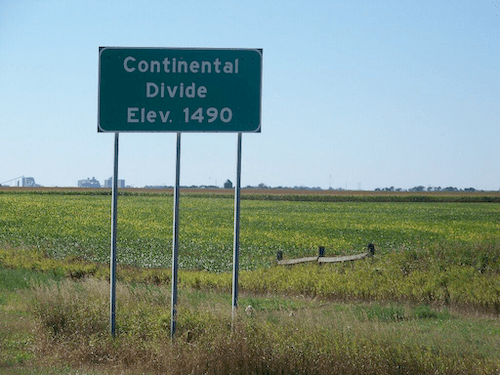
Crossing the North Dakota divide was literally a “watershed moment.” But not much seemed to be different after we passed the sign. The topography seemed the same. But as we traveled for a few more hours, we saw it – the Missouri River. Even though we didn’t notice any major topographical differences, change was, in fact, occurring.
Watershed moments can be dramatic, like crossing a 10,000-foot (3050-meter) continental divide. I suspect that more often than not, spiritual watershed moments look more like the North Dakota divide. But a divide nevertheless. Looking back 25 years to my watershed moment during that Minnesota snowstorm, I can see that a shift toward a doing-being balance has been taking place. Five years into the post-watershed journey, not so much.
When I poke around in a Greek-English interlinear New Testament, I find a lot of what in Greek grammar is referred to as the present continuous tense – terms like be-believing, be-becoming, be-following, etc. Though my watershed moment was 25 years ago, balancing being and doing has been an ongoing journey, a present continuous experience. I think that’s the significance of watershed moments. They are points in our life from which we don’t look back. As we continue walking with Jesus, transformation is slowly taking place even when the outcomes aren’t immediately visible.
Be-becoming!

 Practical Theology Today
2 thoughts on “Watershed Moments”